No formal declaration of war ever started it, and no peace treaty ever ended it — yet for more than four decades, the Cold War shaped nearly every corner of global politics, from proxy wars fought thousands of miles from Washington and Moscow to a nuclear standoff that brought the world to the edge of catastrophe. It was a rivalry between two superpowers with fundamentally incompatible visions for how the postwar world should work, and it defined international life from 1947 until the Soviet Union itself dissolved in 1991.
Wartime Allies, Postwar Rivals
The United States and the Soviet Union fought as allies against Nazi Germany during World War II, but the partnership was uneasy even then, built on a shared enemy rather than shared values. Once that enemy was defeated in 1945, the ideological gap reopened almost immediately: the U.S. championed capitalism and democratic government, while the USSR pushed one-party communist rule and sought to expand its influence over the countries its army had liberated from the Nazis in Eastern Europe. Winston Churchill captured the divide in a 1946 speech warning that an “Iron Curtain” had descended across the continent, separating the Soviet-dominated East from the democratic West.
Containment and the Truman Doctrine
In 1947, President Harry Truman formalized America’s response with what became known as the Truman Doctrine, pledging U.S. support to any country resisting communist takeover, and adopted a broader strategy of containment aimed at stopping Soviet influence from spreading further. Two years later, in 1949, the United States joined Canada and Western European nations to form NATO, the North Atlantic Treaty Organization, a mutual-defense military alliance explicitly aimed at deterring Soviet aggression. The Soviet Union answered in 1955 by organizing its own Eastern European allies into the Warsaw Pact, cementing the military division of the continent.
Berlin Becomes the Flashpoint
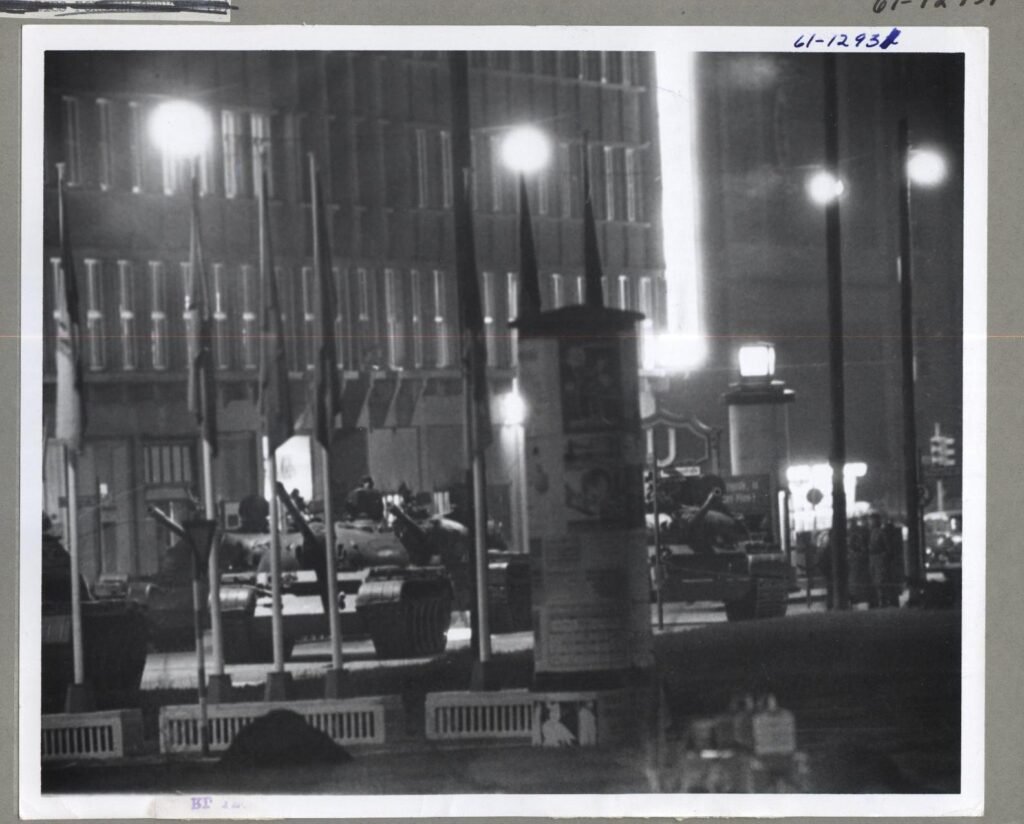
Postwar Germany, and especially the divided city of Berlin, became the Cold War’s most persistent pressure point. In June 1948, the Soviet Union cut off all ground access to the Western-controlled sectors of Berlin in an attempt to force the Allies out; the U.S. and Britain responded with the Berlin Airlift, flying in food and fuel for nearly a year until the Soviets lifted the blockade in May 1949. Tensions flared again in August 1961, when East Germany, backed by Moscow, built the Berlin Wall to stop the flow of East Germans fleeing to the West — a physical barrier that became the era’s defining symbol of division.
Proxy Wars and the Nuclear Standoff
Direct combat between American and Soviet troops never happened, but the two superpowers fought each other indirectly through proxy conflicts, most notably the Korean War (1950–1953) and the Vietnam War (1955–1975), each pitting communist and anti-communist forces against one another with superpower backing on both sides. The closest the world came to direct nuclear war was the Cuban Missile Crisis in October 1962, when President John F. Kennedy confronted Soviet leader Nikita Khrushchev over Soviet nuclear missiles installed in Cuba, just 90 miles from Florida. Both nations built arsenals large enough to guarantee “mutually assured destruction” in any full-scale nuclear exchange, a standoff that shaped military strategy for the rest of the era.
How It Ended
By the 1980s, the Soviet economy was straining under the cost of matching American military spending, and Soviet leader Mikhail Gorbachev introduced reforms — glasnost (openness) and perestroika (restructuring) — intended to modernize the system without dismantling it. Instead, the reforms accelerated its collapse. Eastern European nations began breaking from Soviet control in 1989, and the Berlin Wall fell that November as East German authorities opened the checkpoints amid mass protests. The Soviet Union itself formally dissolved between August and December 1991, ending the Cold War and leaving the United States as the world’s sole superpower.