Every education system rests on one irreplaceable resource: the person standing at the front of the room. Schools can be built and textbooks printed, but without enough trained, supported teachers, learning stalls. World Teachers’ Day, observed every October 5, exists to say that plainly. It honors the people who teach, and it asks a harder question: what does a society owe those it relies on to shape the next generation? Its message pairs naturally with the International Day of Education, because the right to learn depends on the people who make learning happen.
A recommendation, then a day
The day began with a document. On October 5, 1966, a special intergovernmental conference adopted the ILO/UNESCO Recommendation concerning the Status of Teachers. It set benchmarks for the rights and responsibilities of teachers and for their initial preparation, further education, recruitment, employment and conditions of work. A separate Recommendation on higher-education teaching personnel followed in 1997.
World Teachers’ Day has been celebrated since 1994 and marks the anniversary of that 1966 adoption. UNESCO co-convenes it with the International Labour Organization, UNICEF and Education International, which represents teachers’ unions. The 1966 text is a recommendation, not a treaty, so it guides rather than binds. Its influence comes from being the shared reference point for how the world expects teachers to be treated: as professionals with rights, duties, training and a voice, not as interchangeable staff.
The numbers behind the day
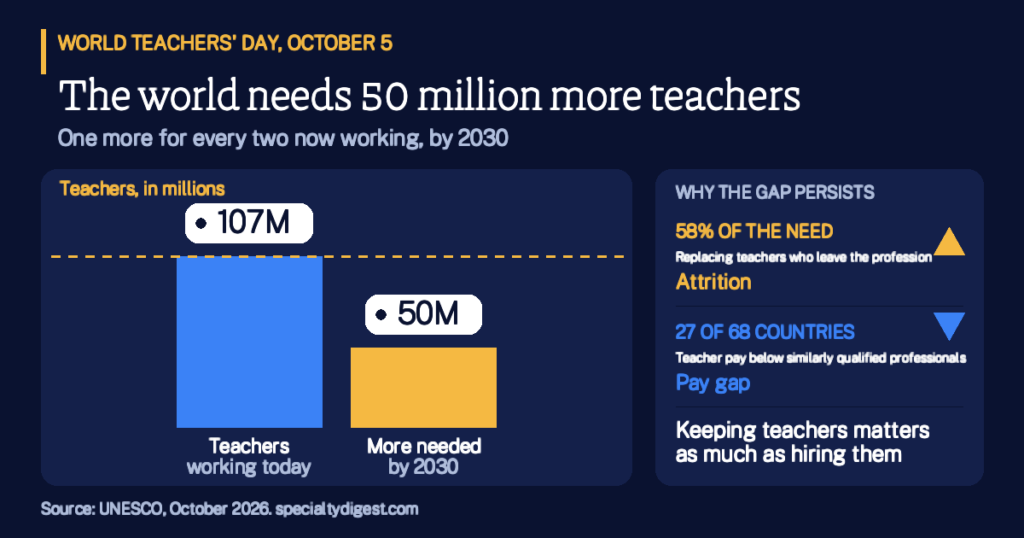
UNESCO’s 2026 data put the world’s teaching force at 107 million people. To give every child access to pre-primary, primary and secondary education, the world still needs an additional 50 million teachers by 2030, roughly one for every two now working. An earlier UNESCO report, in 2024, counted a need for 44 million primary and secondary teachers; the 2026 figure is larger because it also covers pre-primary education.
- 107 millionteachers worldwide, 2026
- 50 millionadditional teachers needed by 2030
- 58%of that need is replacing teachers who leave
- 28 to 1pupils per trained primary teacher, the highest of any level
Example 1: standing still. Imagine a district with 1,000 primary teachers and an annual exit rate of 4.7 percent. It loses about 47 teachers a year, so over five years it must hire roughly 235 people before it adds a single new position. The numbers are round and illustrative, but they show why UNESCO treats keeping teachers as seriously as training them.
Where the shortage bites hardest
The gap is not spread evenly. UNESCO’s 2024 Global report on teachers singled out sub-Saharan Africa, estimating a need for 15 million new teachers by 2030. The same report put the cost of universal primary and secondary education staffing at about US$120 billion a year by 2030 (US$12.8 billion for primary and US$106.8 billion for secondary). Those are planning estimates, not forecasts, but they show that teachers are a financing question as much as a recruitment one. Where classes are largest, children with the greatest needs receive the least individual attention.
Why teachers leave
UNESCO’s 2026 data show annual attrition of 7.2 percent in pre-primary education, 5.4 percent in secondary and 4.7 percent in primary. Pay is one reason. In 27 of the 68 countries UNESCO analyzed, teacher salaries remain below those of similarly qualified professionals across all education levels, and pre-primary and primary teachers earn slightly less than their peers.
Example 2: the crowded classroom. A school has 560 pupils and 20 trained teachers, a ratio of 28 to 1. If four teachers leave and are not replaced, the same pupils now share 16 teachers, a ratio of 35 to 1. Each remaining teacher must stretch attention thinner, which can push even more of them to leave. The figures are illustrative; the cycle is the one UNESCO warns about.
The hidden workweek
Teaching looks like a job of hours spent in front of a class. UNESCO’s data say otherwise: teachers average 19 hours a week in the classroom but about 60 hours in total once unpaid preparation, marking and administration are counted. Feeling valued matters too. In the OECD’s 2024 TALIS survey, teachers in 75 percent of participating countries reported that fewer than 40 percent of their profession felt valued, and teachers who felt valued were over 10 percent less likely to think about leaving within five years.
Example 3: the unseen hours. Take the 60-hour week and the 19 classroom hours. That leaves about 41 hours of work that no pupil sees, around two thirds of the total. Over a 36-week school year, those hours add up to roughly 1,500 hours of planning, grading and paperwork. The week is a round average and the year is illustrative, but the pattern explains why workload shapes who stays.
How the day is marked, and what progress needs
Each year UNESCO holds a global celebration at its Paris headquarters, issues a joint message with the ILO, UNICEF and Education International, and awards the UNESCO-Hamdan Prize for Teacher Development. The 2026 observance falls on the 60th anniversary of the 1966 text, which UNESCO and the ILO are now revising through an Independent Expert Group, with work running to mid-2027.
- 2021Teachers at the heart of education recovery
- 2025Recasting teaching as a collaborative profession
- 2026Standing with teachers: 60 years of protecting the profession, advancing its status and shaping our futures
Progress comes from the same short list each time: pay that matches qualifications, manageable workloads, solid training and a voice in decisions. For readers, the day invites a small act too, such as thanking a teacher by name.
Key Takeaways
- The day marks a document. October 5 is the anniversary of the 1966 ILO/UNESCO Recommendation on the Status of Teachers, and the day has been celebrated since 1994.
- The world needs 50 million more teachers. UNESCO’s 2026 data count 107 million working today and a need for one more for every two by 2030.
- Keeping matters as much as hiring. About 58 percent of the need is replacing teachers who leave.
- Exit rates differ by level. Annual attrition runs 7.2 percent in pre-primary, 5.4 percent in secondary and 4.7 percent in primary.
- Pay still lags. In 27 of 68 countries analyzed, teachers earn less than similarly qualified professionals.
- The workweek is mostly unseen. About 19 classroom hours sit inside a roughly 60-hour week.
- The standard is being rewritten. The 1966 text is under joint revision through mid-2027.
How solid is this? Teacher counts, shortage and attrition figures come from UNESCO’s October 2026 data release and are modeled estimates that may be revised; the 44 million, 15 million and US$120 billion figures are from a 2024 UNESCO report with a narrower scope. The three worked examples use round, made-up numbers to show an idea. See also the International Days hub and the International Days Calendar.