Look at any landscape and you see two stories. One is alive: forests, birds, crops. The other is older and quieter: the rock under the trees, the soil in the field, the river that carved the valley. For most of history, public attention has gone to the first story. International Geodiversity Day, observed every October 6, asks the world to read the second. It is a young observance, approved in 2021 and first celebrated in 2022, and its message is simple. Life stands on a lifeless foundation, and that foundation deserves to be known and protected. It is a natural companion to World Water Day, because much of the water we drink has traveled through rock.
A day born in the geoscience community
The idea came from scientists. The International Union of Geological Sciences, known as the IUGS, and 108 other scientific organizations asked UNESCO to create a day for geodiversity. On November 22, 2021, the 193 Member States attending UNESCO’s General Conference in Paris approved it, and October 6 became International Geodiversity Day. The first celebration followed in 2022, and 2023 marked the second edition.
This is a UNESCO day, proclaimed by its General Conference, so you will not find a General Assembly resolution symbol for it. UNESCO’s International Geoscience and Geoparks Programme, the IGGP, is responsible for administering it. A grassroots campaign still runs the yearly calendar, with geologist Jack Matthews named as a co-coordinator, and recent themes were proposed by individuals in Italy, Slovenia, the Philippines, Iraq and Portugal.
What geodiversity actually means
Geodiversity is short for geological diversity. UNESCO defines it as the natural portion of the planet that is not alive, at the surface and in the interior. It includes minerals, rocks, fossils, soils, sediments, landforms and topography, and water features such as rivers and lakes, along with the processes that make and reshape them. Biodiversity is the living counterpart. The two are partners rather than rivals. In UNESCO’s words, geodiversity underpins biodiversity, climate adaptation and sustainable resource management. A fern needs soil, and soil needs a rock to weather.
Example 1: a valley’s two stories. Suppose a survey of a valley counts 40 plant species across three kinds of soil. Each soil comes from a different rock. Ten species grow only on the thin, dry soil of the ridge, and the other 30 are spread across the two richer soils below. Protect the plants but allow a quarry to strip the ridge, and the soil and its 10 species go with it. The numbers are round and illustrative, but the lesson is real: counting only life misses what life stands on.
A planet in numbers
UNESCO’s 2023 explainer for the day offers a few anchors for scale. Earth is about 4.6 billion years old, and its crust supplies 90 chemical elements to build with. Water covers 71 percent of the surface, and 97 percent of that water is salty. Life has passed through at least five periods of mass extinction, and the evidence for each is written in rock. The Ngorongoro Crater in Tanzania, a landform UNESCO highlights, formed about 2.5 million years ago.
- 4.6 billionyears old, the age of Earth
- 90chemical elements found on Earth
- 71%of the surface covered by water
- 5+periods of mass extinction
Geoparks: geodiversity you can visit
The most visible expression of the idea is the UNESCO Global Geoparks Network. UNESCO describes geoparks as territories of exceptional geological significance, such as rock formations, volcanic ranges, caves, canyons and fossil sites. They are managed to combine conservation with education, sustainable tourism and the participation of local and Indigenous communities.
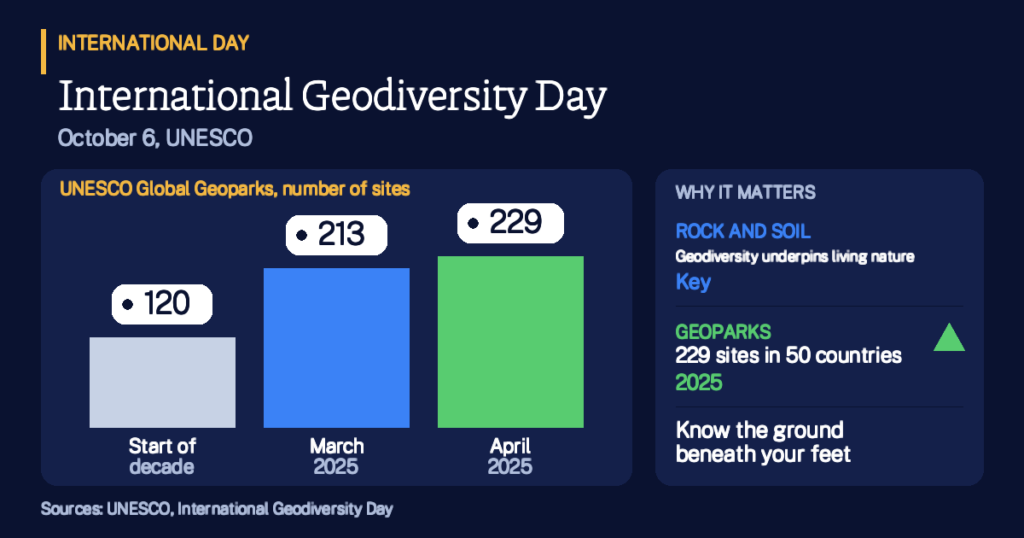
The network has grown quickly. Over the decade to early 2025 it rose from 120 to 213 geoparks in 48 countries. In April 2025 UNESCO named 16 more, bringing the total to 229 in 50 countries, covering almost 855,000 square kilometers. A further group of new and revalidated sites was presented in April 2026, with the total expected to reach 241 in 51 countries once UNESCO’s Executive Board endorses it. This article uses the last confirmed figure.
Example 2: what a geopark can earn. Imagine a rural geopark that draws 20,000 visitors a year, and each visitor spends $50 locally. That is $1,000,000 a year. If 40 percent of it stays with local guides, farms and inns, the community keeps $400,000 that depends on the landscape staying intact. The figures are round and illustrative, but they show why conservation and local livelihoods are designed to go together.
Why the non-living world matters
The day’s organizers point to benefits that are easy to overlook. River flow is regulated by groundwater held in rock, so even in a drought a river may keep running. The slow weathering of rocks is fundamental to the formation of soils. Mineral resources, wisely used, create wealth and employment, and geotourism can bring significant economic benefits to local people.
Geodiversity also helps with the climate and nature crises. UNESCO’s 2025 announcement noted that on Scotland’s Arran, a new geopark, over 260 hectares of upland peat bog have been restored, and that peatlands play an essential role in flood regulation, water quality and supporting biodiversity.
Example 3: the river that keeps running. Suppose a river carries 100 units of water in a wet month, and 30 of those units come from groundwater seeping out of rock. In a dry spell rainfall runoff may fall to zero, yet the river still carries 30 units, or 30 percent of its wet-month flow. Towns downstream keep a supply. The numbers are round and illustrative, but they show how hidden rock quietly protects people from drought.
The forgotten half, and how the day is marked
Geodiversity has long received less public attention than biodiversity, and that gap is part of why the day exists. Each year has a theme, and the announced themes show the direction of travel: from universal access to local, everyday geology.
- 2023Geodiversity is for Everyone
- 2025One Earth, Many Stories
- 2026Geodiversity On Our Doorstep
- 2027Connecting People and Planet
- 2028The Cradle of Life
Marking it takes little. Visit a geopark, or simply look at the stone in the buildings of your own town and ask where it came from. Schools, museums and geological societies host talks and walks, and the organizers invite anyone to list an event.
Key Takeaways
- Geodiversity is nature’s non-living half. Rocks, minerals, fossils, soils, landforms, rivers and lakes all count.
- The day is young. UNESCO’s General Conference approved it on November 22, 2021, and it was first celebrated in 2022.
- Scientists started it. The IUGS and 108 other scientific organizations asked for it.
- Geoparks make it visible. The network reached 229 sites in 50 countries in April 2025.
- It protects life and livelihoods. Rock feeds soils, regulates river flow and supports local jobs.
- Look close to home. The 2026 theme invites you to notice geodiversity on your own doorstep.
How solid is this? Dates, the 193 Member States, the 108 co-signing organizations and the geopark counts come from UNESCO pages. The 2015 start of the geoparks designation is taken from UNESCO’s statement in March 2025 that it was created ten years earlier. The 241 figure was still awaiting endorsement when last checked. Planet-scale numbers come from UNESCO’s 2023 explainer, and themes from the day’s organizers. The three worked examples use round, made-up numbers. See also the International Days hub and the International Days Calendar.
More in Science
- UNESCO, International Geodiversity Day
- UNESCO, UNESCO adopts International Geodiversity Day (November 2021)
- UNESCO, Seven reasons why Geodiversity is for everyone (2023)
- UNESCO, UNESCO names 16 new Global Geoparks (April 2025)
- UNESCO, Ten years of UNESCO Global Geoparks (March 2025)
- International Geodiversity Day, Themes announced for 2026, 2027 and 2028
- International Geodiversity Day, What is geodiversity