Noise-induced hearing loss is permanent hearing damage caused by exposure to excessively loud sound over time, representing one of the most common occupational illnesses worldwide and a hazard present across industries ranging from manufacturing and construction to music and entertainment.
The damage underlying noise-induced hearing loss occurs at the level of delicate sensory hair cells within the inner ear, which can be damaged or destroyed by sufficiently loud or prolonged sound exposure. Unlike many other injuries, this cellular damage cannot be medically reversed once it has occurred, which places particular importance on preventing the exposure in the first place rather than relying on treatment after hearing loss has developed.
Exposure Measurement
Occupational noise exposure is measured and regulated based on both sound intensity, measured in decibels, and duration of exposure, since louder sounds require progressively shorter permissible exposure durations to stay within health-protective limits, reflecting the cumulative nature of noise-related hearing damage over an exposed worker career.
Hierarchy of Controls for Noise
Consistent with general industrial hygiene practice, controlling noise exposure follows a hierarchy prioritizing engineering controls, such as equipment redesign or sound enclosures that reduce noise at its source, over administrative controls like limiting exposure duration, with personal hearing protection such as earplugs or earmuffs serving as a supplementary measure rather than the primary control strategy.
Hearing Conservation Programs
Employers in industries with significant noise exposure typically implement formal hearing conservation programs, including regular audiometric testing to detect early changes in hearing before they become severe, worker training on proper use of hearing protection, and ongoing monitoring of workplace noise levels to verify that controls remain effective over time.
n
Mechanism of Damage
n
Noise-induced hearing loss occurs when sound energy damages the delicate hair cells within the cochlea that convert vibrations into nerve signals the brain interprets as sound. Unlike many other tissues in the body, these hair cells do not regenerate once destroyed, which is why hearing loss from prolonged noise exposure is typically permanent. Damage can result from a single extremely loud event, such as an explosion, or from cumulative exposure to moderately loud noise over years, with the latter pattern being far more common in occupational settings.
n
Audiometric Testing
n
Hearing conservation programs rely on periodic audiometric testing to detect early changes in a worker hearing before they become noticeable in daily life. A baseline test establishes each worker starting hearing threshold, and subsequent annual tests are compared against this baseline to identify any standard threshold shift. Detecting a shift early allows employers to intervene with improved hearing protection, work reassignment, or further evaluation before the damage progresses further.
n
Regulatory Exposure Limits
n
Regulatory agencies establish permissible noise exposure limits typically expressed as an average sound level over an eight-hour workday, along with rules for how exposure is calculated when noise levels vary throughout a shift. These limits incorporate an exchange rate that determines how much the allowable exposure time is reduced for each increase in sound level, reflecting the understanding that louder noise causes damage more quickly than quieter noise even at the same total sound energy. Employers exceeding specified action levels are generally required to implement a hearing conservation program.
n
Hearing Protection Device Selection
n
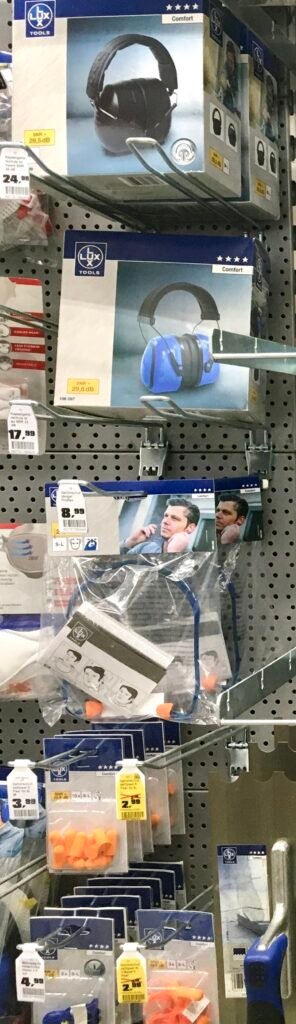
When engineering and administrative controls cannot sufficiently reduce noise exposure, hearing protection devices such as earplugs and earmuffs provide a final layer of defense. Selecting an appropriate device involves considering its noise reduction rating, compatibility with other required protective equipment, and comfort, since devices that are uncomfortable are less likely to be worn consistently throughout a shift. Proper fit is equally important, as an improperly inserted earplug can provide dramatically less protection than its rated performance suggests.
n
Beyond the Workplace
n
While occupational settings remain a major source of damaging noise exposure, hearing conservation principles increasingly extend to recreational and community noise sources as well, including concerts, firearms use, and personal audio devices. Public health messaging has drawn on decades of occupational hearing conservation research to encourage broader awareness that hearing damage from excessive sound exposure is cumulative, permanent, and largely preventable through the same basic principles of limiting exposure time, increasing distance from loud sources, and using appropriate hearing protection.
n
Cost of Inaction
n
Failing to control excessive workplace noise carries costs beyond potential regulatory penalties, including reduced productivity from communication difficulties, increased risk of accidents when workers cannot hear warning signals or verbal instructions, and long-term workers compensation liability for documented hearing loss claims. Because hearing loss develops gradually and painlessly, it is sometimes underestimated as a priority compared to more visibly dramatic workplace hazards, even though it affects a substantial proportion of workers in noisy industries over a full career.
n
Engineering Noise Reduction at the Source
n
The most durable solution to occupational noise exposure addresses the source directly through equipment redesign, substitution of quieter machinery, or modifications such as vibration damping and acoustic enclosures. While these engineering interventions often require greater upfront investment than simply issuing hearing protection, they reduce risk continuously without depending on correct and consistent use by every worker, making them the preferred long-term solution wherever technically and economically feasible.
n
Taken together, exposure measurement, source control, and personal hearing protection form a layered approach that, when consistently applied, can prevent the vast majority of occupational hearing loss cases that would otherwise occur over a worker career.
n
Because recovery is not possible once the relevant hair cells are destroyed, prevention through these layered strategies remains far more valuable than any treatment option available after hearing loss has already occurred.
n
Sustained attention to these fundamentals protects not just hearing acuity itself but the broader quality of life that depends on it, including communication, workplace safety awareness, and social connection in retirement years.
Key facts
- Array
Quick checkCan noise-induced hearing loss be reversed through medical treatment?Show answer
No, noise-induced hearing loss cannot be medically reversed once the sensory hair cells in the inner ear have been damaged, which is why prevention through exposure reduction and hearing protection is considered far more effective than any after-the-fact treatment.
Sources
- Array
Editorially reviewed by Specialty Digest Editorial TeamLast reviewed November 3, 2026Researched and drafted with AI assistanceReport an issue