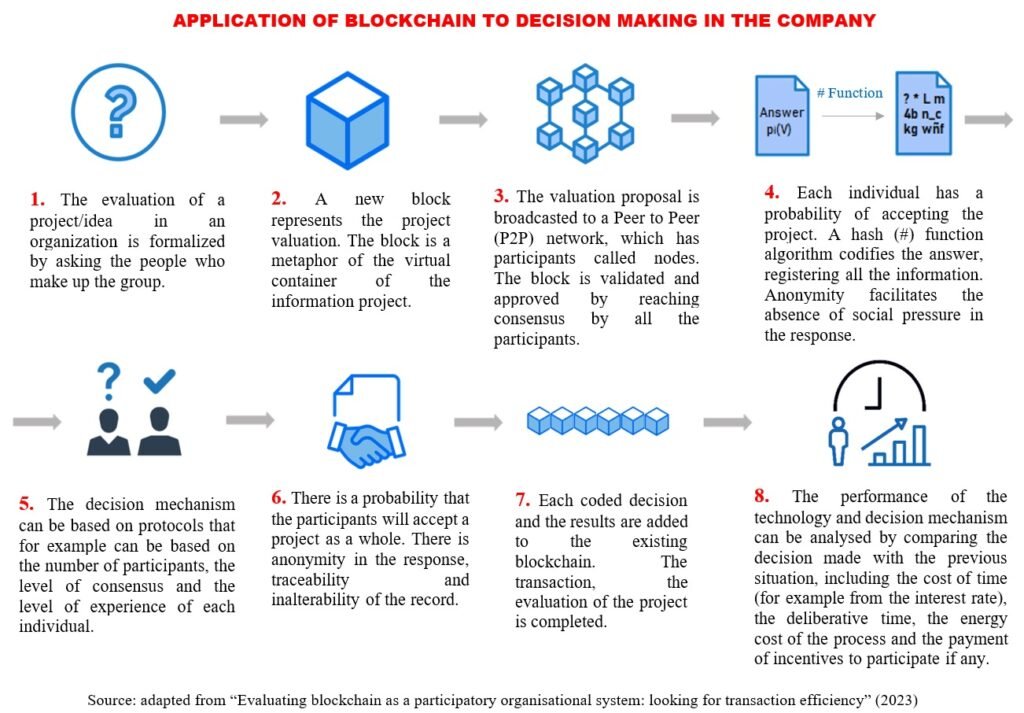
Strip away the crypto hype and a blockchain is really just a ledger — a running record of who owns what — with one unusual property: instead of a single bank or company keeping the master copy, thousands of computers around the world keep identical copies at once, and they all have to agree before a single new entry gets added.
A Chain Made of Hashes
Every blockchain groups transactions into batches called blocks. Each block gets run through a cryptographic hash function — a piece of math that turns any input into a fixed-length string of characters that looks like gibberish, and crucially, that string changes completely if even one character of the input changes, the way changing one word in a sentence can change its entire meaning. Here’s the key design: every new block includes the previous block’s hash as part of its own data. That links every block to the one before it, all the way back to the very first block in the chain, which is where the name “blockchain” comes from.
Why Old Transactions Are So Hard to Fake
Because each block’s hash depends on the block before it, changing a transaction from years ago would change that old block’s hash, which would break the link to the next block, and the next, all the way down the chain. An attacker would have to recompute every single block that came after the one they wanted to alter, and do it faster than the rest of the network keeps adding new legitimate blocks on top. On a large, active blockchain, that becomes computationally impractical — which is what people mean when they call blockchain “tamper-resistant” rather than technically tamper-proof.
Getting Strangers to Agree: Proof of Work
Because there’s no central authority, the network needs a way for participants who don’t trust each other to agree on which new block is valid. Bitcoin popularized proof of work: computers called miners compete to be the first to find a specific numerical answer that makes a block’s hash meet a difficulty target, essentially a lottery won by raw computing power. The winning miner adds their block and collects a reward in newly created cryptocurrency, plus transaction fees. The catch is that this competition consumes enormous amounts of electricity, since miners worldwide are racing to solve the same puzzle simultaneously and only one wins.
The Energy-Saving Alternative: Proof of Stake
Proof of stake replaces that computational race with financial skin in the game. Instead of miners, the network has validators who lock up, or “stake,” their own cryptocurrency as collateral for the chance to be chosen to add the next block — Ethereum, for instance, requires staking 32 ETH to run a validator. Validators who approve fraudulent transactions or go offline can have a portion of their stake destroyed, a penalty called slashing, which motivates honest behavior without burning nearly as much electricity. Ethereum’s 2022 switch from proof of work to proof of stake cut its energy use by more than 99 percent, and most newer blockchains, including Cardano and Solana, use proof-of-stake variants for that reason.
More Than Just Cryptocurrency
While Bitcoin and Ethereum are the most visible examples, the same core idea — a distributed, tamper-resistant, chronologically linked record — is also being applied to supply-chain tracking, digital identity verification, and recording ownership of digital assets like NFTs, wherever multiple parties need to trust a shared history without relying on one central gatekeeper.