5G is faster and far more responsive than 4G, but the gap between them isn’t one upgrade — it’s a set of changes to the radio spectrum, the antennas, and the physical network that carriers use, which is also why your phone can say “5G” in the status bar while feeling exactly as fast as it did last year. Understanding what actually changed means looking past that marketing icon and into how the network is built underneath it.
5G Uses Different Radio Waves
4G LTE runs almost entirely on frequencies below 3 gigahertz, the same crowded spectrum used by older cellular generations. 5G adds two new bands on top of that. “Low-band” and “mid-band” 5G sit in familiar territory and offer modest speed gains with roughly the same wide coverage as 4G. The bigger upgrade is millimeter wave, or mmWave, which operates between 30 and 300 gigahertz — radio waves so physically short, measured in millimeters rather than the tens of centimeters used by ordinary cellular signals, that carriers can pack far more data into each transmission. The tradeoff is range: mmWave signals struggle to pass through walls, trees, or even heavy rain, which is why they’re mostly clustered around stadiums, airports, and downtown blocks rather than blanketing entire suburbs.
5G Responds Almost Instantly
Speed gets the headlines, but latency — the delay between a device requesting data and the network responding — is where 5G makes its biggest leap. Typical 4G networks respond in roughly 70 milliseconds; 5G, under ideal conditions, can respond in under 1 millisecond. That difference is barely noticeable when loading a webpage, but it matters enormously for things like cloud gaming, remote surgery robotics, or a self-driving car reacting to a pedestrian, where even a tenth-of-a-second delay is the gap between safe and not. On raw throughput, IEEE Spectrum has put 5G’s theoretical peak download speed at roughly 20 gigabits per second, compared with about 1 gigabit per second for 4G — meaning a full HD movie that took 4G LTE close to ten minutes to download could, in principle, finish in under a second on 5G.
More Antennas Packed Into Every Tower
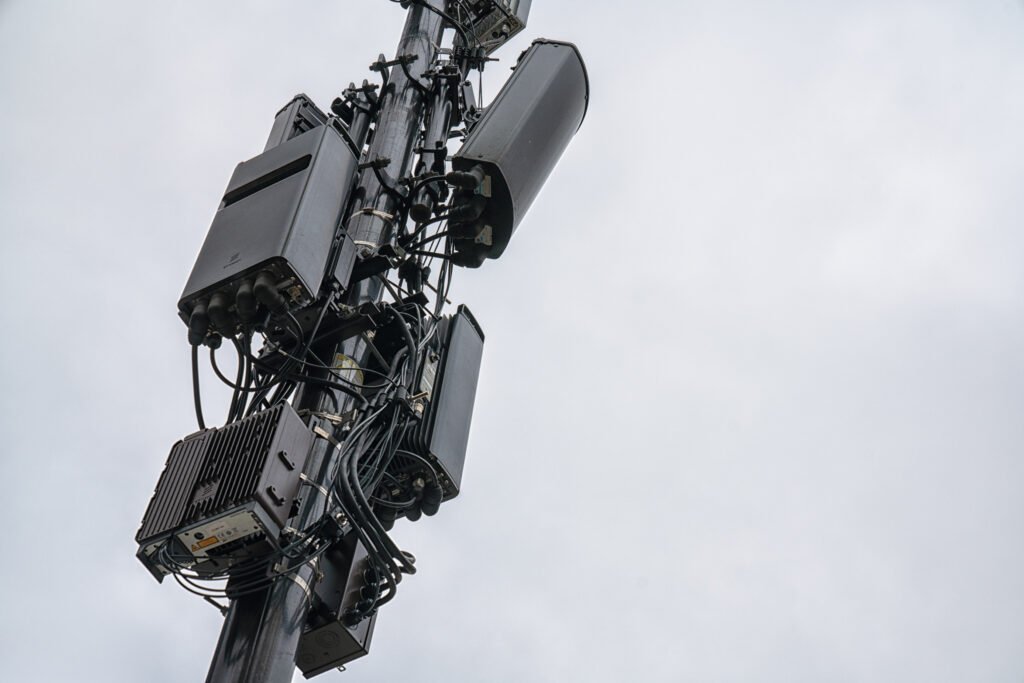
Part of that capacity boost comes from massive MIMO (multiple-input, multiple-output), a technology that crams far more antennas onto a single base station: a typical 4G tower uses around a dozen antenna ports, while a 5G station can support closer to 100. Paired with beamforming, a technique that steers a focused signal directly at a connected device rather than broadcasting evenly in every direction, this lets a single 5G tower serve many more simultaneous users without the network bogging down — the way a packed 4G cell tower often does during a concert or a sporting event, when thousands of phones are trying to connect through the same few antennas at once.
Smaller Cells, Placed Much Closer Together
Because mmWave signals travel such short distances, 5G networks lean on “small cells” — compact base stations roughly the size of a pizza box, mounted on light poles and building sides every few hundred meters through dense urban areas — instead of the tall macro towers that carry most 4G traffic across wide areas. That also explains the uneven rollout: a single city block might have blazing mmWave 5G while a rural highway ten miles away still runs on 4G LTE or slower mid-band 5G with speeds much closer to what people are already used to.
None of this works without hardware built for the new bands. Older 4G phones stay fully functional on 5G networks, but they don’t get the faster connection, because the radios inside them can’t decode the new frequencies or take advantage of massive MIMO and beamforming. For most people today, the practical upgrade shows up less as a dramatic speed jump and more as steadier performance in crowded places — plus a network foundation for uses 4G was never built to handle at scale, like connected cars, smart infrastructure, and remote-controlled machinery.