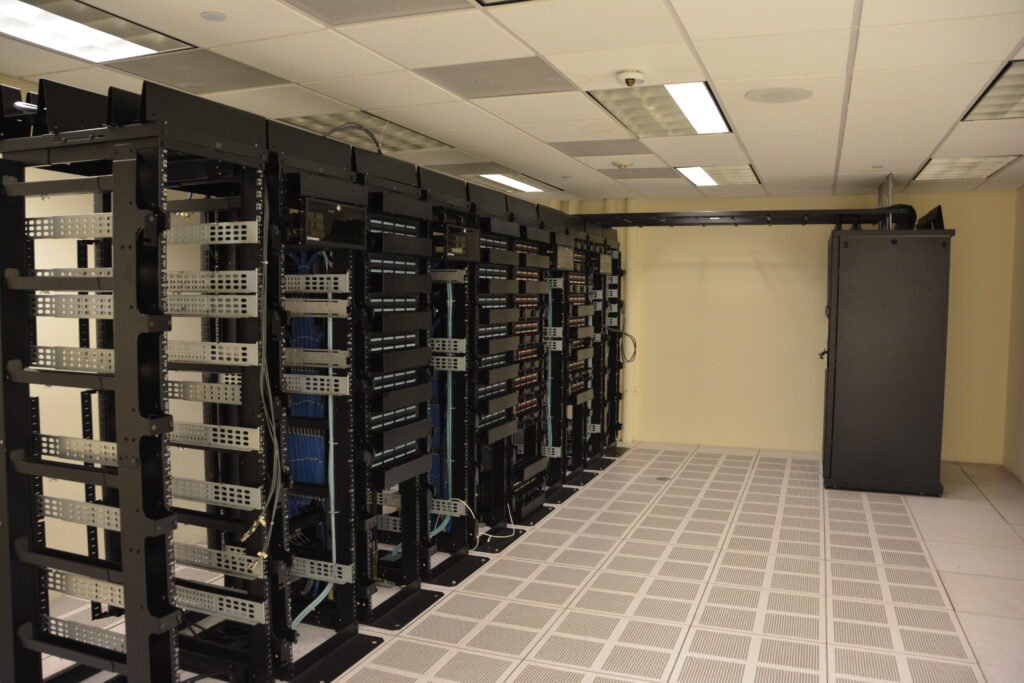
Cloud computing means renting computing power, storage, or software that runs on servers owned and maintained by someone else, accessed over the internet instead of running on your own machine. “The cloud” sounds weightless, but it’s really one of the most physical things in modern computing: rows of humming server racks in warehouse-sized buildings, drawing enough electricity to power small cities, sliced up and rented out to millions of people who never see them.
So where is my data actually stored?
Those servers sit in data centers — physical facilities that companies like Amazon, Microsoft, and Google operate around the world. When you save a file to Google Drive or stream a show on Netflix, you’re really reading and writing data on a server in one of these buildings, often hundreds or thousands of miles away. There’s no cloud in the sky; there’s just someone else’s computer, running around the clock.
How can one server serve thousands of customers?
A single physical server sitting idle most of the time would be a poor use of very expensive hardware, so cloud providers rely on virtualization — software that carves one physical machine into multiple virtual machines, each behaving like an independent computer with its own operating system, even though they all share the same underlying processors, memory, and storage. Every virtual machine is sandboxed from the others on the same hardware, so one customer’s data and applications stay invisible to the next. That’s what lets a single data center effectively act like thousands of separate computers serving thousands of separate customers at once, and it’s the main reason cloud computing is so much cheaper than everyone buying and running their own servers.
The three layers of cloud service
Cloud services generally break down into three tiers, distinguished by how much a customer manages versus how much the provider handles. Infrastructure as a Service (IaaS) — the layer closest to raw hardware, like Amazon EC2 — rents virtual servers and storage while the customer installs and manages their own operating system and software on top. Platform as a Service (PaaS), like Google App Engine, goes a layer further, handling the operating system, runtime, and databases so developers can just deploy their code. Software as a Service (SaaS), like Slack or Dropbox, hands over a finished, ready-to-use application where the provider manages everything and the customer just logs in. Moving up that ladder trades control for convenience: less to manage, but less say in how it’s managed.
Why cloud services rarely go down
Because hardware fails and buildings can lose power, cloud providers duplicate data and services across multiple physical servers and often multiple geographic regions. If one server, or even an entire data center, goes offline, traffic automatically shifts to a working copy elsewhere. That’s why a cloud outage severe enough for ordinary users to notice usually means something has failed at a scale far larger than one broken machine. This built-in redundancy, more than any single piece of hardware, is what lets cloud services promise the kind of near-constant uptime that would be difficult and expensive for any individual company to guarantee on its own.