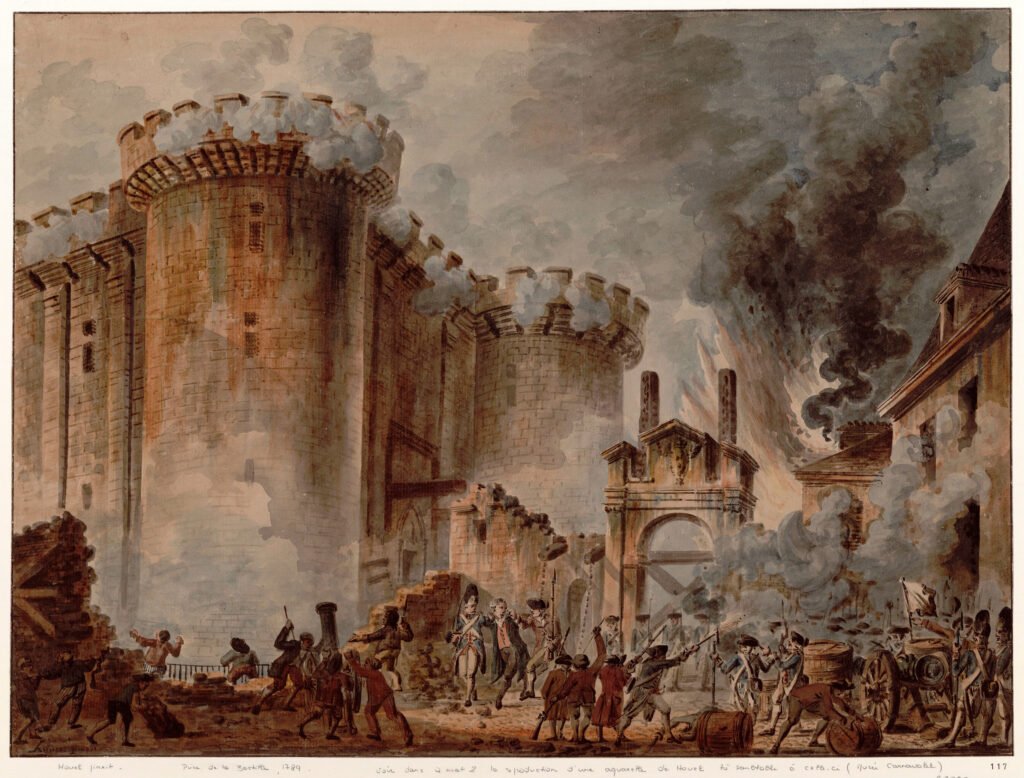
The French Revolution was triggered by a bankrupt monarchy, a tax system that spared the people best able to pay, and a bread crisis that finally made the whole arrangement unbearable. France in 1789 wasn’t a poor country — it was a badly governed one, and when the king dismissed a popular reformist minister on top of everything else, years of built-up pressure erupted first at Versailles and then, on July 14, 1789, in the streets of Paris.
Why the French crown was broke
By the 1780s the French crown was effectively bankrupt, having poured enormous sums into backing the American Revolution against Britain on top of decades of lavish royal spending under King Louis XVI and his predecessors. Successive finance ministers proposed fixes, including a universal land tax that would have applied even to the nobility and clergy, who had long been exempt from most taxation. The aristocracy blocked those reforms every time, which left the ordinary tax base — already stretched thin — to keep absorbing the cost. Poor harvests in the mid-1780s then sent bread prices soaring; by 1789, the poorest French families were spending as much as 80 percent of their income on bread alone.
Why ordinary people had almost no political voice
French society was legally split into three estates: the clergy, the nobility, and the Third Estate, which covered everyone else — roughly 98 percent of the population, from wealthy merchants to peasant farmers. Despite representing nearly the entire country, the Third Estate held no more voting power in national assemblies than either of the other two estates combined, because votes were traditionally counted by estate rather than by individual person. That imbalance, combined with growing exposure to Enlightenment ideas about individual rights and representative government, left the Third Estate increasingly unwilling to accept a system that taxed it hardest while giving it the least say.
How the Estates-General fell apart
Desperate for new revenue, Louis XVI summoned the Estates-General — a national assembly of all three estates — on May 5, 1789, the first time it had convened since 1614. Disputes over voting procedure broke out almost immediately. When the king refused to let delegates vote by individual head rather than by estate, the Third Estate broke away entirely: on June 17, 1789, its delegates declared themselves the National Assembly, claiming they alone represented the will of the French people. Three days later, on June 20, locked out of their usual meeting hall, they gathered on a nearby tennis court and swore the Tennis Court Oath, pledging not to disband until France had a written constitution.
Why the Bastille fell on July 14, 1789
The king’s response made things worse: he massed roughly 30,000 troops around Paris and, on July 11, dismissed Jacques Necker, the popular reformist finance minister. Parisians took that as a sign a crackdown was coming. Riots broke out, and crowds began seizing weapons — first raiding the Hôtel des Invalides for muskets, then marching on the Bastille, a royal fortress and prison, in search of gunpowder. After negotiations broke down and shots were fired, the crowd, joined by mutinous soldiers from the French Guard, forced the fortress’s surrender. The Bastille itself held only seven prisoners, but its fall mattered because it proved royal authority could be broken by force, and it pressured the king into recalling Necker and pulling his troops back.
What happened next
Momentum built fast once the Bastille had fallen. On August 4, 1789, the National Assembly voted to abolish the feudal privileges of the nobility and clergy, dismantling centuries of legal inequality in a single session. Later that month it adopted the Declaration of the Rights of Man and of the Citizen, enshrining principles of liberty, equality, and popular sovereignty that would echo well beyond France. The monarchy itself lasted only a few more years: Louis XVI was executed in January 1793, as the Revolution entered its more radical and violent phase.