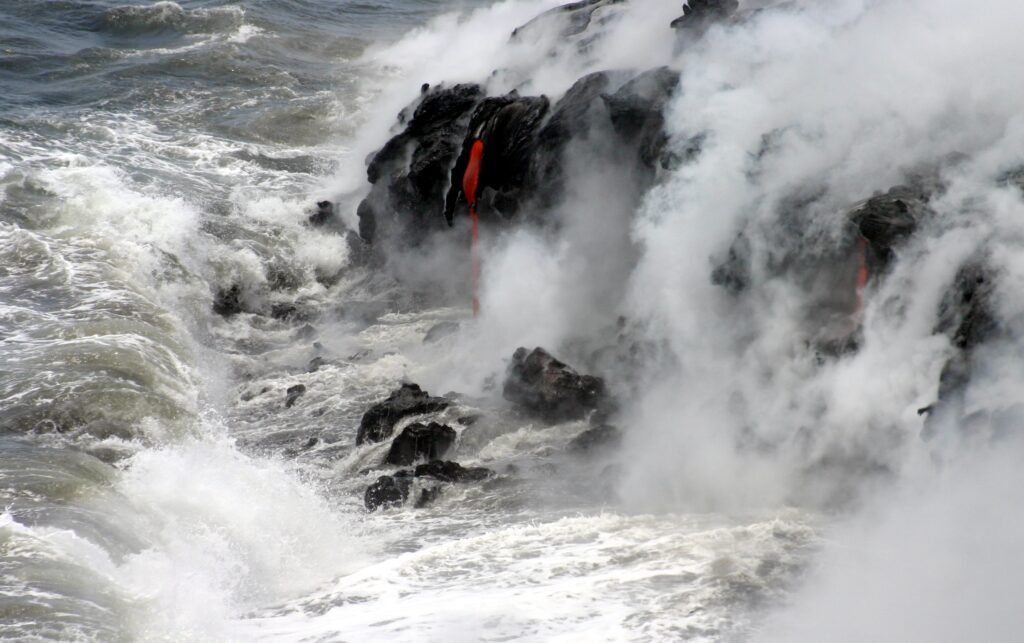
Volcanoes form when molten rock, or magma, forces its way up from deep underground to the surface, and where that happens on Earth comes down to just three geological settings: where tectonic plates collide, where they pull apart, and a handful of fixed hot zones deep in the mantle that don’t care about plate boundaries at all. Roughly 1,350 volcanoes worldwide are considered potentially active, and about 500 of them have erupted in just the last century, according to the U.S. Geological Survey — a reminder that this is an ongoing process, not ancient history.
Magma Starts Deep and Fights Its Way Up
The USGS explains that magma originates many tens of miles beneath the ground, where extreme heat partially melts solid rock. That molten rock is lighter than the solid material around it, so it rises, pushed along by buoyancy and by the pressure of gases dissolved inside it — the same way a shaken soda pushes bubbles upward. When magma finally forces its way through a weak point in the crust, it erupts: sometimes as a slow-moving river of lava, sometimes as a violent blast of rock fragments, ash, and gas that can throw fine particles miles into the sky. What determines which of those two you get is largely where the magma formed in the first place.
Where Plates Collide
Most of the world’s volcanoes form at convergent plate boundaries, where one tectonic plate is forced beneath another in a process called subduction — one slab of crust diving under a neighboring one and sinking into the mantle — according to National Geographic Education. As the descending plate sinks deeper, rising heat and pressure melt the mantle rock above it, generating fresh magma that rises to the surface and builds chains of volcanoes called volcanic arcs. Roughly 425 of these volcanoes ring the Pacific Ocean in the horseshoe-shaped belt known as the Ring of Fire, including the Aleutian Islands and the Andes, which is why that stretch of the Pacific accounts for such a large share of the world’s active volcanic activity and earthquakes alike.
Where Plates Pull Apart
Volcanoes also form at the opposite kind of boundary, where plates are moving away from each other rather than colliding. Along divergent boundaries like the Mid-Atlantic Ridge, magma continuously rises from the mantle to fill the gap left behind, building new crust on both sides as it cools. That underwater mountain range stretches nearly 60,000 kilometers, or about 37,000 miles, making it the longest chain of volcanoes on Earth, even though almost all of it is hidden beneath the ocean and rarely makes headlines the way a land eruption does.
The Hotspots That Ignore Plate Boundaries
Not every volcano needs a plate boundary at all. Hawaii and Yellowstone sit atop what geologists call hotspots — unusually hot, long-lived regions deep in the mantle that melt through the plate above them regardless of where a boundary happens to be, according to USGS research. Because the hotspot itself stays roughly fixed while the Pacific Plate slowly slides over it, Hawaii’s volcanic activity has left behind a trail of islands that get progressively older toward the northwest. Kauai’s oldest rocks are about 5.5 million years old, while the Big Island, still sitting directly over the hotspot, has rock less than 700,000 years old and an active volcano to show for it — a geological timestamp of exactly how far the plate has drifted.
The Setting Shapes the Eruption
Where a volcano forms also shapes what it looks like and how it behaves. Thin, runny lava at hotspots and some divergent boundaries tends to build broad, gently sloped shield volcanoes, like those in Hawaii, that erupt relatively gently. Thicker, gas-rich magma at subduction zones tends to erupt far more explosively, building the classic steep-sided stratovolcanoes like Mount Fuji or Mount St. Helens. It’s the same basic process — magma rising and breaking through — producing wildly different results, depending on exactly where on the planet that magma finally makes it to the surface.
- U.S. Geological Survey, Volcano Hazards Program, “About Volcanoes.” usgs.gov.
- National Geographic Education, “Plate Tectonics and Volcanic Activity.” education.nationalgeographic.org.
- USGS, “Hotspots” (This Dynamic Earth). pubs.usgs.gov.
- Photo: Brocken Inaglory, CC BY-SA 3.0, via Wikimedia Commons.