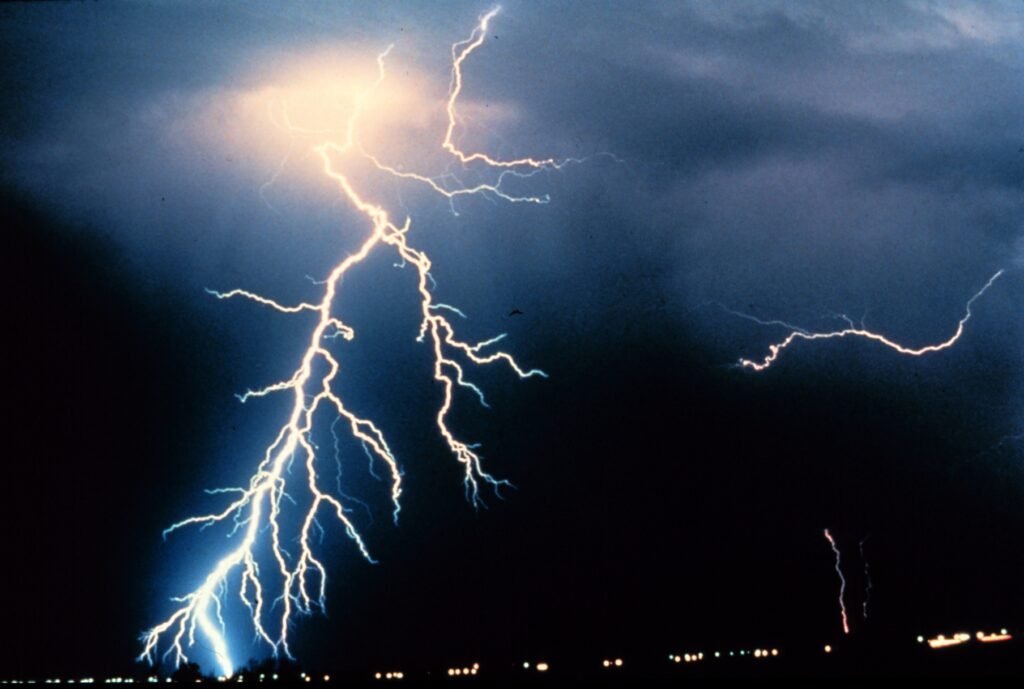
Lightning is a brief, violent transfer of electricity between a cloud and the ground — or between two parts of a cloud — and thunder is simply the sound of it: the crack and rumble of air that has just been superheated fast enough to produce a shockwave. In the United States alone, it strikes millions of times a year, and it’s still one of the more familiar natural phenomena that scientists haven’t fully nailed down.
How a storm builds up that much electricity
Inside a thunderstorm, ice crystals, hail and soft ice pellets called graupel are constantly colliding as they’re tossed around by powerful updrafts and downdrafts. According to NOAA’s National Severe Storms Laboratory, those collisions transfer charge: lighter ice crystals tend to pick up a positive charge and get carried toward the top of the cloud, while heavier graupel picks up a negative charge and settles toward the lower part of the cloud. That separation turns the storm cloud into something like a giant battery, with a strong negative charge pooling near its base and a positive charge building near its top and spreading down toward the ground below. Researchers are still refining exactly how this sorting happens — NOAA notes competing “precipitation” and “convection” theories — but the outcome isn’t in dispute: an electrical imbalance that keeps growing until it has to discharge somewhere.
Why a strike happens in two steps, not one
When the charge difference grows large enough to overcome the air’s natural resistance, a channel of negative charge called a stepped leader arcs downward from the cloud in a series of rapid, branching steps, invisible to the eye. As it nears the ground, it connects with an upward streamer of positive charge rising from a tall object — a tree, a building, sometimes a person. Once that connection completes the circuit, a much brighter and more powerful surge called the return stroke travels back up the same channel to the cloud, and that return stroke is the visible flash people actually call lightning. What looks like one continuous bolt is often several of these rapid strokes firing along the same channel within a fraction of a second, which is part of why a strike can seem to flicker.
Where the sound of thunder actually comes from
The air inside a lightning channel is heated to roughly 50,000 degrees Fahrenheit in a fraction of a second, according to the National Weather Service — hotter than the surface of the sun. NOAA separately cites a figure closer to 18,000 degrees for how much the air is heated by the strike; either number describes the same mechanism, near-instant, extreme heating followed by rapid cooling. That instantaneous heating makes the surrounding air expand explosively, and as it cools just as quickly afterward, it contracts, and the resulting pressure wave is what registers to human ears as a thunderclap.
A lightning channel can stretch for miles, and sound from different points along that channel reaches your ears at slightly different times, layered with echoes off clouds, terrain and buildings. That’s why thunder usually rolls and rumbles instead of arriving as one single crack: the National Weather Service notes that a sharp, immediate crack means the strike was close, while a long, low rumble means it happened farther away.
Using the sound to judge how close the danger is
Light from a flash reaches you almost instantly, but sound travels roughly one mile every five seconds, so counting the seconds between seeing a flash and hearing its thunder, then dividing by five, gives a rough distance in miles — a 15-second gap means the strike was about 3 miles away, per the National Weather Service. That math is a useful trick, but it isn’t the actual safety rule: the agency’s real guidance is blunter than the math suggests. If you can hear thunder at all, you’re already within range of the next strike, and the right move is to get indoors rather than keep counting.