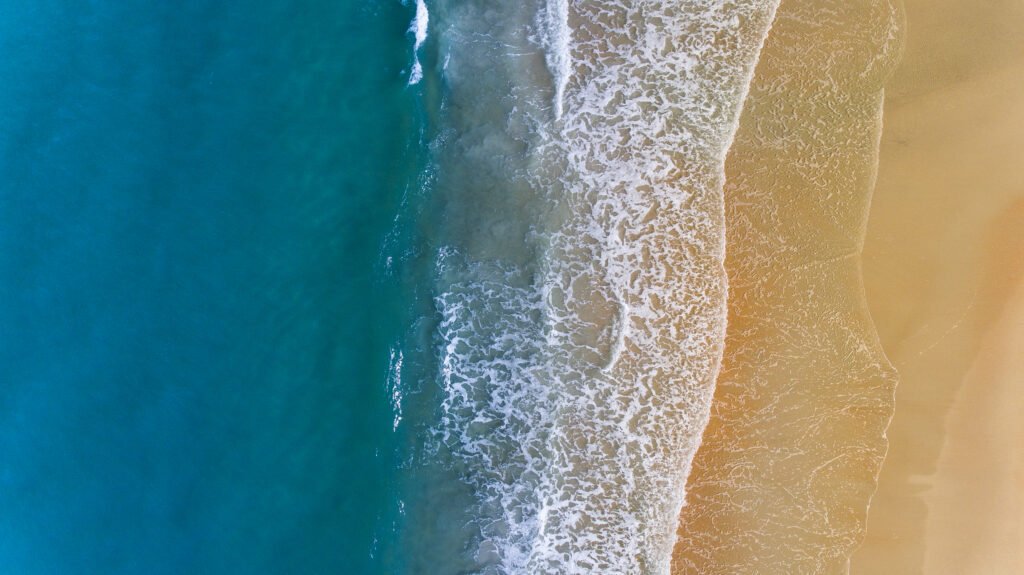
The ocean is salty because rivers and underwater volcanic vents have been adding dissolved minerals to it for roughly four billion years, while evaporation removes only the water and leaves the salt behind to build up. It is not a single event; it is a slow accumulation from two very different sources.
Rivers Carry Salt Too, Just Too Little to Taste
Rivers actually do carry dissolved salts and minerals toward the sea; they are just too dilute for a person to notice. Rain absorbs carbon dioxide from the air on the way down, which makes it mildly acidic, and that acidic water slowly erodes rock and soil as it flows downhill. The erosion releases ions like sodium and chloride — the same two elements that make up ordinary table salt — which rivers then carry out to sea. Rivers and streams deliver an estimated 4 billion tons of dissolved salts to the ocean every year. On its own that is barely detectable, but the ocean has been collecting this runoff for roughly 4 billion years, and because water constantly evaporates from the surface while the dissolved salt stays behind, the concentration has only gone up.
Hydrothermal Vents Add Salt From Below
Rivers are not the only source. Along mid-ocean ridges, seawater seeps down into cracks in the ocean floor, where it is superheated by magma close to the Earth’s crust. That hot water reacts chemically with the surrounding rock, stripping out minerals like iron, manganese, and various salts, before the mineral-rich fluid gushes back out through seafloor openings called hydrothermal vents — sometimes visible as the dramatic plumes known as black smokers. This underwater volcanic activity has been adding dissolved minerals straight into the ocean for as long as the seafloor has existed, working alongside river runoff rather than instead of it.
How Salty Is the Ocean, Exactly?
Scientists measure ocean saltiness as salinity, and the global average is about 35 parts per thousand — meaning roughly 3.5 percent of seawater’s weight is dissolved salt. That number is not uniform: salinity runs higher in warm, evaporation-heavy regions like the subtropics, and lower near the mouths of major rivers or in polar regions fed by melting ice. A few enclosed bodies of water take this much further; the Dead Sea, which has no outlet and loses water only to evaporation, has built up to nearly 32 percent salinity, far beyond the open ocean’s average.
Why the Ocean Is Not Getting Saltier Today
Given billions of years of rivers and vents adding salt, it might seem like the ocean should keep getting saltier forever, but it has actually settled into a rough equilibrium. Marine organisms constantly pull dissolved ions like calcium and silica out of seawater to build shells, skeletons, and other structures, removing salt at roughly the same pace new salt arrives, and more gets locked away in seafloor sediments and evaporite deposits over geologic time. The result is an ocean whose overall salinity has stayed fairly stable for a very long stretch of Earth’s history, even though the processes adding and removing salt never stop.
None of this is just a chemistry footnote. Combined with temperature, salinity determines the density of seawater, and differences in density power the huge, slow-moving currents that circulate heat around the planet, including the deep ocean conveyor belt that shapes climate far beyond the coastline. Salinity also decides which species can live where, since most marine organisms are adapted to a fairly narrow salinity range — which is why a sudden freshwater influx, like a large pulse of meltwater from melting ice, can disrupt an entire ecosystem built around that balance.