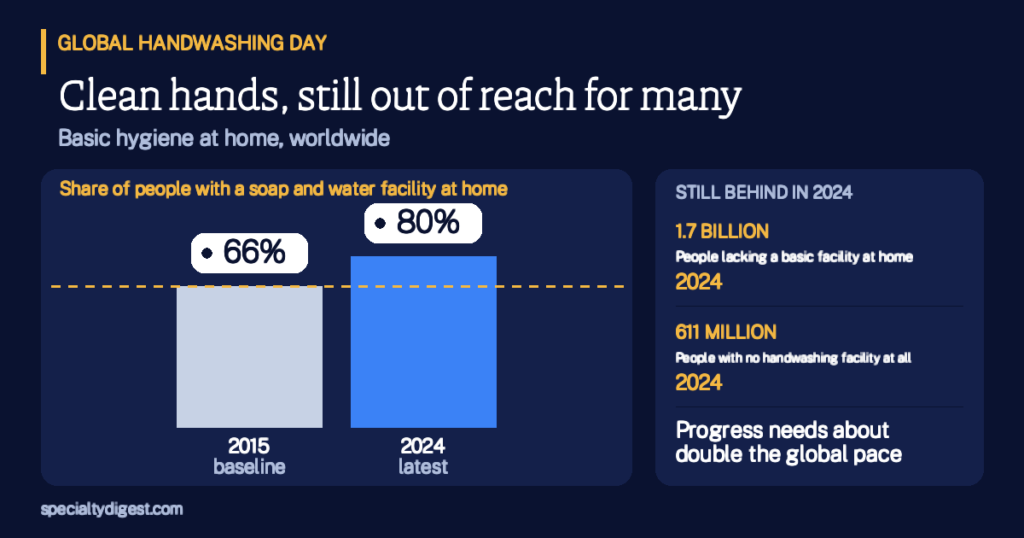
Washing hands is one of the oldest and cheapest health measures people have, and one of the easiest to underestimate. It takes about the time of a short song, needs only soap and water, and can interrupt the spread of diarrhea and respiratory infections. Yet in 2024, 1.7 billion people still lacked even a basic place to do it at home. Global Handwashing Day, observed every October 15, exists to close that gap by pairing a simple habit with the facilities that make the habit possible. It pairs naturally with World Toilet Day, since hygiene and sanitation protect health together.
How a school-yard habit became a global day
The first Global Handwashing Day was held in 2008, when over 120 million children in more than 70 countries washed their hands with soap. The day was founded by the Global Handwashing Partnership, which describes itself as a coalition of international stakeholders. Its steering committee and strategic partners have included UNICEF, Unilever, USAID and the World Bank, a mix of public agencies and private companies working toward the same behavior.
The day has grown into a worldwide moment. The partnership’s 2017 report counted nearly 30 million people from 143 countries taking part in events, and estimated that celebrations reached more than 520 million people once mass media and social media were included. In 2020 it reported that the day reached over 1 billion people with handwashing messages. The idea has stayed the same throughout: make the habit visible, and make it ordinary.
What “hand hygiene” actually means
Hand hygiene is more than a rinse. Global monitoring counts a household as having a basic service when it has a handwashing facility with soap and water on the premises. Without a facility, a family may know every health message and still have nowhere to act on it. In October 2025, on Global Handwashing Day itself, the World Health Organization released its first-ever global Guidelines on Hand Hygiene in Community Settings. They name five key moments, shown below, and confirm that an alcohol-based hand rub with at least 60 percent alcohol is an effective alternative when hands are not visibly dirty.
Example 1: the day of one family. Picture a household of five with one handwashing station that has soap and water, placed near the cooking area. A parent washes before preparing food, the children wash before eating, and everyone washes after using the toilet. That is roughly three moments each, or about fifteen washes a day. The numbers are round and illustrative, but they show why a single well-placed station matters more than a poster on the wall.
The numbers behind the day
There is real progress to report. Global coverage of basic hygiene services, meaning a handwashing facility with soap and water at home, rose from 66 percent in 2015 to 80 percent in 2024. That is a gain of 14 percentage points in nine years.
- 80%of people had basic hygiene at home in 2024
- 1.7 billionpeople lacked basic hand hygiene services at home in 2024
- 611 millionpeople had no handwashing facility at all in 2024
- 1 billion+people reached by Global Handwashing Day messages in 2020
Notice the gap between the two readings. A global figure of 80 percent sounds nearly finished, yet it still leaves 1.7 billion people behind, because the world’s population is so large. The remaining shortfall is also the hardest to reach, since it sits where water is scarce, soap is costly and public services are thin.
Why a bar of soap protects so much
Hands carry germs from surfaces, food, bodies and waste to mouths, eyes and noses. Breaking that chain protects the person washing and everyone around them. UNICEF DATA, citing a 2019 burden-of-disease update, attributes 394,000 deaths from diarrhea and 356,000 deaths from acute respiratory infections to unsafe hand hygiene.
WHO’s 2025 guidelines state that hand hygiene can reduce diarrhea by 30 percent and acute respiratory infections by 17 percent. The U.S. Centers for Disease Control and Prevention reports ranges from community handwashing education: 23 to 40 percent fewer people sick with diarrhea and 16 to 21 percent fewer respiratory illnesses. The figures differ because studies differ in design and setting, but they point the same way: the habit works, and it works best in crowded places such as homes, schools and clinics.
Example 2: a classroom ledger. Suppose a school of 1,000 children would otherwise suffer 500 episodes of diarrhea in a year. A 30 percent reduction would prevent about 150 of them. That is 150 fewer sick days, fewer missed lessons and fewer worried parents. The numbers are made up for illustration, but the reasoning follows the WHO figure above.
Who is left behind
Handwashing is a habit, but it depends on infrastructure. WHO’s guidelines list reliable water, plus soap or alcohol-based hand rub, among the core requirements, along with safe disposal of the used water. Where a tap is a long walk away, hand hygiene competes with drinking, cooking and cleaning for every liter. That connection is why the day is closely tied to World Water Day and to sanitation.
The challenge is sharpest in poorer and unstable places. WHO says reaching the 2030 target requires about a doubling in the global rate of progress, up to 11 times faster in least developed countries and 8 times faster in fragile contexts.
Example 3: the arithmetic of speed. Between 2015 and 2024, coverage rose 14 points in nine years, or roughly 1.6 points a year. If a country kept that pace, it would add about 10 points by 2030. Doubling the pace would add about 20. These round figures are illustrative, not a forecast, yet they show why “about a doubling” is a demanding target.
How the day is marked, and what comes next
Each October 15, schools, health workers, companies and community groups run demonstrations, songs, school contests and media campaigns. The partnership has used a series of themes to keep the message fresh, and “Be a Handwashing Hero” is now described as the multi-year theme. In 2021, UNICEF and WHO used the day to launch the State of the World’s Hand Hygiene report, and in 2025 WHO used it to release its first community guidelines. Those guidelines set out seven cross-cutting principles to help governments turn advice into programs.
- 2017Our Hands, Our Future!
- 2021Our Future is at Hand, Let’s Move Forward Together
- 2024Why are clean hands still important?
- Multi-yearBe a Handwashing Hero
Key Takeaways
- The day began with children. The first Global Handwashing Day, in 2008, saw over 120 million children in more than 70 countries wash with soap.
- A habit needs a place. Basic service means a facility with soap and water at home, not just good advice.
- Progress is real. Basic hygiene coverage rose from 66 percent in 2015 to 80 percent in 2024.
- The gap is still large. In 2024, 1.7 billion people lacked basic service and 611 million had no facility at all.
- Five moments matter. Clean hands before food, before eating or feeding, after the toilet, after coughing or sneezing, and when dirty.
- The health payoff is large. WHO cites 30 percent less diarrhea and 17 percent fewer respiratory infections.
- Speed is the challenge. Reaching 2030 needs about double the pace worldwide and up to 11 times in least developed countries.
How solid is this? Coverage and death figures are modeled estimates for 2024 and 2019, and they are revised as new data arrive. The 30 and 17 percent effects come from WHO’s 2025 guidelines, while CDC ranges come from community education studies, so they are not directly comparable. A 2026 theme could not be confirmed, so none is stated. The three worked examples use round, made-up numbers. See also the International Days hub and the International Days Calendar.