Look at any meal and ask who grew, harvested, carried, ground or sold the food. Very often the answer is a rural woman. Just as often, she owns little of the land she works, earns less than the men beside her and has hours of unpaid chores waiting when the field work ends. The International Day of Rural Women, observed every October 15, asks the world to notice this gap between what rural women contribute and what they receive.
From a 2007 decision to a yearly day
The day grew out of decades of United Nations attention to rural women. In 2007 the Third Committee of the General Assembly approved a text asking the Assembly to declare October 15 of each year the International Day of Rural Women, and the Assembly followed. The first observance took place in 2008.
Today the day is marked by UN Women, the Food and Agriculture Organization (FAO) and other UN bodies, and each year it carries a theme. The 2026 theme, Rural Women Farmers Caring for Mother Nature, also links the day to the International Year of the Woman Farmer 2026, which the General Assembly designated in 2024. FAO launched that year in December 2025, with IFAD and the World Food Programme coordinating activities throughout 2026.
Who is a rural woman?
The term covers smallholder farmers, herders, fisherwomen, wage workers on farms and plantations, food processors and market traders. It also includes the many who work in family businesses without pay or recognition. What unites them is where they live and how much of the work around them is invisible. Agrifood systems, the whole chain from field to plate, employ a large share of working women. According to FAO, in 2021 these systems employed 40 percent of working women worldwide, nearly equal to the share for men.
The picture varies sharply by region. In its 2023 report, FAO found that in sub-Saharan Africa 66 percent of employed women work in agrifood systems, against 60 percent of men. In southern Asia the figures are 71 percent of women and 47 percent of men.
The numbers behind the day
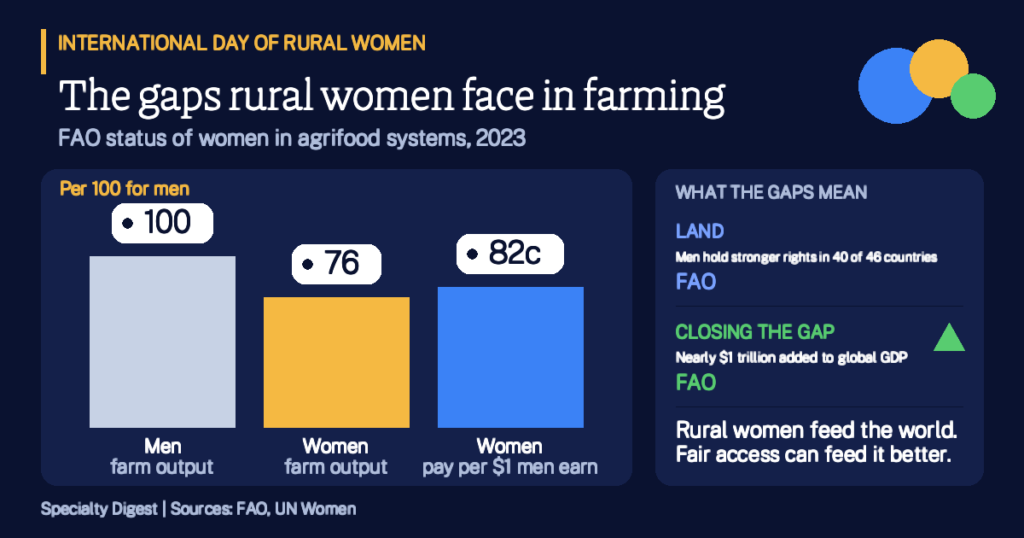
In April 2023 FAO published The status of women in agrifood systems, the first report of its kind since 2010. Its findings explain why the day exists. Women farmers are less productive on paper, not because they are less able, but because they have less access to land, credit, training, tools and time. On farms of the same size, FAO found a 24 percent gender gap in productivity. Women in agricultural wage work earned 82 cents for every dollar men earned, a figure FAO’s later 2025 materials put at 78 cents, which shows how estimates shift with the data used.
Example 1: the same field, different inputs. Imagine two neighbors who each farm one hectare. One has a title deed, a bank loan and a hired tractor. The other farms by permission of a relative, cannot borrow and plants by hand. If the first harvests 100 sacks and the second 76, the difference mirrors the gap FAO describes. The numbers are round and illustrative, but the lesson is that the gap comes from what each farmer can reach, not from skill.
Land, time and a warming planet
Land is the base of rural wealth, and it is where the gap is widest. FAO reported that men have greater ownership or secure tenure rights over agricultural land than women in 40 of the 46 countries that reported on the relevant Sustainable Development Goal indicator. UN Women’s Gender Snapshot 2026 reports a disparity in 71 of 78 developing and European Union countries with data. Without secure land rights, a woman can rarely use land as collateral or invest in it with confidence.
Time is the second constraint. UN Women reports that women spend on average 2.5 times as many hours on unpaid care work as men, and that women and girls together spend 250 million hours a day collecting water, over three times more than men and boys. FAO adds that women and girls’ unpaid care work contributes at least $10.8 trillion a year to the world economy, yet it appears in no wage statistics.
- 40 of 46countries where men hold stronger land rights, FAO 2023
- 2.5 timesmore unpaid care hours for women than men, UN Women
- 250 millionhours a day women and girls spend collecting water
- $10.8 trilliona year in unpaid care work by women and girls, FAO
Climate change is the third. FAO reports that a 1 degree Celsius rise in long-term average temperature is associated with a 34 percent drop in the incomes of female-headed households relative to male-headed ones, and that each day of extreme heat cuts the value of women farmers’ crops by 3 percent relative to men.
Example 2: the lost hours. Suppose a woman spends three hours a day fetching water and cooking over a fire, while her husband spends one hour on similar chores. Over a 300-day working year she gives up about 600 more hours than he does, the equivalent of fifteen full-time work weeks. The figures are round and illustrative, but they show how unpaid time quietly limits what a woman can earn or learn.
A shock that fell unevenly
Crises tend to hit the people with the thinnest cushions. FAO found that the gap in food insecurity between men and women widened from 1.7 percentage points in 2019 to 4.3 percentage points in 2021. During the first year of the COVID-19 pandemic, 22 percent of women working in off-farm segments of agrifood systems lost their jobs, compared with 2 percent of men.
What closing the gap could change
The same research shows a large upside. FAO estimates that closing the farm productivity and agricultural wage gaps would raise global GDP by nearly $1 trillion, about 1 percent, and reduce the number of food-insecure people by 45 million, which it calls a conservative estimate. FAO also reports that narrowing gaps in employment, education and income could eliminate 52 percent of the food insecurity gap, and that empowering rural women could raise incomes for 58 million more people and strengthen resilience for 235 million.
Example 3: a cooperative’s gain. Picture a village where 50 women farmers gain legal land titles, a shared storage shed and basic training. If each raises her yearly harvest value from $400 to $500, the group earns $5,000 more a year. The numbers are round and illustrative, but they show how small, practical changes add up at village scale.
How the day is marked
Governments, farmer groups and UN offices mark October 15 with conferences, field events, exhibitions and campaigns that put rural women at the microphone. In 2026 the theme, Rural Women Farmers Caring for Mother Nature, ties the day to the International Year of the Woman Farmer and to the 2026 meetings under the three Rio Conventions on climate change, biodiversity and desertification.
- 2021Rural Women Cultivating Good Food for All
- 2026Rural Women Farmers Caring for Mother Nature
Key Takeaways
- Rural women feed the world. In 2021, agrifood systems employed 40 percent of working women worldwide.
- The gap is about access, not ability. On same-size farms, women’s output is 24 percent lower because of unequal access to land, credit and tools.
- Land rights are the root. Men hold stronger rights in 40 of 46 reporting countries, which blocks credit and investment.
- Unpaid time is a hidden tax. Women spend about 2.5 times as many hours on unpaid care as men.
- Shocks hit women harder. The food insecurity gap grew from 1.7 to 4.3 points between 2019 and 2021.
- Closing the gap pays. FAO estimates nearly $1 trillion in added global GDP and 45 million fewer food-insecure people.
- Everyone can help. Support women producers, ask about land and credit rights, and follow the 2026 Year of the Woman Farmer.
How solid is this? The figures come from FAO’s 2023 status report, FAO’s 2025 launch material for the International Year of the Woman Farmer and UN Women’s 2026 materials. They are modeled estimates and some carry no separate reference year, so treat the trillion-dollar and 45-million figures as conservative projections rather than forecasts. The three worked examples use round, made-up numbers to show an idea. See also World Water Day, the International Days hub and the International Days Calendar.