Turn on a tap and you rarely think about what stands behind it: a protected source, pipes that are maintained, and treatment that works every hour of every day. For roughly one in four people on Earth, that chain is missing or broken. World Water Day, observed every year on March 22, exists to keep that fact in public view and to turn attention into action.
Where the day came from
The idea was born at the 1992 United Nations Conference on Environment and Development in Rio de Janeiro, where governments recommended an international day for freshwater. On December 22, 1992, the General Assembly adopted resolution 47/193 without a vote and declared March 22 World Day for Water, to be observed from 1993. It invited countries to mark the day with documentaries, conferences and exhibitions on protecting and developing water resources.
Today the campaign is coordinated by UN-Water, created in 2003 to align the work of the more than 30 UN organizations that run water and sanitation programs. No single agency owns the subject, which is why a coordinating body, and a shared day, matter.
What “safe water” actually means
A pipe in the ground is not the same as safe water. Health agencies use a precise standard called safely managed drinking water: water from a source on the premises, free from contamination and available when needed. Miss any one of the three and a household falls a step down the ladder.
Example 1: the yard well. A family has a well in its yard, and tests show the water is clean. In the dry season the well runs dry for weeks, and the family walks to a neighbor’s tap. Clean and close, but not available when needed. By the standard, this household does not have safely managed water, even though most surveys would see a well and tick a box.
The ladder matters because most of the people still waiting are not at the bottom. Of the 2.1 billion without safely managed water in 2024, about two thirds already had a basic service. The next rungs down are limited services, unimproved sources and, at the very bottom, 106 million people who drink straight from rivers, lakes and ponds.
How far the world has come, and how far it has not
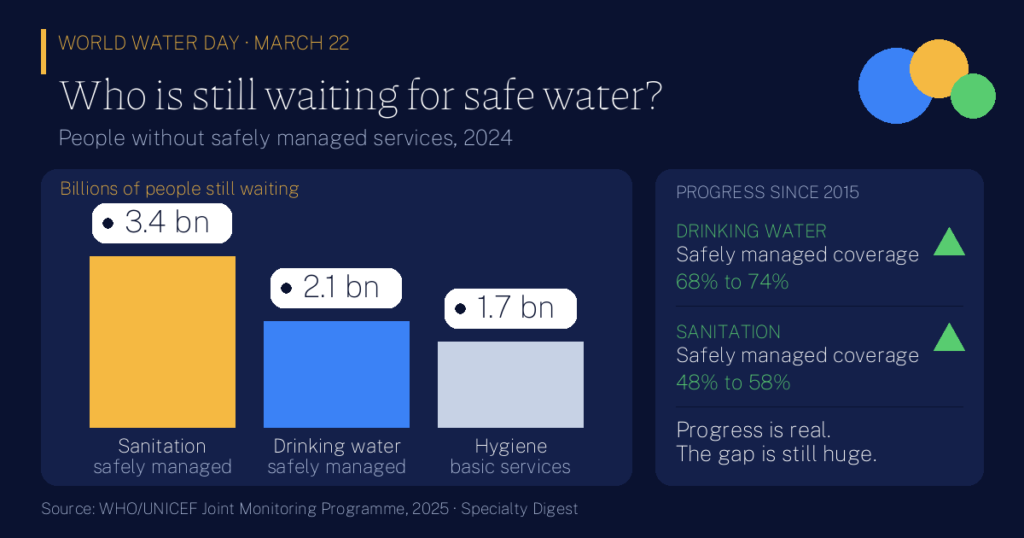
The honest picture has two sides. Between 2015 and 2024, 961 million people gained safely managed drinking water, lifting global coverage from 68 to 74 percent. Safely managed sanitation rose from 48 to 58 percent, and basic hygiene from 66 to 80 percent. Those are historic gains.
Yet in 2024, 2.1 billion people still lacked safely managed drinking water, 3.4 billion lacked safely managed sanitation (including 354 million who practice open defecation), and 1.7 billion lacked basic hygiene at home, 611 million of them with no handwashing facility at all. At the current pace the world would reach only 77 percent drinking water coverage by 2030, and the JMP estimates that progress would need to speed up eightfold to meet the goal.
The averages also hide who is left behind. People in the least developed countries are more than twice as likely to lack basic drinking water and sanitation, and in fragile settings safely managed water coverage is 38 percentage points lower. In cities and low-income countries the number of people without safely managed water has actually risen since 2015, even as it fell in the world overall.
Why it is a health story first
The World Health Organization estimates that safe water, sanitation and hygiene could have prevented at least 1.4 million deaths in 2019. Diarrheal disease accounts for most of them, and children carry a heavy share: 395,000 deaths among children under five, or 7.6 percent of all deaths in that age group. The mechanism is simple. Contaminated water and poor sanitation spread bacteria, viruses and parasites, and repeated diarrhea stops children from absorbing nutrients, which worsens malnutrition and leaves them more vulnerable still.
- 1.4 milliondeaths in 2019 that safe water, sanitation and hygiene could have prevented (WHO)
- 395,000of them children under five, 7.6% of all deaths in that age group
- 30%fewer cases of diarrhea when people wash hands with soap and water
- 17%fewer acute respiratory infections with the same habit
The good news is how cheap the best defense can be. Washing hands with soap and water can cut diarrhea by 30 percent and acute respiratory infections by 17 percent, which UN-Water says could save around 740,000 lives every year.
Example 2: the handwashing arithmetic. Imagine a neighborhood where 1,000 children would otherwise have a diarrheal illness in a season. If soap-and-water handwashing became routine, about 300 of those illnesses would not happen. That is 300 fewer sick days, fewer missed lessons, and 300 fewer worried parents. The numbers are round and illustrative, but the 30 percent effect is what the evidence shows.
More than health: time, school and equality
Where water is not at home, someone has to fetch it. In most countries with data, women and girls carry that task, and in parts of sub-Saharan Africa and Central and Southern Asia many spend more than 30 minutes a day on it.
Example 3: the hidden hours. Thirty minutes a day sounds small. Over a year it is about 182 hours, more than seven full days and nights spent walking and waiting instead of studying, earning or resting. School adds another layer: 429 million school-age children lack basic drinking water at school. These links explain the 2026 theme, “Where water flows, equality grows”, which treated safe water and sanitation as human rights and as enablers of gender equality.
Water as a bridge between nations
Rivers, lakes and aquifers do not follow borders. More than 3 billion people depend on water that crosses a national boundary, yet of 153 countries that share such waters, only 24 reported agreements covering all of them. That is why the 2024 theme was Water for Peace, and why 2025, which was also the International Year of Glaciers’ Preservation, focused on the ice that supplies nearly 2 billion people. Each year’s theme turns the same day toward a different pressure point.
- 2020Water and Climate Change
- 2021Valuing Water
- 2022Groundwater
- 2023Accelerating Change
- 2024Water for Peace
- 2025Glacier Preservation
- 2026Where water flows, equality grows
How the day is marked
In the weeks before March 22, UN-Water runs a global campaign and partners host events. UNESCO usually releases the UN World Water Development Report on or around the day, so that the observance comes with fresh evidence for policymakers. Reach is large: the 2025 campaign was seen across 63.5 billion social media and online accounts. A day on the calendar cannot lay a pipe, but it does keep a hidden crisis on the agenda of governments, utilities and ordinary citizens.
Key Takeaways
- Safe water is a service, not just a source. It must be clean, close to home and available whenever it is needed.
- Progress is real but unfinished. 961 million people gained safe drinking water since 2015, and 2.1 billion still wait.
- Soap and water protect children first. Handwashing is among the cheapest ways to cut diarrhea and respiratory infections.
- Time is a hidden cost. Hours spent fetching water fall mostly on women and girls, and they take away school and income.
- Shared water needs shared rules. Agreements between countries turn a source of tension into a source of stability.
- Ask about water where you live. Find out how your community’s water is tested and who is responsible, and support those who keep it safe.
How solid is this? Coverage figures are modeled estimates from the WHO/UNICEF Joint Monitoring Programme for 2024 and are revised with each update. The health burden figures are the latest WHO estimates, for 2019. The three worked examples use round, made-up numbers to show an idea. For every observance on one page, see the International Days hub and the International Days Calendar.
More in Health
- UN General Assembly. Resolution A/RES/47/193, Observance of World Day for Water (1992).
- UN-Water. About UN-Water.
- WHO and UNICEF Joint Monitoring Programme. Progress on household drinking water, sanitation and hygiene 2000-2024 (2025).
- World Health Organization. Improving access to water, sanitation and hygiene can save 1.4 million lives per year (2023).
- UN-Water. Water and Health: facts and figures.
- UN-Water. World Water Day 2024 campaign: Water for Peace.
- UN-Water. World Water Day 2026 fact sheet.