Backyard poultry can bring fresh eggs, income, food security and a valuable connection with nature. For children, raising chickens or ducks can also teach responsibility and respect for animals.
But a bird does not have to look sick to carry dangerous bacteria.
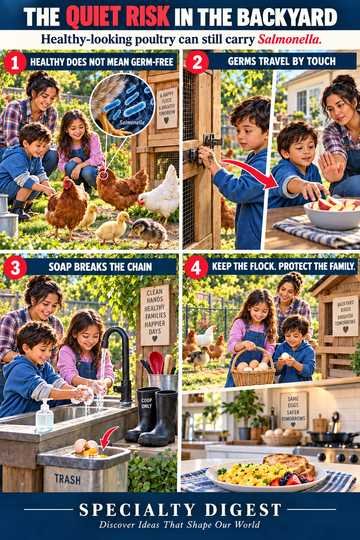
Chickens, ducks and other poultry can harbour Salmonella while appearing active, healthy and clean. The bacteria may spread through their droppings and contaminate feathers, feet, eggs, cages, soil, feeding equipment and other parts of their surroundings.
The danger, therefore, is often not visible in the bird. It is hidden in the chain of contact connecting the coop to the human mouth.
How infection reaches the household
A person may collect eggs, clean a cage, refill a feeder or touch a coop door. If the hands become contaminated and the person then touches food, the face or the mouth before washing properly, Salmonella can enter the body.
Coop footwear and equipment can also carry contaminated material into kitchens and living spaces. Even someone who never handles a chicken directly may encounter bacteria transferred from another person’s hands, clothes or tools.
This is why apparently harmless behaviour—such as kissing a chick, cuddling a duckling or eating beside a poultry enclosure—can create an avoidable health risk.
The essential lesson is simple:
You do not have to eat a chicken to acquire Salmonella from one.
What outbreaks reveal
The risk is not merely theoretical. Public-health agencies have repeatedly investigated large outbreaks associated with backyard poultry.
As of August 27, 2026, the US Centers for Disease Control and Prevention reported 1,061 confirmed illnesses, 234 hospitalisations and two deaths across 46 states and Puerto Rico. Among patients who were interviewed, approximately three-quarters reported contact with backyard poultry.
A separate outbreak completed in 2024 involved 470 confirmed cases across 48 states, including 125 hospitalisations and one death.
The actual numbers were probably higher. Many people with Salmonella recover without visiting a health facility or receiving laboratory testing, so their illnesses never become part of official outbreak totals.
These events expose a dangerous misconception: if birds look healthy and their enclosure appears clean, people may assume that ordinary precautions are unnecessary. Yet visual cleanliness cannot confirm that Salmonella is absent.
Who faces the greatest risk?
Salmonella infection commonly causes diarrhoea, fever and abdominal cramps. Some people may also experience nausea, vomiting or dehydration.
Many otherwise healthy adults recover, but the illness can become severe. Young children, older adults and people with weakened immune systems face a greater risk of hospitalisation or complications. In uncommon cases, the bacteria can enter the bloodstream and spread beyond the intestines.
Children younger than five deserve particular protection. They are naturally attracted to chicks and ducklings, frequently touch their faces and may not wash their hands effectively. Their immune systems also make them more vulnerable to serious illness.
Adults should therefore supervise older children closely and prevent those under five from handling backyard poultry or entering contaminated areas.
The habits that break the chain
Families do not need to abandon backyard poultry keeping. They need clear boundaries between the flock, the home and the kitchen.
The most effective precautions are practical:
- Wash hands immediately with soap and running water after touching birds, eggs, cages or anything in the poultry environment.
- Keep chickens, ducks and other poultry outside the home.
- Do not kiss, cuddle or hold birds close to the face.
- Avoid eating and drinking around the coop.
- Keep feed containers, cleaning tools and coop footwear outdoors.
- Clean poultry equipment outside, away from kitchens and food-preparation areas.
- Supervise children and ensure that they wash their hands correctly.
- Collect eggs frequently and discard cracked ones.
- Store and prepare eggs hygienically, and cook them thoroughly.
Hand sanitiser can be useful when soap and water are temporarily unavailable, but proper handwashing should follow as soon as possible.
Medical attention may be necessary if diarrhoea or vomiting is severe or persistent, dehydration develops, or the affected person belongs to a high-risk group.
Backyard farming without preventable illness
For many households, keeping poultry is more than a hobby. It supports livelihoods, improves access to food and strengthens local resilience. Public-health advice should preserve these benefits while helping families manage the biological risks.
The answer is neither fear nor complacency. It is responsible coexistence.
Healthy-looking birds may still carry germs. Fresh-looking eggs still require safe handling. Children can learn from animals without treating them as toys. Families can continue raising poultry while preventing the coop’s microbial environment from entering the home.
The danger may be invisible, but the defence is not complicated: maintain sensible distance, protect the kitchen and wash every pair of hands that has entered the birds’ world.
The SmartRead takeaway
Familiar animals are not automatically harmless animals.
Backyard poultry can provide food, income and companionship, but appearances cannot reveal whether a bird carries Salmonella. Good hygiene interrupts the hidden route between poultry and people—allowing families to keep the flock while protecting everyone around it.
Sources
- Centers for Disease Control and Prevention. “Salmonella Outbreaks Linked to Backyard Poultry.” Updated August 27, 2026. cdc.gov
- Centers for Disease Control and Prevention. “Investigation Update: Salmonella Outbreaks, April 2026.” cdc.gov
- Centers for Disease Control and Prevention. “Investigation Update: Salmonella Outbreak, Backyard Poultry – May 2024.” cdc.gov
Centers for Disease Control and Prevention, “Salmonella Outbreaks Linked to Backyard Poultry,” updated August 27, 2026. Centers for Disease Control and Prevention, “Salmonella Outbreak Linked to Backyard Poultry – May 2024.”