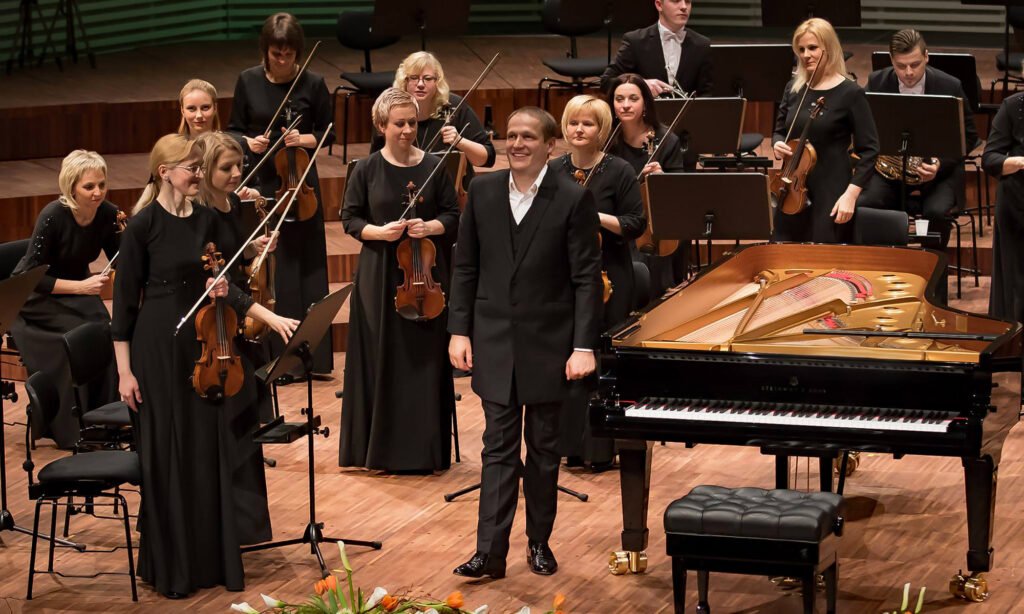
A symphony is an extended multi-movement composition for orchestra, typically lasting between twenty and forty-five minutes and usually built from three or four distinct movements that vary in tempo and character. The word derives from the Greek symphonia, meaning roughly ‘agreement or concord of sound,’ and its meaning shifted considerably over the centuries before settling on its modern orchestral sense.
n
Origins in the Baroque overture
n
During the Baroque era, terms such as ‘sinfonia’ and ‘symphony’ covered a range of pieces, including the instrumental overtures that opened operas. The Italian opera overture, structured in a fast-slow-fast pattern, is generally considered the direct forerunner of the independent orchestral symphony, as composers increasingly detached these instrumental introductions from the operas they once preceded and developed them as standalone concert pieces.
n
Standardization in the Classical era
n
Joseph Haydn, often called the father of the symphony, composed at least 106 symphonies across a thirty-six-year career, and his output played a central role in standardizing the form. Many of his earliest symphonies from the 1750s were written in three movements, but the four-movement structure, pairing an opening sonata-form movement with a slower second movement, a dance-based minuet or scherzo, and a fast finale, gradually became the standard template by the later eighteenth century.
n
Mozart and Beethoven’s expansion
n
Wolfgang Amadeus Mozart contributed significantly to the symphony’s expressive range during the same period, and Ludwig van Beethoven subsequently expanded the genre’s scale and ambition dramatically, treating the symphony as a vehicle for large-scale musical and even philosophical statements. Beethoven’s Ninth Symphony, completed in 1824, broke new ground by incorporating vocal soloists and a full chorus into its final movement, permanently expanding what a symphony could include.
n
Romantic and modern evolution
n
Composers including Johannes Brahms, Gustav Mahler, and Jean Sibelius continued to reshape the symphony through the Romantic era and into the twentieth century, experimenting with movement count, overall length, and orchestral scale; Mahler’s symphonies, for example, often run well over an hour and employ unusually large orchestral forces. Dedicated symphony orchestras became institutionalized civic organizations during this period, with ensembles such as the London Symphony Orchestra, founded in 1904, becoming prominent fixtures of musical life in major cities.
n
Inside a symphony orchestra
n
A typical symphony orchestra numbers anywhere from about thirty to over one hundred musicians, organized into string, woodwind, brass, and percussion sections, with a full score coordinating individual parts written for each player or section. The symphony as a musical form and the symphony orchestra as a performing ensemble are closely linked but distinct, since orchestras also regularly perform concertos, overtures, and other works that are not symphonies.
n
Programmatic symphonies
n
Not every symphony follows a purely abstract musical structure. French composer Hector Berlioz’s Symphonie fantastique, premiered in 1830, is one of the most famous examples of a programmatic symphony, meaning a symphony built around an explicit narrative, in this case an opium-fueled vision of obsessive, unrequited love, with a recurring melodic theme representing the beloved recurring across all five of its movements. Programmatic symphonies like this one blurred the line between purely musical form and the kind of storytelling more commonly associated with opera or ballet.
n
Famous symphony orchestras today
n
Beyond the London Symphony Orchestra, major symphony orchestras such as the Berlin Philharmonic, the Vienna Philharmonic, and the New York Philharmonic remain central institutions in classical music performance, each with distinct performance traditions and recording histories, and each regularly performing both the standard symphonic repertoire from Haydn through Mahler and newly commissioned contemporary symphonic works.
n
The symphony as a measure of ambition
n
Because completing a symphony has long been regarded as a major compositional achievement, many composers approached the genre with particular caution; some, echoing a superstition sometimes called the curse of the ninth, were notably anxious about writing a ninth symphony after Beethoven’s Ninth, with Gustav Mahler reportedly reluctant to formally number a work that would have been his own ninth symphony. Whether or not such superstitions carried any real weight, they reflect how strongly the symphony has functioned as a benchmark of a composer’s serious artistic ambition.
n
Recording technology has also changed how audiences experience the symphony, since a work originally designed to be heard once in a concert hall can now be studied repeatedly on recordings, letting listeners and students follow its harmonic and thematic structure in far more detail than a single live performance would normally allow.
n
Film composers have also drawn on the symphony’s large-scale orchestral vocabulary, frequently using full symphonic forces to score blockbuster films, which has introduced many listeners to the sound of a large orchestra without their ever attending a traditional symphony concert.
n
A symphony’s premiere was also historically a significant social event in major European cities, often attended by critics whose published reviews could shape a composer’s reputation for years, giving the genre a public visibility well beyond its purely musical content.
n
Today, youth and community orchestras around the world continue to introduce new generations of musicians to symphonic repertoire, helping sustain a performance tradition that stretches back through more than two and a half centuries of continuous development.
n
FAQs
n
What is the difference between a symphony and a symphony orchestra? A symphony is a specific type of multi-movement musical composition, while a symphony orchestra is the large ensemble of musicians that performs symphonies along with many other kinds of orchestral works.
n
Why is Haydn called the father of the symphony? Because his roughly 106 symphonies, composed over thirty-six years, played a major role in establishing the four-movement structure and formal conventions that later composers continued to build on.
Key facts
- Word derives from Greek symphonia, meaning concord of sound
- The Italian fast-slow-fast opera overture is considered the symphony's direct forerunner
- Haydn wrote at least 106 symphonies and is called the father of the symphony
- Beethoven's Ninth Symphony (1824) added vocal soloists and chorus
Related concepts
Quick checkWhich composer is known as the father of the symphony?Show answer
Joseph Haydn, who composed at least 106 symphonies and helped standardize the genre's four-movement structure.
Sources
- Wikipedia, Symphony
- Britannica, Symphony (music)
- LOUIS Pressbooks, Classical Period: The Symphony
Editorially reviewed by Specialty Digest Editorial TeamLast reviewed November 1, 2026Researched and drafted with AI assistanceReport an issue