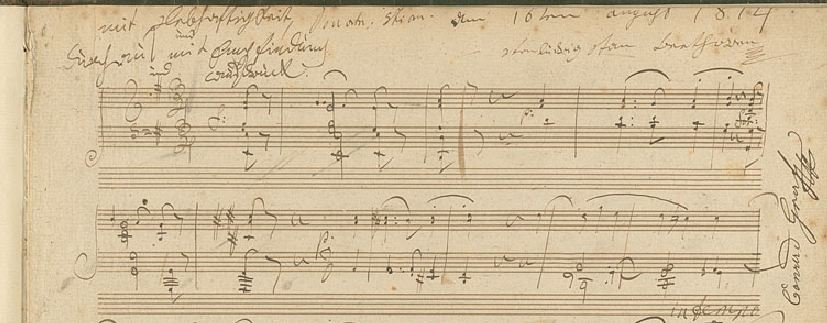
Sonata form, also called sonata-allegro form, is a musical structure used to organize a single movement, most often the first movement, of a larger work such as a sonata, symphony, or string quartet. Built around the thematic and harmonic organization of tonal material, it became the dominant framework for serious instrumental composition during the Classical and Romantic eras.
n
The three main sections
n
Sonata form movements are organized into three principal sections. The exposition presents the main themes, typically in two contrasting keys, most often the tonic and the dominant, connected by a modulating transition. The development then explores and alters that thematic material through more distant keys and fragmentation, making it the section where the music is usually at its most harmonically unstable, before a final retransition prepares the return of the home key. The recapitulation then restates the exposition’s themes, now resolved within the tonic key, so that material first heard elsewhere returns home by the movement’s end. An optional introduction may precede the exposition, and an optional coda may follow the recapitulation.
n
Historical roots
n
The word ‘sonata’ dates back to the seventeenth century and originally simply meant a piece intended to be played rather than sung. Early examples were often built from simple two-part binary forms, and the harpsichord sonatas of Domenico Scarlatti are frequently cited as an important transitional step from binary form toward the more elaborate sonata-allegro structure that followed.
n
Codification in the Classical era
n
Sonata form’s norms were firmly established during the Classical period, primarily through the instrumental works of Joseph Haydn and Wolfgang Amadeus Mozart, whose compositions became the model later theorists studied. An early formal description came from theorist Heinrich Koch in 1793, who defined the form mainly through its pattern of modulation and cadences rather than through its specific melodic themes.
n
The nineteenth-century theoretical model
n
The thematically focused version of sonata form commonly taught today was developed later, during the 1820s and 1840s, by theorists including Anton Reicha, Adolf Bernhard Marx, who may have coined the term ‘sonata form’ itself, and Carl Czerny, largely based on close study of Beethoven’s piano sonatas. During the Romantic era that followed, composers increasingly treated the form as the foundation of serious instrumental music even as they expanded and personalized its coda sections, and later composers departed from the model so often that scholars began speaking of ‘sonata forms’ in the plural rather than one fixed template.
n
Sonata form versus a sonata
n
It is worth distinguishing sonata form, the structural plan described here, from a sonata, which is simply a multi-movement instrumental piece, often for one or two performers, that may use sonata form in one or more of its movements but is not defined solely by it; a symphony or string quartet can likewise contain a movement in sonata form without itself being called a sonata.
n
Sonata form in concertos
n
Sonata form was also adapted for use in the concerto, a work for solo instrument and orchestra, through what is often called double-exposition form, in which the orchestra first presents the main themes alone before the soloist enters and the exposition effectively repeats with the soloist now taking the leading role. This adaptation let composers preserve sonata form’s underlying dramatic shape while still giving a soloist the kind of prominent, virtuosic entrance concerto audiences expected.
n
Beethoven’s expansion of the coda
n
Beethoven in particular is credited with transforming the coda, originally a brief closing passage, into a much more substantial and dramatically important final section in works such as his Hammerklavier Sonata, sometimes making the coda nearly as long and significant as the earlier sections of the movement. This expansion gave later Romantic composers a model for using a movement’s ending as a genuine culmination of its drama rather than merely a formal sign-off.
n
Teaching sonata form
n
Sonata form remains a central topic in music theory education, where students are typically taught to identify its sections by analyzing a movement’s key changes and thematic material, a skill considered fundamental to understanding the broader Classical and Romantic instrumental repertoire. Because real compositions frequently bend or complicate the textbook model, teachers often use sonata form less as a rigid checklist and more as a flexible set of expectations that a given piece can meet, modify, or deliberately subvert.
n
Later composers, including those working in jazz-influenced and film score traditions, have continued to borrow sonata form’s basic logic of presenting, developing, and resolving musical ideas, even when they depart entirely from its original tonal, Classical-era vocabulary.
n
Understanding sonata form also helps listeners anticipate a movement’s dramatic arc in live performance, recognizing the tension of the development section and the satisfaction of hearing familiar themes finally resolve back in the home key during the recapitulation.
n
Some scholars distinguish sonata form proper from the looser, more general ‘sonata principle,’ using the latter term to describe pieces that follow its broad dramatic logic of departure and return without strictly matching every detail of the textbook three-section model.
n
FAQs
n
Is every sonata written in sonata form? No; a sonata is simply a type of instrumental composition, and while its opening movement very often uses sonata form, other movements commonly use different structures, such as theme and variations or rondo form.
n
Do modern composers and theorists still use sonata form? Many twentieth-century composers departed significantly from the traditional model, and theorists including Heinrich Schenker and, more recently, James Hepokoski and Warren Darcy with their Sonata Theory have reinterpreted the form through new frameworks of harmony, cadence, and genre expectation.
Key facts
- Built from three sections: exposition, development, and recapitulation
- Norms established in the Classical era through Haydn and Mozart's works
- The thematic model taught today was developed in the 1820s-40s by Reicha, Marx and Czerny
- A sonata (the piece) is not the same thing as sonata form (the structure)
Related concepts
Quick checkWhat are the three main sections of sonata form?Show answer
The exposition, which presents contrasting themes; the development, which alters and explores them; and the recapitulation, which resolves them in the home key.
Sources
- Wikipedia, Sonata form
- Britannica, Sonata form
- Wikipedia, History of sonata form
Editorially reviewed by Specialty Digest Editorial TeamLast reviewed November 1, 2026Researched and drafted with AI assistanceReport an issue