A sewer system is a network of underground pipes that collects wastewater from homes, businesses, and sometimes stormwater runoff, and carries it to a treatment plant or, in some older systems, directly to a natural waterway. Sewer systems rank among the most essential pieces of urban infrastructure, since they protect public health by removing waste and contaminated water from populated areas quickly and reliably.
How Sewer Systems Move Wastewater
Most sewer systems rely primarily on gravity, with pipes laid at a carefully calculated slope so wastewater flows downhill from buildings toward a treatment plant without needing constant pumping. Where terrain is flat or a treatment plant sits at a higher elevation than part of the service area, pumping stations lift wastewater up and over these obstacles, adding mechanical complexity and ongoing energy costs that gravity-only systems avoid. Engineers must carefully size pipes to handle expected flow without running so full that sewage backs up during peak usage or heavy rain.
Separate Versus Combined Sewer Systems
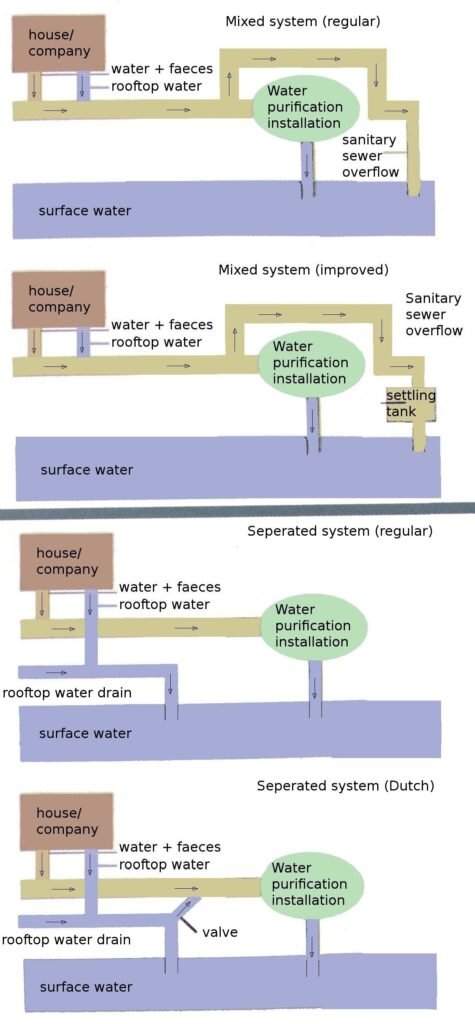
Separate sewer systems use distinct pipe networks for wastewater and stormwater, keeping rainwater runoff apart from sewage so that a treatment plant only has to process the wastewater it was actually designed for. Combined sewer systems, common in many older cities, carry both wastewater and stormwater through the same pipes, a design that can overwhelm treatment capacity during heavy rain, forcing untreated combined sewage to overflow directly into rivers or lakes, a problem many cities are now investing heavily to address through pipe separation or additional storage capacity.
Treatment and Final Discharge
Wastewater carried by a sewer system ultimately arrives at a treatment plant, where it undergoes processes similar to those used in broader municipal water treatment, removing solids, breaking down organic matter, and disinfecting the water before it is released back into the environment. Some industrial facilities pretreat their wastewater before it enters the public sewer system, removing specific chemicals or contaminants that a standard municipal treatment plant is not designed to handle safely.
Maintenance and Common Problems
Sewer pipes, many decades old in established cities, are prone to problems including cracking, root intrusion from nearby trees seeking moisture, grease buildup that narrows the usable pipe diameter, and sediment accumulation that can eventually block flow entirely. Cities use specialized cameras and robotic inspection equipment to examine the inside of sewer pipes without digging them up, identifying developing problems before they cause a sewage backup or a pipe collapse that would require far more disruptive and costly emergency repairs.
Sanitary Sewers Versus Septic Systems
Properties connected to a municipal sanitary sewer rely on the city’s shared pipe network and treatment plant, while properties outside a sewer service area, common in rural areas, typically use individual septic systems that treat wastewater on-site using a septic tank and a drain field that allows treated water to slowly filter back into the surrounding soil. Septic systems require periodic pumping and careful siting to avoid contaminating nearby groundwater or wells.
History of Sewer Infrastructure
Organized sewer systems date back to ancient civilizations, including sophisticated drainage networks in ancient Rome, though many cities lost this infrastructure knowledge for centuries afterward. Major investment in modern sewer systems accelerated in the nineteenth century after scientists linked contaminated water and poor sanitation to deadly disease outbreaks in rapidly growing industrial cities, prompting large public investment in underground sewer networks that remain the backbone of urban sanitation today.
Modernizing Aging Sewer Networks
Many major cities face the costly challenge of replacing or rehabilitating sewer pipes that were installed well over a century ago, often using materials and sizing standards that no longer match current population density or rainfall patterns influenced by a changing climate. Rather than fully excavating old pipes, many utilities now use trenchless rehabilitation methods, such as inserting a flexible liner that cures into a new pipe inside the old one, reducing construction disruption and cost compared to traditional dig-and-replace repairs.
Stormwater Management and Green Infrastructure
Beyond traditional underground pipes, many cities now pair sewer infrastructure with green infrastructure such as permeable pavement, rain gardens, and retention ponds that absorb or slow stormwater before it ever reaches the sewer system, reducing the volume of water that pipes and treatment plants must handle during storms. This approach is particularly valuable in cities with aging combined sewer systems, since reducing the stormwater entering the network directly reduces the frequency and severity of sewage overflow events during heavy rainfall.
Public Health and Regulatory Oversight
Because failures in sewer infrastructure can directly expose people to disease-causing pathogens, sewer systems operate under strict regulatory oversight, with utilities required to monitor and report sewage overflows and to develop long-term capital plans for addressing aging or undersized infrastructure. Regulators increasingly require cities with combined sewer systems to develop formal plans and timelines for reducing overflow events, reflecting a growing recognition that sewer infrastructure, though mostly invisible underground, is just as critical to public health as the water treatment systems it ultimately feeds.
FAQs
What is the difference between a separate and a combined sewer system?
A separate system uses distinct pipes for wastewater and stormwater, while a combined system carries both through the same pipes, which can overflow untreated sewage into waterways during heavy rain.
Why do sewer pipes rely mainly on gravity?
Gravity flow avoids the energy cost and mechanical complexity of constant pumping, so engineers lay pipes at a calculated downhill slope wherever terrain allows, using pumping stations only where gravity alone cannot move wastewater.
In the news
Quick checkWhy do sewer pipes rely mainly on gravity?Show answer
Gravity flow avoids the energy cost of constant pumping, so engineers lay pipes at a downhill slope wherever terrain allows, using pumping stations only where needed.
Editorially reviewed by Specialty Digest Editorial TeamLast reviewed November 2, 2026Researched and drafted with AI assistanceReport an issue