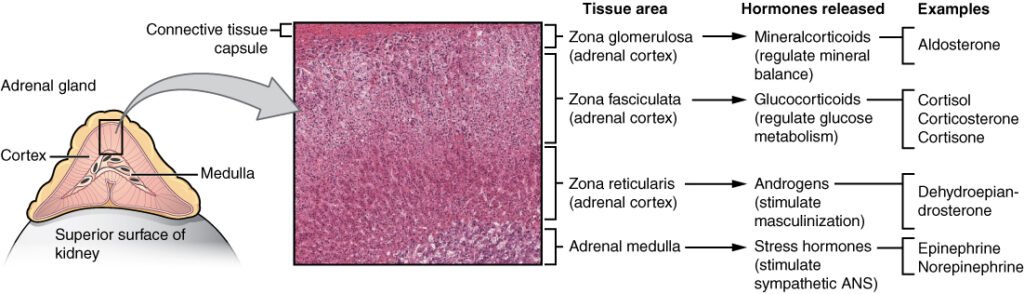
Cortisol is a steroid hormone produced by the adrenal glands, two small glands located above the kidneys, that plays a central role in the body’s response to stress while also regulating a wide range of everyday physiological processes including blood sugar levels, metabolism, inflammation, and the sleep-wake cycle. Often called the body’s primary stress hormone, cortisol is released in response to physical or psychological stressors but also follows a predictable daily rhythm even in the complete absence of stress.
The HPA Axis
Cortisol production is controlled by a signaling pathway called the hypothalamic-pituitary-adrenal axis, in which the hypothalamus releases corticotropin-releasing hormone in response to stress or as part of its normal daily rhythm, prompting the pituitary gland to release adrenocorticotropic hormone, which in turn signals the adrenal glands to produce and release cortisol into the bloodstream. Rising cortisol levels feed back to suppress further release of corticotropin-releasing hormone and adrenocorticotropic hormone, a negative feedback loop that under normal circumstances helps keep cortisol levels within an appropriate range rather than rising indefinitely.
The Daily Cortisol Rhythm
Cortisol follows a well-established daily pattern called the diurnal rhythm, typically peaking shortly after waking in the morning, an increase sometimes called the cortisol awakening response, and then gradually declining throughout the day to reach its lowest point around midnight, roughly aligning with the body’s sleep-wake cycle and helping prepare the body for daytime activity and nighttime rest respectively. Disruption to this normal rhythm, whether from shift work, chronic stress, certain sleep disorders, or specific medical conditions affecting the adrenal glands, has been associated in research with a range of negative health effects, though establishing clear cause-and-effect relationships for many of these associations remains an active area of ongoing study.
The Acute Stress Response
In response to an acute stressor, cortisol works alongside adrenaline to help mobilize the body’s resources, increasing blood glucose availability by promoting glucose release from storage and reducing glucose uptake by non-essential tissues, temporarily suppressing processes like digestion and immune activity that are less immediately necessary for responding to an acute threat, and heightening alertness. This response evolved to help the body cope effectively with short-term physical threats, and it generally functions well for brief, genuinely acute stressors, after which cortisol levels return to their normal baseline once the stressor has passed.
Chronic Stress and Elevated Cortisol
When stress becomes chronic rather than brief and resolved, sustained elevation of cortisol can contribute to a range of negative effects, including impaired immune function, disrupted sleep, mood disturbances, and changes in body fat distribution, particularly increased abdominal fat storage, along with potential effects on memory and cognitive function with sufficiently prolonged exposure. Chronic stress does not simply mean cortisol stays constantly elevated at the same level in every case; some research on long-term chronic stress has found blunted or dysregulated cortisol patterns in certain circumstances, reflecting that the relationship between chronic stress and cortisol regulation is more complex than a simple, uniform elevation.
Clinical Cortisol Disorders
Cushing’s syndrome results from chronically excessive cortisol, whether from a tumor affecting the pituitary or adrenal glands or from long-term use of corticosteroid medications, producing symptoms including weight gain concentrated in the face and trunk, thinning skin, and elevated blood sugar. Addison’s disease, by contrast, results from insufficient cortisol production due to adrenal gland damage, producing symptoms including fatigue, low blood pressure, and weight loss, and requires lifelong hormone replacement medication to manage safely.
Measuring Cortisol
Cortisol can be measured through blood, saliva, or urine testing, each offering different practical advantages depending on what question the testing is meant to answer; blood tests capture cortisol at a specific moment and are commonly used in clinical settings to evaluate suspected adrenal disorders, while saliva testing is less invasive and well suited to tracking the cortisol awakening response or multiple samples across a single day to characterize the full diurnal rhythm. Because cortisol naturally fluctuates substantially throughout the day, a single measurement taken without attention to timing can be difficult to interpret meaningfully, which is why clinicians evaluating possible cortisol disorders typically specify precise collection times or use specialized testing protocols rather than relying on one isolated sample taken at an arbitrary time.
Popular interest in cortisol as a wellness and lifestyle topic has grown considerably in recent years, with various supplements, diets, and lifestyle products marketed specifically as ways to lower cortisol and reduce stress, though the scientific evidence supporting many of these specific commercial claims varies widely and is considerably less robust than the well-established, clinically validated science of cortisol’s basic physiological roles described above. Established approaches with stronger supporting evidence for managing stress-related cortisol elevation include regular physical activity, adequate and consistent sleep, and stress-reduction practices such as mindfulness and relaxation techniques, each of which has been studied more extensively and with more rigorous research designs than most commercially marketed cortisol-specific products.
Cortisol interacts closely with other hormones throughout the body, including suppressing reproductive hormone production during periods of significant chronic stress, a connection researchers believe reflects an evolutionary trade-off in which the body deprioritizes functions like reproduction that are not immediately necessary for survival during periods interpreted by the body as consistently threatening or resource-scarce. This interaction is one proposed explanation for stress-related menstrual irregularities and reduced fertility observed in some individuals experiencing chronic, unresolved stress over extended periods.
FAQs
Why does cortisol typically peak shortly after waking up?
This is part of the normal diurnal cortisol rhythm, sometimes called the cortisol awakening response, which helps prepare the body for daytime activity independent of any specific stressor.
What’s the difference between Cushing’s syndrome and Addison’s disease?
Cushing’s syndrome results from chronically excessive cortisol production, while Addison’s disease results from insufficient cortisol production due to adrenal gland damage.
Quick checkWhy is timing important when interpreting a cortisol test result?Show answer
Cortisol naturally fluctuates substantially across the day as part of its diurnal rhythm, so a single sample taken without attention to timing can be difficult to interpret meaningfully.
Editorially reviewed by Specialty Digest Editorial TeamLast reviewed November 2, 2026Researched and drafted with AI assistanceReport an issue