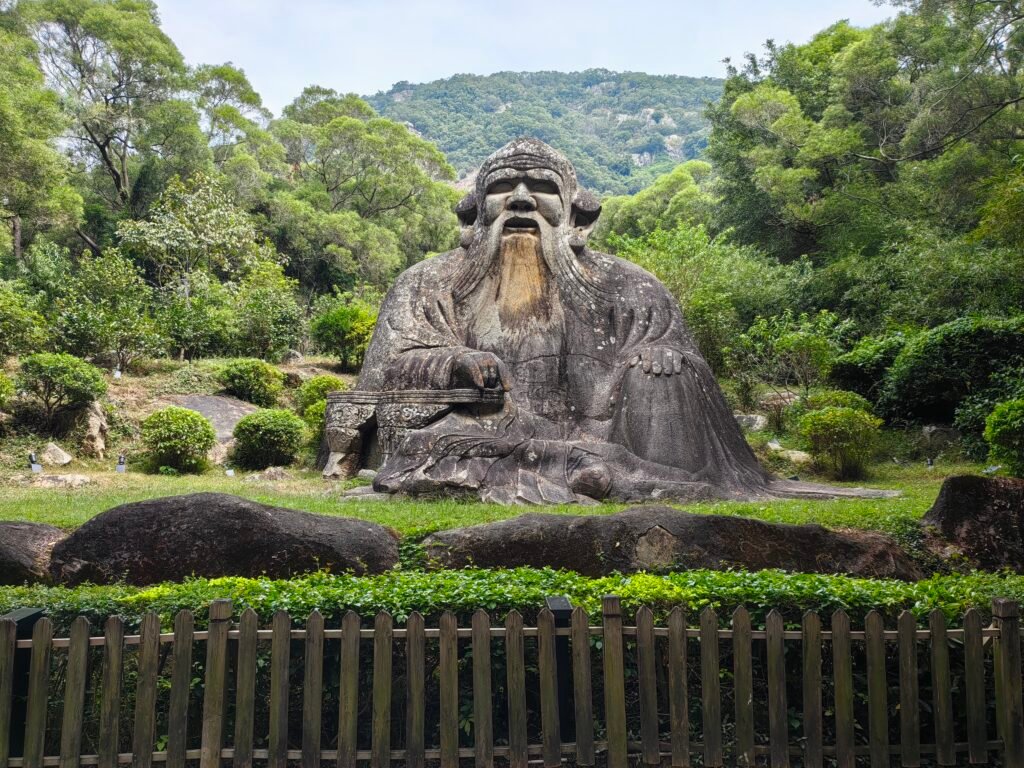
Taoism, also spelled Daoism, is a Chinese philosophical and religious tradition that centers on living in harmony with the Dao, often translated as “the Way,” the underlying, often indescribable process that gives rise to and flows through all things. Taoism took shape during China’s Warring States period, roughly 450 to 300 BCE, and has since developed into both a body of philosophical reflection and an organized religion with temples, priests, and ritual practice.
Origins and early history
Taoist thought emerged alongside other schools of Chinese philosophy during the Warring States period, drawing on older Shang and Zhou religious practices as well as ideas from Naturalism, Mohism, Confucianism, and the divinatory text known as the I Ching. The two foundational works of Taoist philosophy, the Tao Te Ching and the Zhuangzi, were largely compiled during this era, though their authorship remains debated among historians.
The Tao Te Ching is traditionally attributed to a sage named Laozi, who later tradition describes as an older contemporary of Confucius working as a court archivist. Many modern scholars regard Laozi as a legendary or composite figure rather than a single historical author, and the text itself was likely assembled from multiple sources over time. The second major work, the Zhuangzi, is associated with the philosopher Zhuang Zhou, who lived roughly between 370 and 290 BCE and is remembered as Taoism’s most influential early hermit and storyteller.
Core ideas
At the heart of Taoist philosophy is the Dao itself, a concept the Tao Te Ching famously describes as resistant to definition: “The Tao that can be told is not the eternal Tao.” Rather than a deity or a fixed set of rules, the Dao is presented as the natural order underlying change, something to be sensed and followed rather than grasped intellectually.
From this flows the idea of wu wei, often rendered as “non-action” or “effortless action.” Wu wei does not mean literal passivity but rather acting in a way that works with the grain of natural circumstances instead of forcing outcomes through willful struggle, in the way water shapes a landscape by yielding rather than resisting.
Taoist cosmology also draws heavily on yin and yang, the paired, interdependent forces, dark and light, yielding and assertive, whose constant interplay was understood to generate all change in the universe. Closely related is qi, the vital energy or life force that Taoist practitioners seek to cultivate, balance, and preserve through diet, breathing, and meditation in pursuit of health and longevity.
A person who lives in accordance with the Dao is said to possess de, often translated as “virtue” or “power,” the visible expression of the Dao’s influence in daily conduct. Taoist texts also prize ziran, or naturalness and spontaneity, and the image of pu, the “uncarved log,” representing a state of original simplicity before the complications of social convention. The Tao Te Ching further commends what later commentators called the Three Treasures: compassion, moderation, and humility.
Later history and spread
During the Han dynasty, from 202 BCE to 220 CE, Taoist ideas circulated as a loosely unified tradition centered in the Shu region of modern Sichuan, producing texts such as the Huainanzi and the Taipingjing. Organized religious Taoism is usually traced to 142 CE, when Zhang Daoling founded the Way of the Celestial Masters, generally regarded as the first formal Taoist religious community; the movement later won recognition from the warlord Cao Cao in 215 CE. A related Taoist-influenced uprising, the Yellow Turban Rebellion, broke out in the late Han before being suppressed after years of conflict.
During the Six Dynasties period, from 316 to 589 CE, new schools emerged, including Shangqing and Lingbao, and the scholar Lu Xiujing helped compile the Daozang, the Taoist canon, beginning in the 5th century. Taoism reached its greatest official influence under the Tang dynasty, which gave it strong imperial patronage. Through the Song, Yuan, Ming, and Qing dynasties, Taoism continued developing new schools and blended in places with Buddhism and Confucianism, though it gradually lost ground as the Qing court favored Buddhism and Neo-Confucianism instead.
Taoism suffered severe disruption in the 19th and 20th centuries amid war and political upheaval, and during China’s Cultural Revolution from 1966 to 1976, Taoist priests were sent to labor camps and many temples were destroyed. A gradual recovery began after China’s reform and opening-up period starting in 1979, and Taoist practice continues today both in China and among diaspora communities worldwide.
Major schools
Taoism developed into numerous distinct schools over its long history rather than remaining a single unified movement. The Way of the Celestial Masters, founded in 142 CE, is considered the earliest organized tradition. Shangqing, or Supreme Clarity, emerged from a series of visionary revelations between 364 and 370 CE and emphasized meditative and shamanic spiritual travel. Lingbao, or Numinous Treasure, founded by Ge Chaofu between 397 and 402 CE, centered on scripture recitation and talismans and incorporated elements borrowed from Mahayana Buddhism.
The Zhengyi, or Orthodox One, school remains a living liturgical tradition today, known for its ritual and spell work. Quanzhen, or Complete Perfection, was founded in the 12th century by Wang Chongyang and emphasized inner alchemy, monastic discipline, and asceticism; its Longmen, or Dragon Gate, branch was established during the Qing dynasty by Wang Kunyang and continued to promote inner alchemical practice.
Practices
Taoist practice spans a wide range of activities aimed at cultivating health, longevity, and alignment with the Dao. These include meditation techniques such as “fasting of the mind,” breathing exercises, and qigong, alongside internal alchemy, known as neidan, which seeks to transform and refine the body’s vital energies, and external alchemy, known as waidan, historically associated with efforts to create elixirs. Dietary regimens and health practices collectively called yangsheng, or “nourishing life,” are also central to many Taoist communities.
Ritual practice includes the use of talismans, exorcism rites, and divination, while Taoist cosmology has also shaped Chinese astrology, feng shui, and traditional medicine. Movement arts associated with Taoist philosophy, including tai chi and various forms of Wudang quan, remain widely practiced today, both as spiritual disciplines and as popular forms of exercise, well beyond the boundaries of formal Taoist religious communities.
FAQs
- Is Taoism a philosophy or a religion? Both. Scholars traditionally distinguish Daojia, the philosophical school built around texts like the Tao Te Ching, from Daojiao, the organized religious tradition with temples and priesthoods, though many researchers now consider this a false separation rather than two genuinely distinct traditions.
- Who founded Taoism? Laozi is the traditional founder, though many historians view him as a legendary figure. The philosopher Zhuangzi and the religious movement founded by Zhang Daoling were both central to Taoism’s early development.
Key facts
- Founded: traditional founder Laozi; core texts compiled c. 450-300 BCE (Warring States period)
- Core text: Tao Te Ching (Daodejing), attributed to Laozi
- Key concepts: Dao, wu wei, yin-yang, qi, de
- First organized religious movement: Way of the Celestial Masters, founded 142 CE by Zhang Daoling
- Canon: Daozang, compiled from the 5th century CE
Quick checkWhat does "wu wei" mean in Taoism?Show answer
Wu wei means effortless or non-forcing action, acting in harmony with natural patterns rather than through willful struggle against them.
Sources
- Wikipedia, 'Taoism', https://en.wikipedia.org/wiki/Taoism
- Britannica, 'Shinto' (comparative religion context), https://www.britannica.com/topic/Shinto
Editorially reviewed by Specialty Digest Editorial TeamLast reviewed November 2, 2026Researched and drafted with AI assistanceReport an issue