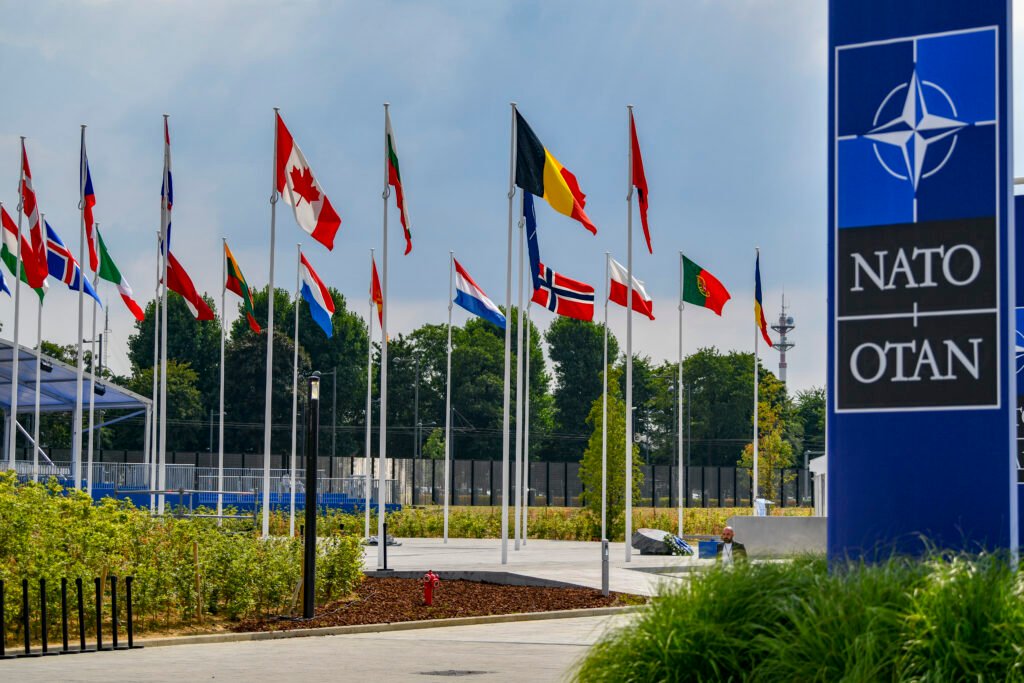
A military alliance is a formal agreement between two or more states establishing mutual obligations related to national security, typically including a commitment to come to one another’s defense if a member is attacked. Alliances let states pool military capability, share the financial and strategic burden of defense, and signal clearly to potential adversaries that an attack on one member will trigger a response from the entire group, a signal that can itself help prevent an attack from happening in the first place. Alliances can be bilateral, joining just two states, or multilateral, joining many states under a single joint command structure, and they can be formalized through a short treaty of only a few clauses or through an elaborate charter establishing permanent institutions, as NATO has done with its headquarters, integrated command, and regular consultations among member governments.
Types of alliances
Most historical and modern alliances are primarily defensive in character, obligating members to assist one another only if attacked rather than committing them to joint offensive action, though some historical alliances blended defensive and offensive elements depending on the specific circumstances that triggered them. Collective security arrangements represent a related but distinct concept, aiming to deter and respond to aggression in general, from any source, rather than binding a fixed set of allies against a specific identified rival, pursuing what scholars sometimes describe as a balance of principle rather than the shifting balance of power that characterizes more traditional alliance politics. Non-aggression pacts and ententes, looser arrangements that fall short of a full mutual-defense commitment, occupy a middle ground between a formal alliance and the absence of any security relationship at all. Asymmetric alliances, in which one much stronger partner protects a weaker one in exchange for basing rights, political alignment, or other concessions, are common throughout history and differ in character from alliances among roughly equal powers, where the obligations and expected contributions of each member are more evenly balanced.
Historical examples
The Anglo-Portuguese Alliance, dating to 1373, is generally recognized as the oldest alliance still formally in effect anywhere in the world, illustrating that some alliances can persist for centuries even as the strategic circumstances that originally produced them change beyond recognition. The Triple Alliance of 1882, binding Germany, Austria-Hungary, and Italy, was framed at the time as a means of preserving European peace, but it also helped provoke the counterbalancing Franco-Russian alliance roughly a decade later, contributing to the rigid two-bloc system of alliances that many historians cite as a key factor behind the outbreak of the First World War. The Triple Alliance of 1668, joining Great Britain, Sweden, and the Dutch Republic against the France of Louis XIV, illustrates how alliance patterns in early modern Europe shifted repeatedly as states recalculated where the greatest threat to their own security currently lay.
Why states form alliances
The most straightforward motive for forming an alliance is protection against an external threat that a state could not adequately counter relying on its own resources alone, but states also form alliances for subtler reasons, including improving diplomatic relations with a potential rival or managing an existing conflict with it through structured engagement rather than open hostility. Neorealist scholars, building on Kenneth Waltz’s balance of power theory, argue that alliances tend to form naturally in world politics as weaker states combine their strength against whichever power currently appears most threatening. Since the Second World War, alliances have increasingly been understood to function as deterrents in their own right, and recent analysis suggests that alliances, taken as a whole, measurably reduce the likelihood of war between their members and potential adversaries. Alliances can also encourage a useful division of labor, letting individual members specialize in particular military capabilities where they hold a comparative advantage rather than every member trying to maintain the full range of capabilities independently.
Recurring problems
Alliances create their own characteristic set of problems alongside their benefits. Free-riding occurs when some members contribute far less to the alliance’s shared defense burden than others while still enjoying its full protection, a persistent source of friction within long-running alliances such as NATO. Entrapment describes the risk that a state gets dragged into a conflict it would otherwise have avoided simply because an ally’s actions triggered the alliance’s mutual-defense obligations, while abandonment describes the opposite risk, that an ally fails to honor its commitments when a crisis actually arrives, leaving the attacked member to face the threat largely alone. Historical research has also linked the historically unusual prevalence of covert, undisclosed alliances in the decades before the First World War to a kind of escalating cycle, in which the existence of secret alliances created incentives for other states to seek secret alliances of their own.
FAQs
What is the oldest military alliance still in effect?
The Anglo-Portuguese Alliance, dating to 1373, is generally recognized as the oldest alliance still formally in effect anywhere in the world.
What is the difference between a military alliance and collective security?
A military alliance typically binds a fixed set of states against identified threats, while collective security aims to deter and respond to aggression from any source rather than a specific named rival.
What is free-riding in the context of alliances?
When some alliance members contribute far less to the shared defense burden than others while still enjoying the alliance’s full protection.
What is the difference between entrapment and abandonment risks in alliances?
Entrapment means being dragged into a conflict because an ally’s actions triggered alliance obligations, while abandonment means an ally fails to honor its commitments when a crisis actually arrives.
Does NATO’s Article 5 automatically commit members to military action?
Article 5 commits each member to treat an armed attack on one as an attack on all, but it leaves the specific response each member takes to its own judgment, which can range from direct military support to other forms of assistance.
Key facts
- Anglo-Portuguese Alliance (1373) is the oldest alliance still formally in effect
- Most alliances are defensive; collective security targets aggression from any source
- Triple Alliance (1882) helped produce the rigid pre-WWI two-bloc alliance system
- Free-riding, entrapment, and abandonment are recurring problems within alliances
In the news
Quick checkWhat is the oldest military alliance still in effect?Show answer
The Anglo-Portuguese Alliance, dating to 1373, is generally recognized as the oldest alliance still formally in effect.
Sources
- Wikipedia: Military Alliance
Editorially reviewed by Specialty Digest Editorial TeamLast reviewed November 2, 2026Researched and drafted with AI assistanceReport an issue