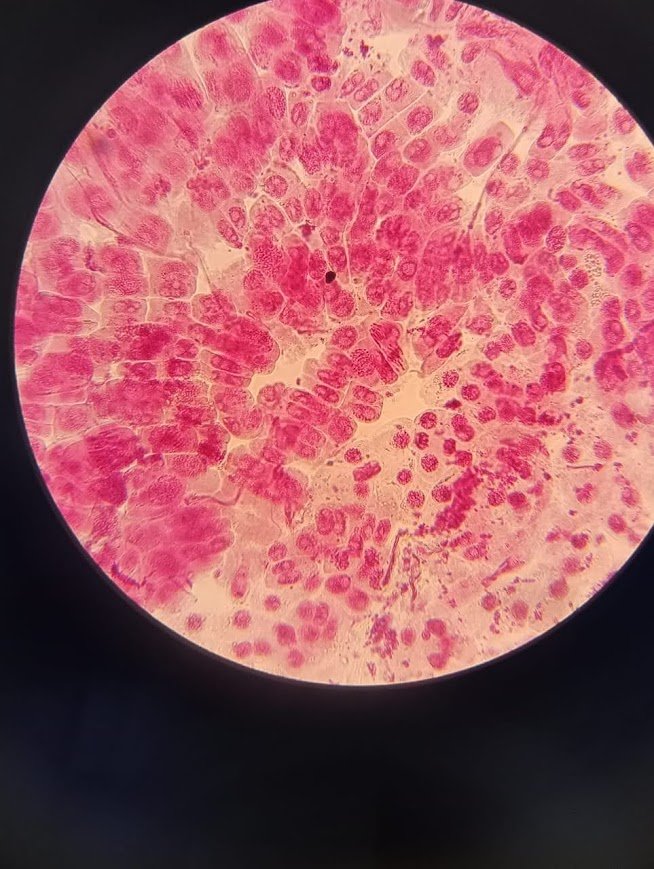
Mitosis is the process by which a single eukaryotic cell divides to produce two genetically identical daughter cells, each containing a complete copy of the original cell chromosomes. Mitosis is the mechanism behind growth, tissue repair, and the replacement of worn-out cells in multicellular organisms, and it is distinct from meiosis, the related process that produces reproductive cells with only half the usual amount of genetic material. Because mitosis must duplicate and distribute an organism entire genome accurately every time a cell divides, errors in the process are closely linked to diseases including cancer, making mitosis one of the most intensively studied processes in cell biology. A single adult human body carries out an estimated several billion mitotic divisions every day simply to replace cells that wear out through ordinary use, such as the cells lining the gut and the skin, which are replaced on a timescale of days rather than years.
The phases of mitosis
Mitosis is traditionally divided into several distinct phases. During prophase, the chromosomes condense into tightly coiled structures visible under a microscope, and the structures that will separate them, called the spindle apparatus, begin to form. During metaphase, the chromosomes align along the cell equator, attached to spindle fibers extending from opposite poles of the cell, a positioning step that cells check carefully before proceeding, since misalignment can cause chromosomes to be distributed unevenly, a condition called aneuploidy that is strongly associated with cancer when it occurs in ordinary body cells. During anaphase, the spindle fibers shorten and pull the duplicated chromosomes apart, drawing one complete set toward each end of the cell. During telophase, the chromosomes decondense, a new nuclear membrane forms around each set, and the original cell finally splits into two separate daughter cells through a process called cytokinesis.
The cell cycle and preparation for division
Mitosis itself is only one part of a larger sequence called the cell cycle, which also includes a much longer period called interphase, during which the cell grows, carries out its normal functions, and most importantly duplicates its entire set of chromosomes so that each daughter cell will receive a complete copy. The cell cycle includes several checkpoints at which the cell verifies that DNA has been copied correctly and that conditions are favorable before committing to divide, and these checkpoints rely heavily on a class of proteins called cyclins and their associated enzymes, whose rising and falling concentrations act as an internal clock driving the cell through each stage in the correct order. When these checkpoint systems fail, a cell can begin dividing uncontrollably even when it should not, which is precisely the abnormal behavior that defines cancer at the cellular level.
Mitosis versus meiosis
Mitosis produces two daughter cells that are genetically identical to the original parent cell and to each other, and it occurs in ordinary body cells throughout an organism life for growth and repair. Meiosis, by contrast, occurs only in specialized reproductive cells and produces four daughter cells, each containing only half the parent cell genetic material, through two successive rounds of division rather than one. This precise halving is essential for sexual reproduction, since it ensures that when a sperm cell and an egg cell combine during fertilization, the resulting embryo receives the correct full complement of chromosomes rather than double the normal amount. Meiosis also introduces genetic variation among offspring through a shuffling process called recombination that has no equivalent in ordinary mitotic division, which is one reason siblings who share the same two parents can nonetheless differ substantially from one another in their inherited traits.
Why mitosis matters to medicine
Cancer develops when mutations disable the normal controls that regulate mitosis, allowing cells to divide repeatedly without the usual restraints and eventually forming a tumor. Many common cancer treatments, including several widely used chemotherapy drugs, work specifically by interfering with mitosis, disrupting the spindle apparatus or blocking DNA replication in order to stop rapidly dividing cancer cells from completing division, though these treatments also affect other fast-dividing healthy cells such as those in hair follicles and the digestive lining, which is why temporary hair loss and digestive upset are such common side effects of standard chemotherapy regimens. Understanding the precise molecular checkpoints that normally prevent runaway division has become a major focus of cancer research, since drugs that restore or exploit these checkpoints offer a way to target cancer cells more selectively than older chemotherapy approaches, sparing more of the healthy, fast-dividing tissue that broader treatments tend to damage.
FAQs
What are the main phases of mitosis?
The main phases are prophase, metaphase, anaphase, and telophase, followed by cytokinesis, in which the cell physically splits into two daughter cells.
What is the difference between mitosis and meiosis?
Mitosis produces two genetically identical daughter cells for growth and repair, while meiosis produces four reproductive cells with half the usual genetic material, introducing genetic variation through recombination.
How is mitosis related to cancer?
Cancer develops when mutations disable the normal checkpoints that regulate mitosis, allowing cells to divide repeatedly and uncontrollably, which is why many cancer treatments work by interfering with the mitotic process.
What happens during interphase?
During interphase, the cell grows, carries out its normal functions, and duplicates its entire set of chromosomes in preparation for mitosis.
Can mitotic errors be inherited?
Errors that occur during mitosis in ordinary body cells generally affect only that cell and its descendants within the same organism, rather than being passed on to offspring, since inherited traits are instead determined by what happens during meiosis in reproductive cells.
Key facts
- Produces two genetically identical daughter cells from one parent cell
- Phases: prophase, metaphase, anaphase, telophase, followed by cytokinesis
- Part of the larger cell cycle, which includes interphase for growth and DNA duplication
- Distinct from meiosis, which produces reproductive cells with half the genetic material
- Failure of mitotic checkpoints is closely linked to cancer
Quick checkWhat is the difference between mitosis and meiosis?Show answer
Mitosis produces two genetically identical daughter cells for growth and repair, while meiosis produces four reproductive cells carrying half the usual genetic material.
Sources
- National Human Genome Research Institute, Mitosis; Britannica, Cell division
Editorially reviewed by Specialty Digest Editorial TeamLast reviewed November 2, 2026Researched and drafted with AI assistanceReport an issue