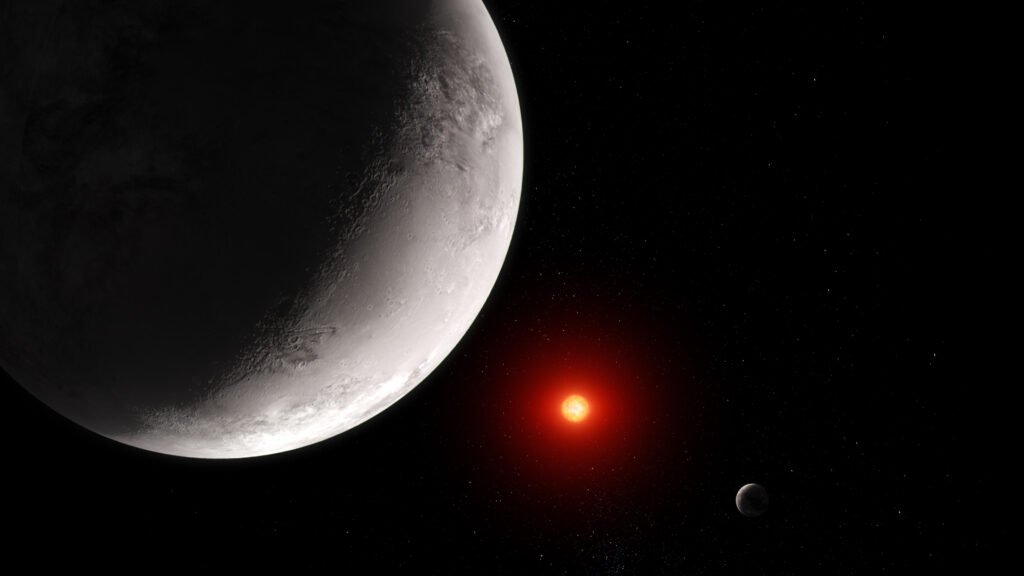
An exoplanet is a planet that orbits a star other than the Sun, situated anywhere else in the universe beyond our own solar system. Astronomers had long suspected that other stars hosted planets of their own, but the first confirmed detection of an exoplanet orbiting an ordinary, Sun-like star came only in 1995, when Swiss astronomers Michel Mayor and Didier Queloz identified a planet they named 51 Pegasi b, a discovery that earned them a share of the 2019 Nobel Prize in Physics. Since that breakthrough, astronomers have confirmed the existence of several thousand exoplanets, revealing a universe filled with planets far more numerous and far more varied in size, composition, and orbit than anything found within our own solar system. Many of these discoveries have come from dedicated space telescopes capable of monitoring tens of thousands of stars simultaneously over periods of months or years, a scale of observation that would be impossible to replicate from the ground alone.
How exoplanets are detected
Because exoplanets are extraordinarily faint compared to the bright stars they orbit, astronomers rely mainly on indirect detection methods rather than directly photographing them. The transit method, responsible for the majority of confirmed discoveries, detects a slight, periodic dimming in a star brightness as a planet passes directly in front of it from the observer point of view, a technique used extensively by NASA space telescopes designed specifically to monitor the brightness of large numbers of stars continuously. The radial velocity method instead detects the slight wobble a planet gravity induces in its host star, measured through tiny, repeating shifts in the star light spectrum, and was the method used to discover 51 Pegasi b. Direct imaging, which captures an actual picture of a planet separated from the glare of its star, remains far more difficult and has so far succeeded mainly for very large planets orbiting unusually far from their host stars, where the glare of the parent star is comparatively easier to block out using specialized instruments.
Types of exoplanets
Exoplanets display far greater diversity than the eight planets found in our own solar system. Hot Jupiters are large, gas-giant planets that orbit extremely close to their host star, completing an orbit in just days and reaching scorching surface temperatures despite their gas-giant composition, a planetary type with no equivalent among our own solar system worlds. Super-Earths are rocky planets larger than Earth but smaller than Neptune, a size category entirely absent from our own solar system yet seemingly common throughout the galaxy based on the exoplanets discovered so far. Astronomers also search specifically for planets within a star habitable zone, the range of orbital distances where surface temperatures could allow liquid water to exist, since liquid water is considered a key ingredient for life as it is understood on Earth, though some scientists caution that life elsewhere could in principle rely on chemistry quite different from anything found on Earth.
The search for habitable worlds
Identifying a planet within its star habitable zone does not by itself confirm that the planet is actually habitable, since factors such as atmospheric composition, geological activity, and the presence or absence of a protective magnetic field all influence whether liquid water could realistically persist on its surface. Space telescopes launched since the mid-2010s have been specifically designed to search nearby, relatively bright stars for small, potentially rocky planets within their habitable zones, and more advanced telescopes have begun directly analyzing the faint light passing through some exoplanet atmospheres in search of chemical signatures that might hint at biological activity. No confirmed evidence of life beyond Earth has yet been found on any exoplanet, but the rapid pace of detection and increasingly sophisticated atmospheric analysis techniques have made this search one of the most actively pursued questions in modern astronomy.
What exoplanet discoveries have revealed
Perhaps the most significant overall finding from exoplanet research is simply how common planets are, with current estimates suggesting that most stars in the galaxy host at least one planet, implying that our galaxy alone likely contains many billions of planets. The sheer diversity of confirmed exoplanets, including types with no counterpart in our own solar system, has forced astronomers to substantially revise theories of how planetary systems form and evolve, since any credible theory must now explain this much broader range of outcomes. The study of exoplanets has also matured into one of the most dynamic and rapidly advancing fields within astronomy, consistently producing new discoveries as telescope technology and data analysis techniques continue to improve, with upcoming observatories expected to extend atmospheric analysis to a much larger number of smaller, Earth-sized worlds in the years ahead.
FAQs
When was the first exoplanet discovered?
The first confirmed exoplanet orbiting an ordinary, Sun-like star, 51 Pegasi b, was discovered in 1995 by Swiss astronomers Michel Mayor and Didier Queloz.
How do astronomers detect exoplanets?
Mainly through the transit method, which detects periodic dimming as a planet passes in front of its star, and the radial velocity method, which detects a slight gravitational wobble in the host star.
What is a habitable zone?
The range of orbital distances around a star where surface temperatures could allow liquid water to exist, considered a key factor in the search for potentially habitable exoplanets.
What is a hot Jupiter?
A large, gas-giant exoplanet that orbits extremely close to its host star, completing an orbit in just days, a planetary type with no equivalent in our own solar system.
Key facts
- First confirmed exoplanet, 51 Pegasi b, discovered in 1995 by Mayor and Queloz (2019 Nobel Prize)
- Detected mainly via the transit method and the radial velocity method
- Thousands of exoplanets confirmed, showing far more diversity than our solar system
- Habitable zone: orbital range where liquid water could exist on a planet surface
- Most stars in the galaxy are now thought to host at least one planet
In the news
Quick checkWhat is a habitable zone?Show answer
The range of orbital distances around a star where surface temperatures could allow liquid water to exist on a planet.
Sources
- Nobel Prize in Physics 2019; NASA Exoplanet Exploration
Editorially reviewed by Specialty Digest Editorial TeamLast reviewed November 2, 2026Researched and drafted with AI assistanceReport an issue