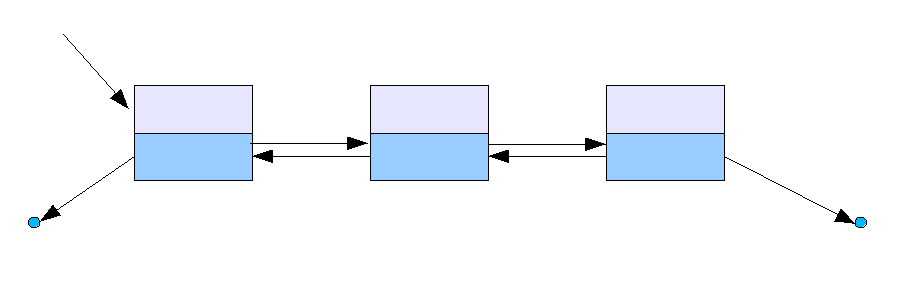
A data structure is a specific way of organizing, storing, and accessing data inside a computer so that operations on that data, such as searching, inserting, deleting, or sorting, can be carried out efficiently. Rather than treating information as an undifferentiated block, a data structure arranges values into a defined shape, for example a line, a tree, or a web of connections, so that a program can predict how long an operation will take and how much memory it will use. Every piece of software, from a simple contact list to a search engine ranking billions of web pages, relies on some combination of data structures chosen to match the task at hand.
Common Types
The most basic data structure is the array, a fixed-size block of memory holding elements of the same type that can be accessed instantly by position, or index. Arrays are fast for reading a known position but costly to resize or to insert into the middle. The linked list solves the resizing problem by storing each element, or node, together with a pointer to the next node, allowing the list to grow or shrink without moving existing data, at the cost of slower access to any specific position. Stacks and queues restrict how data can enter and leave a collection: a stack follows last-in-first-out order, much like a stack of plates, while a queue follows first-in-first-out order, much like a line at a checkout counter. Both appear constantly inside compilers, web browsers, and operating systems to manage tasks that must happen in a strict sequence.
Trees organize data hierarchically, with a single root node branching into child nodes. A binary search tree keeps every value in its left branch smaller than the node above it and every value in its right branch larger, which lets a program find any value by repeatedly halving the range to search, similar to the strategy used in binary search. Hash tables take a different approach entirely: a mathematical function called a hash function converts each piece of data into a number that points directly to a storage slot, making lookup close to instantaneous regardless of how much data is stored. Graphs, the most general structure, represent nodes connected by edges with no required hierarchy, which makes them suited to modeling road networks, social connections, or the links between web pages.
Why the Choice Matters
Choosing the right data structure is often the single biggest factor in whether a program runs in a fraction of a second or grinds to a halt. Computer scientists describe this tradeoff using big-O notation, a shorthand for how the time or memory an operation needs grows as the amount of data grows. Searching an unsorted array for a value takes time proportional to the size of the array, written O(n), while the same search in a well-built hash table takes roughly constant time, written O(1), no matter how large the collection becomes. A programmer managing millions of records who picks the wrong structure can turn a task that should take milliseconds into one that takes minutes, and that difference can decide whether a product feels instant or unusable.
Modern programming languages ship with built-in, heavily optimized versions of the most common structures, often called collections or containers, so most developers rarely need to build a linked list or a hash table from scratch. Even so, understanding how these structures behave underneath is what separates code that merely works from code that scales to real workloads. Database systems add another layer, using specialized structures such as B-trees to keep enormous amounts of data on disk searchable in a handful of steps, and search engines use inverted indexes, a structure that maps each word to every document containing it, to answer queries across billions of pages in a fraction of a second. Even everyday tools like spell-checkers and autocomplete features depend on carefully chosen structures such as tries, which store words letter by letter along shared branches.
Frequently Asked Questions
Is a data structure the same thing as an algorithm? No. A data structure is how data is organized; an algorithm is the sequence of steps used to process that data. The two are closely linked because a given algorithm is often written to take advantage of a particular structure, but they are distinct ideas taught side by side in computer science courses.
Which data structure is fastest? There is no single fastest structure; each one trades speed in one operation for speed in another. A hash table offers very fast lookup but no natural ordering, while a balanced tree offers slightly slower lookup but keeps data sorted automatically. Selecting a structure means matching its strengths to what the program actually needs to do most often.
Do beginners need to memorize every data structure? Not every one, but a working grasp of arrays, linked lists, stacks, queues, trees, and hash tables covers the overwhelming majority of real-world programming problems and forms the foundation most technical interviews and computer science courses are built around.
How do data structures relate to computer memory? Every data structure is ultimately a pattern laid over raw memory addresses. Arrays exploit memory that sits in one unbroken block, which is why their elements can be reached instantly through simple arithmetic on the starting address. Linked structures instead scatter their elements across memory and rely on pointers to stitch them back together, trading that locality for flexibility. Understanding this underlying layout helps explain why some operations that look equally simple on paper perform very differently once real hardware, with its caches and memory hierarchy, gets involved.
Key facts
- Arrays give instant access by position but are costly to resize.
- Linked lists grow and shrink easily but access is slower.
- Hash tables provide near-instant lookup using a hash function.
- Trees organize data hierarchically for fast searching.
- Big-O notation describes how an operation's cost scales with data size.
Quick checkWhy does the choice of data structure affect how fast a program runs?Show answer
Different structures trade speed in one operation for speed in another, so picking one that matches the task keeps common operations like lookup, insertion, or sorting fast as the amount of data grows.
Sources
- Introduction to Algorithms (Cormen et al.); MIT OpenCourseWare 6.006
Editorially reviewed by Specialty Digest Editorial TeamLast reviewed November 2, 2026Researched and drafted with AI assistanceReport an issue