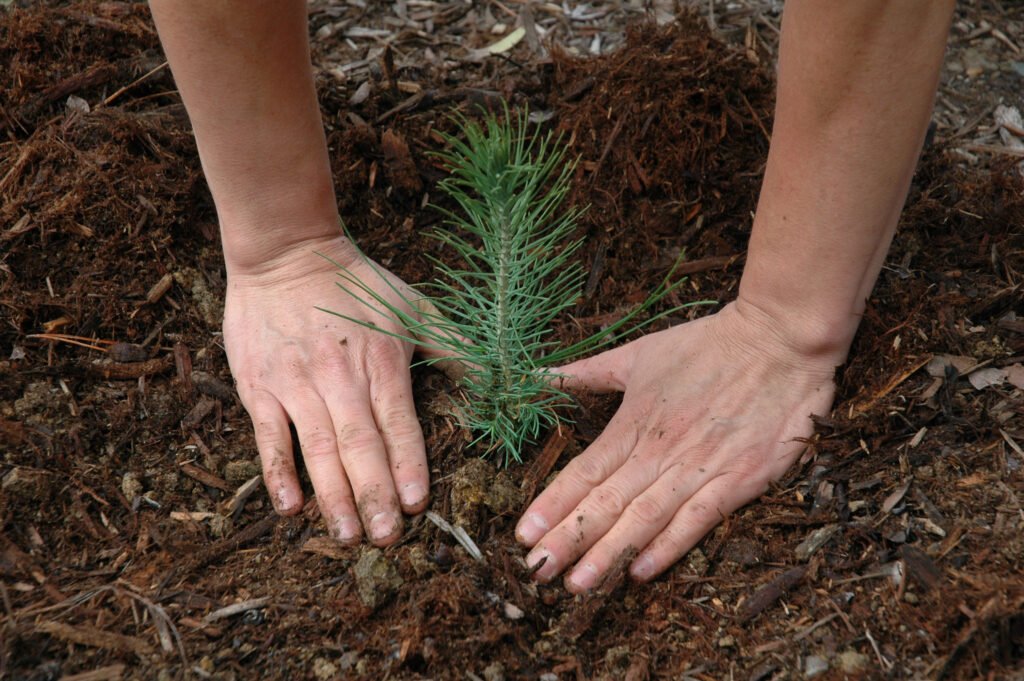
Reforestation is the practice of replanting trees in areas where forest cover has been removed by logging, fire, disease, or land-use change, restoring tree cover and the ecological functions it supports.
Methods of Reforestation
Practitioners establish new forest cover either by planting nursery-grown seedlings directly into cleared ground, by direct seeding that scatters seed across a site to germinate naturally, or by assisting natural regeneration from nearby seed sources and root sprouts already present on site. The choice of method depends on site conditions, available budget, and how quickly managers need canopy cover to re-establish, with planted seedlings generally producing faster, more predictable results than natural regeneration alone.
Reforestation Versus Afforestation
Reforestation specifically restores tree cover to land that was previously forested, distinguishing it from afforestation, which establishes forest on land that had no recent tree cover, such as converting agricultural fields or grassland into new forest. This distinction matters for carbon accounting and policy, since afforestation can change local hydrology and biodiversity in ways that simply restoring a former forest typically does not.
Climate and Carbon Role
Because growing trees absorb carbon dioxide from the atmosphere, reforestation has become a widely promoted strategy for climate mitigation, with large-scale national and international programs pledging to restore millions of hectares of degraded forest land. Critics caution that poorly planned reforestation using fast-growing monoculture plantations can deliver far less biodiversity and long-term carbon benefit than restoring a diverse, naturally structured forest.
Challenges to Successful Restoration
Reforestation efforts can fail if seedlings are planted on unsuitable soil, if invasive species outcompete young trees, or if local communities are not involved in long-term site protection, since newly planted areas remain vulnerable to grazing, fire, or renewed clearing for years before trees mature. Successful large-scale programs generally combine careful species selection suited to local conditions with sustained monitoring and community engagement well beyond the initial planting event.
Species Selection and Genetic Considerations
Choosing which species and genetic stock to plant during reforestation significantly affects long-term outcomes, since trees sourced from seed adapted to local climate and soil conditions generally establish and grow more successfully than generic nursery stock, while poorly matched species can struggle or fail entirely on a given site. Many reforestation programs now maintain seed banks and breeding programs specifically focused on producing genetically appropriate planting stock for different regions and anticipated future climate conditions.
Role of Local Communities
Reforestation projects that actively involve nearby communities in planning, planting, and ongoing protection tend to show substantially higher long-term survival rates than top-down projects imposed without local buy-in, since community members with a direct stake in the outcome are far more likely to protect young trees from grazing, fire, or illegal clearing over the years it takes for a forest to mature.
Large-Scale Restoration Pledges
International initiatives such as the Bonn Challenge have pledged to restore hundreds of millions of hectares of degraded and deforested land worldwide, drawing attention and funding to reforestation but also raising questions about how progress toward such pledges should be measured, since simply counting hectares planted says little about whether those plantings ultimately survive and mature into functioning forest.
Monoculture Versus Mixed-Species Planting
Reforestation projects face a persistent tension between fast-growing monoculture plantations, which deliver quicker carbon sequestration and timber value, and slower-establishing mixed native species plantings, which better restore biodiversity and ecosystem resilience; many contemporary programs now favor mixed approaches specifically to avoid the ecological shortcomings associated with large-scale single-species plantations.
Measuring and Verifying Success
Satellite imagery and drone-based canopy surveys have made it far easier to independently verify whether a reforestation project has actually resulted in surviving tree cover years after planting, rather than relying solely on self-reported planting counts that say nothing about long-term survival rates in the field.
Economic Incentives for Landowners
Carbon credit markets and government subsidy programs increasingly pay private landowners directly for successful reforestation, creating a financial incentive structure that did not exist a generation ago and that has drawn new categories of investors into forest restoration as a commercial activity rather than a purely philanthropic one.
Lessons From Large-Scale Failures
Several high-profile national tree-planting campaigns have fallen short of their survival targets after initial fanfare, offering cautionary lessons that planting ceremonies and headline hectare counts matter far less than sustained follow-up care, appropriate species selection, and genuine community investment in protecting young trees through their vulnerable early years.
Integrating Reforestation Into Broader Landscapes
Increasingly, planners design reforestation projects not as isolated tree-planting events but as part of broader landscape restoration plans that also address agricultural practices, watershed health, and wildlife corridor connectivity, recognizing that restoring a patch of trees in isolation delivers far less ecological value than reconnecting that patch to a larger functioning landscape.
Public Participation and Volunteer Programs
Many reforestation efforts now actively recruit volunteer planters through corporate team-building events, school programs, and community organizations, broadening public engagement with forest restoration even though volunteer-driven planting typically still requires professional oversight to ensure correct species selection and planting technique for long-term survival.
Taken together, these evolving practices show reforestation maturing from a simple planting exercise into a data-driven, community-engaged discipline with direct ties to global climate policy.
Whether through government-led national campaigns or small community nurseries, the work of putting trees back into the ground remains one of the most tangible, hands-on responses available to address both local land degradation and global climate concerns.
Measured by hectares planted or by trees still standing decades later, success in reforestation ultimately depends on the unglamorous follow-through that happens long after any planting ceremony ends.
Key facts
- Restores tree cover on previously forested land;Distinct from afforestation, which creates new forest on non-forest land;Promoted widely as a climate change mitigation strategy
Quick checkHow does reforestation differ from afforestation?Show answer
Reforestation restores tree cover on land that was previously forested, while afforestation creates forest on land with no recent tree cover
Sources
- Food and Agriculture Organization forest restoration guidance
Editorially reviewed by Specialty Digest Editorial TeamLast reviewed November 3, 2026Researched and drafted with AI assistanceReport an issue