Pick up a phone, plug in a charger or step into an elevator, and you are trusting a document most people never see. Standards are the agreed specifications behind safe sockets, cards that fit every reader, screws that match their nuts and networks that let one phone call another. Every year on October 14, the International Electrotechnical Commission (IEC), the International Organization for Standardization (ISO) and the International Telecommunication Union (ITU) celebrate World Standards Day to pay tribute, in ITU’s words, to the many thousands of experts who write them. It is a quiet day about a quiet force, and its lesson is simple: agreement is infrastructure.
A meeting in London
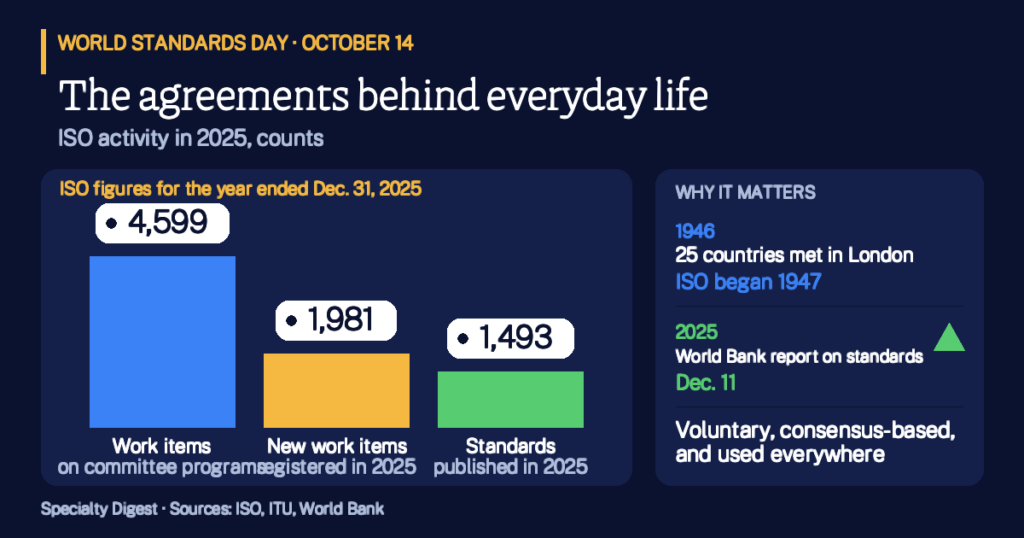
The date marks a meeting. ISO’s own account says its story began in 1946, when delegates from 25 countries met at the Institute of Civil Engineers in London and decided to create a new international organization to facilitate the international coordination and unification of industrial standards. On February 23, 1947, ISO officially began operations. According to published accounts, the first World Standards Day was celebrated in 1970, and October 14 was chosen to recall that London gathering.
International standard setting is older than ISO. ITU-T, the standards arm of ITU, says it has followed a contribution-led, consensus-based approach since ITU’s inception in 1865, and it calls itself the world’s only truly global ICT standards body. Today three organizations share the day, each with its own field.
Example 1: the plug that does not fit. Imagine a traveler who owns a laptop made in one country, a charger bought in another and a hotel socket built to a third design. Without agreed specifications, each pairing needs a custom adapter, and some pairings are unsafe. With a shared standard, the parts work together on the first try. The scenario is illustrative, but it captures the everyday value of standards: parts made by strangers fit together.
What a standard is, and what it is not
A standard is a document that sets out requirements, specifications or guidelines so that products, services and processes do what they claim. ISO leaders describe international standards as voluntary and consensus-based, and ITU describes a process in which all participants’ voices are heard and every step forward is determined by consensus. Voluntary means no standards body can force anyone to use them. They succeed because buyers, sellers and regulators find them useful, and many governments later point to them in their own rules.
ITU-T adds that international standards avoid costly market battles over preferred technologies and give companies from emerging markets a level playing field with access to new markets. That is a quiet fairness argument: a rule everyone can read is easier to meet than a secret one.
The three bodies divide the work by field, but they increasingly share projects. ITU’s 2025 message for the day pointed to a joint International AI Standards Summit planned for Seoul in December, and to a new database of AI standards.
The numbers behind the day
ISO’s own tally for 2025 shows how much quiet work the system absorbs. At December 31, 2025, its portfolio held 26,116 International Standards and standards-type documents. During 2025 it published 1,493 standards, registered 1,981 new work items and carried 4,599 work items on the programs of its technical committees, spread across 4,248 technical bodies. Behind them stand national standards bodies: ISO described a membership of 170 of them in December 2025, compared with 165 member countries cited in its 2014 World Standards Day article. The system is a federation, and each national body brings its own country’s experts to the table.
- 26,116International Standards and standards-type documents, Dec. 31, 2025
- 170national standards bodies in ISO’s membership, Dec. 2025
- 25countries sent delegates to the 1946 London meeting
- 1,493ISO standards published in 2025
Do not read these as a scoreboard. A standard is not better for being newer, and many of the most useful ones are revised rather than replaced. What the figures show is a permanent, distributed workshop that never closes.
Why standards matter for trade and development
Standards are sometimes called the hidden half of trade. The International Trade Centre has said that more than 50 percent, and in some countries as much as 70 percent, of the difficulties exporting firms face come from the technical requirements of the destination market, as reported in ISO’s magazine. The article does not date that estimate, so treat it as a broad signal rather than a current measurement.
In December 2025 the subject reached a very large stage. The World Bank described its 2025 World Development Report, titled Standards for Development, as the first time in the 45-year history of its flagship report that an edition was dedicated to international standards, and ISO joined the Bank to launch it on December 11, 2025. The Bank’s Indermit Gill suggested that the standardized shipping container may have done more for trade in manufactured goods than all trade deals combined. The report’s framework is summed up in three verbs: adapt, align and author.
Example 2: the exporter’s test bill. Suppose a small factory sells to three countries, and each requires its own testing of the same product at an illustrative cost of $4,000 per market, or $12,000 in all. If all three accept the same international standard, one test at $4,000 may do. The factory keeps $8,000 to spend on hiring or equipment. The numbers are round and made up, but they show how shared rules lower the barrier for small firms.
Who is left out of the room
Writing standards takes time, travel and technical staff, and not every country can spare them. As ISO summarized the World Bank report, many developing countries face economic and institutional constraints that limit their ability to participate in the process. That matters because the people who write a standard shape its details, from which materials qualify to which test methods count. ITU’s Seizo Onoe framed the goal as trusted technical standards “based on broader participation than ever before.” Inclusion is also practical: a standard written without a region’s conditions in mind can be hard to apply there.
Example 3: a seat at the table. Picture a country with one national standards body and four technical staff. Each international committee meeting needs a specialist, so the four can follow only a handful of the many committees that touch the country’s industries. Funding two more specialists, an illustrative step, would let it follow half again as many. Representation is a budget line before it is a principle.
How the day is marked
The three organizations issue a joint message each year, offer a free toolkit of slides and social media templates on the World Standards Day website, and pick a theme. Past themes show the range of the field.
- 2008Intelligent and sustainable buildings
- 2016How standards build trust
- 2017Standards make cities smarter
- 2018The Fourth Industrial Revolution
- 2026Spotlight on SDG 7, affordable and clean energy
In recent years the day has tied standards to the UN Sustainable Development Goals, which the organizers call highly ambitious and say will require the cooperation of many public and private partners. The 2026 spotlight on energy carries the line that clean and reliable energy is about more than electricity. Like World Water Day, it is a reminder that a goal on paper needs working systems underneath.
Key Takeaways
- Standards are agreements, not commands. They are voluntary and consensus-based, and they work because people choose to use them.
- The date comes from London. Delegates from 25 countries met there in 1946, and ISO began operating on February 23, 1947.
- Three bodies share the day. IEC, ISO and ITU celebrate it together every October 14.
- The work never stops. ISO alone published 1,493 standards in 2025 and held 26,116 documents at year end.
- Standards lower trade barriers. The International Trade Centre links over half of exporters’ difficulties to technical requirements.
- Participation decides whose needs are written in. Many developing countries face limits on joining the process.
- Notice the invisible. The next time a charger fits or a card reads on the first try, an agreement did that.
How solid is this? The ISO counts are the organization’s own figures for 2025, and the membership figures come from its news pages in 2014 and December 2025. The reason for October 14 and the 1970 first observance come from published accounts rather than a primary ISO page. The trade estimate from the International Trade Centre is undated. The three worked examples use round, made-up numbers to show an idea. See also the International Days hub and the International Days Calendar.
More in Society
- ISO, About us: the 1946 London meeting and 1947 start
- ISO, ISO in figures: 2025 data
- IEC, ISO and ITU, World Standards Day site
- ITU, Standards capture consensus on technologies for a better world (October 2025)
- ISO, World Development Report 2025: Standards for Development (December 2025)
- ITU-T, About
- ISO, ISOfocus: standards, trade and poverty reduction