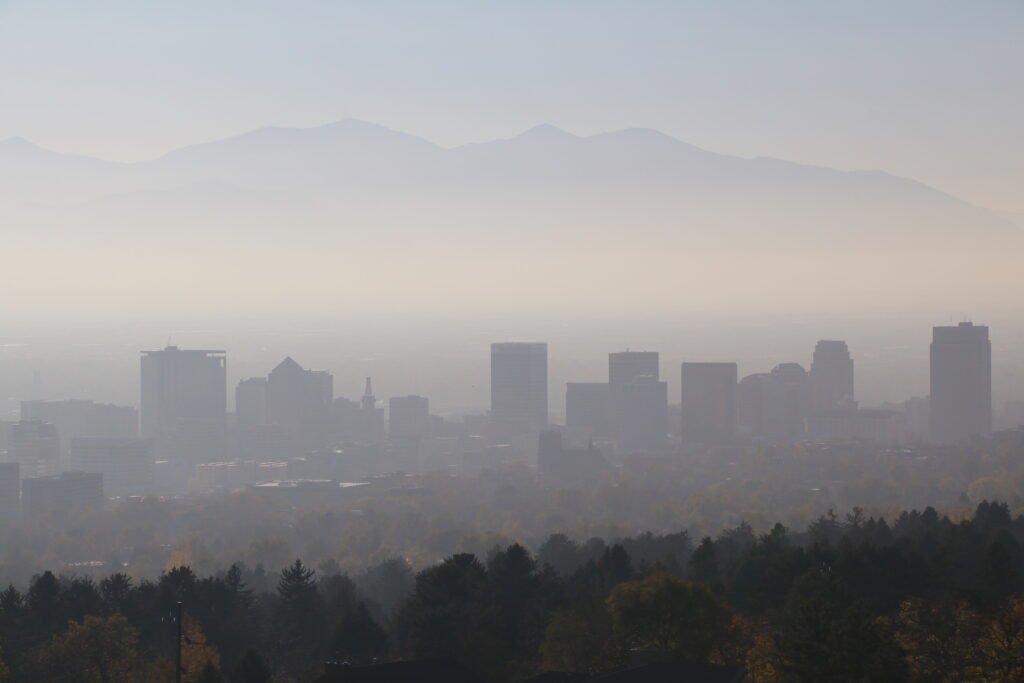
Air pollution is the contamination of indoor or outdoor air by chemical, physical, or biological agents that alter its natural characteristics, in ways that can harm human health, damage ecosystems, and affect the climate. The World Health Organization treats it as one of the largest single environmental risks to health worldwide, estimating that nearly everyone alive breathes air that exceeds its guideline limits at some point.
History of air pollution as a public health issue
Coal smoke had fouled cities for centuries, but a single event made the danger impossible to ignore. From 5 to 9 December 1952, a mix of cold weather, heavy coal burning, and a high-pressure weather system that trapped smoke over London produced what became known as the Great Smog. An estimated 4,000 people died during those five days, with delayed deaths from its long-term effects eventually bringing the toll to roughly 12,000. The British government initially resisted the idea that pollution had caused the deaths, but public pressure led to local smoke bans and, in 1956, Parliament’s Clean Air Act, which created smoke-free zones and restricted coal burning in homes and factories. The episode became one of the founding events of modern air quality regulation, and it prompted other countries, including the United States with its own Clean Air Act legislation, to adopt similar controls in the following decades.
Types of air pollution
The WHO divides air pollution into two broad categories. Ambient, or outdoor, air pollution comes mainly from burning fossil fuels in power generation, industry, and vehicles, and it affects people in high-, middle-, and low-income countries alike, in both cities and rural areas. Household, or indoor, air pollution comes mainly from burning solid fuels, such as wood, crop waste, charcoal, coal, and dung, or kerosene, in open fires or inefficient stoves used for cooking, heating, and lighting; it falls disproportionately on poorer households, and on the women and children who typically spend the most time near these fires.
Pollution levels also vary sharply by season and geography even within the same country. Vehicle and industrial emissions can combine with seasonal agricultural burning and still air to push cities such as Delhi well above WHO guideline levels for weeks at a time each winter, while coastal or well-ventilated cities with similar traffic volumes often see noticeably lower readings simply because weather disperses pollutants more effectively.
How air pollution affects health
Fine particulate matter, known as PM2.5, is small enough to enter the bloodstream and reach nearly every major organ, and it is linked to heart disease, stroke, lung cancer, and chronic respiratory disease. Larger particles, PM10, lodge deeper in the lungs and cause inflammation. Ground-level ozone is a major trigger of asthma attacks, while nitrogen dioxide and sulfur dioxide contribute to asthma, bronchial symptoms, and reduced lung function. The World Health Organization’s 2021 air quality guidelines recommend an annual average PM2.5 concentration of no more than 5 micrograms per cubic meter, a level most of the world’s population does not currently meet.
Applications and examples of air pollution’s impact
Combined outdoor and household air pollution is associated with roughly 7 million premature deaths each year by WHO estimates, with outdoor pollution alone causing about 3.68 million premature deaths annually in low- and middle-income countries, nearly eight times the toll in high-income countries. Smoke from cooking fires causes an additional estimated 3.2 million premature deaths a year, and around 2.6 billion people remain exposed to dangerous levels of household air pollution. Children are especially vulnerable: more than 440,000 children under five died prematurely in 2022 from breathing polluted air, and exposure during pregnancy may reduce birth weight.
Why air pollution matters
Air pollution and climate change share many of the same sources, since burning fossil fuels for power and transportation generates both the pollutants that damage health directly and the gases that drive the greenhouse effect. This overlap means that policies aimed at cutting one, such as shifting away from coal-fired power, often reduce the other as a side effect, which is part of why air quality and climate policy are increasingly designed together rather than as separate problems. Even so, researchers caution that progress has been uneven: regulation has sharply cut some pollutants in wealthier countries since events like the Great Smog, while household air pollution in poorer regions remains, by the WHO’s own figures, a larger overall killer than outdoor pollution in those same areas.
FAQs
What does a daily air quality index number actually mean? Most air quality indexes convert measured pollutant levels, often PM2.5 or ozone, into a single scale that typically runs from good to hazardous, making it easier for the public to judge same-day health risk without needing to interpret raw pollutant concentrations directly; the exact scale and thresholds vary somewhat by country.
Has air pollution gotten better or worse worldwide? Both, depending on where you look. Many wealthier countries have cut key pollutants sharply since events like London’s Great Smog prompted regulation, while rapid industrialization and continued reliance on solid cooking fuels have kept pollution levels high or rising in parts of the world that industrialized more recently, which is why the WHO reports that the overall health burden remains heavily concentrated in low- and middle-income countries.
Can indoor air pollution affect people in wealthier countries too? Yes, though the sources differ. While open cooking fires are rare in high-income countries, indoor pollutants there can still come from gas stoves, tobacco smoke, mold, and household chemicals, so indoor air quality remains a genuine concern even where solid-fuel cooking is uncommon.
Key facts
- London's Great Smog of December 1952 killed an estimated 4,000 people within days and roughly 12,000 in total, leading to the UK's 1956 Clean Air Act.
- The WHO divides air pollution into ambient (outdoor) and household (indoor) pollution.
- Combined outdoor and household air pollution causes about 7 million premature deaths a year, per WHO estimates.
- Fine particulate matter (PM2.5) can enter the bloodstream and is linked to heart disease, stroke, lung cancer, and chronic respiratory disease.
- The WHO's 2021 guidelines recommend an annual average PM2.5 level no higher than 5 micrograms per cubic meter.
This entry explains a medical term. It is not medical advice. If you are concerned about your health, speak with a qualified health professional.
Related concepts
Quick checkWhich kills more people globally: outdoor air pollution or household air pollution?Show answer
Outdoor (ambient) air pollution causes more deaths overall, about 3.68 million a year in low- and middle-income countries, but household air pollution from cooking fires still causes a large additional toll of about 3.2 million deaths a year, mostly in poorer regions.
Sources
- World Health Organization. How air pollution is destroying our health. 2024 (accessed 2026-11-01)
- World Health Organization. Air pollution. 2024 (accessed 2026-11-01)
- London Museum. The Great Smog of 1952. 2023 (accessed 2026-11-01)
Editorially reviewed by Specialty Digest Editorial TeamLast reviewed November 1, 2026Researched and drafted with AI assistanceReport an issue