Animation is the technique of creating the illusion of movement by displaying a rapid sequence of still images, each slightly different from the one before it, so that the human eye and brain perceive continuous motion rather than a series of separate pictures. Animation can be created through drawing, painting, physical models, computer-generated imagery, or many other methods, and it has been used for everything from short comic entertainment to feature-length films, television series, visual effects within live-action movies, and interactive video games.
Early experiments and devices
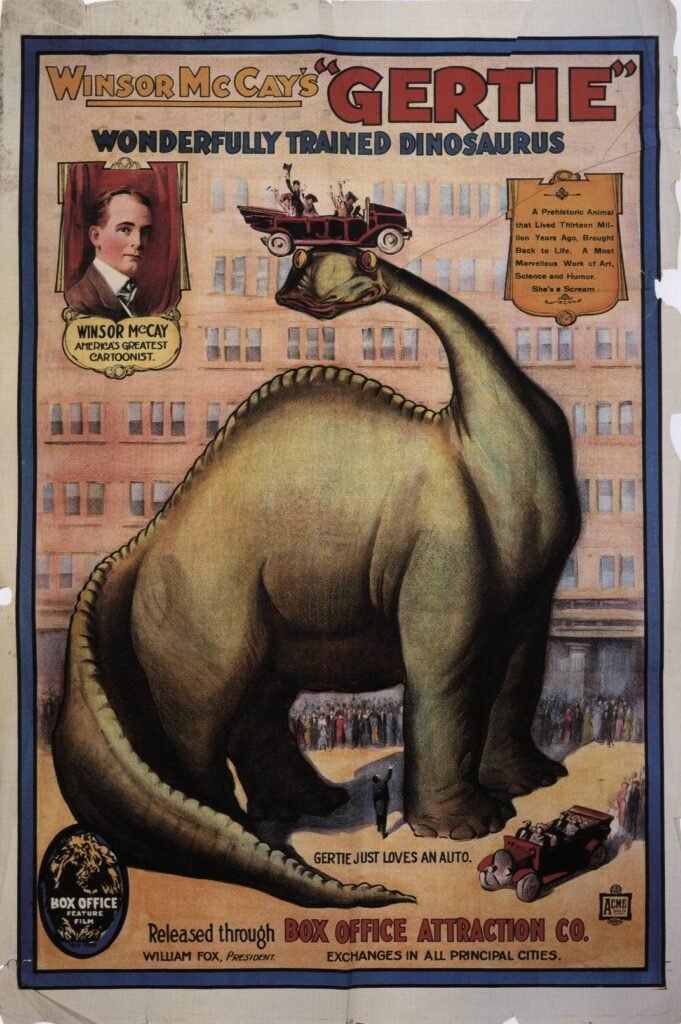
Before film cameras existed, nineteenth-century inventors developed mechanical devices such as the zoetrope, a spinning cylinder with a sequence of images visible through slits that created the illusion of motion when viewed while rotating, demonstrating the basic perceptual principle animation would later rely on using actual film. Once motion picture cameras became available, pioneers such as the American cartoonist Winsor McCay produced some of the earliest celebrated animated films, including Gertie the Dinosaur in 1914, which combined hand-drawn animation with McCay’s own live stage performance interacting with the animated character, an early demonstration of how animated characters could be given the appearance of real, individual personality rather than simply moving shapes.
Cel animation and the rise of the animated short
Cel animation, the dominant technique for hand-drawn animation through most of the twentieth century, involves drawing each character or moving element on a separate transparent sheet, originally made of celluloid, that could be layered over a static painted background and photographed one frame at a time, allowing animators to redraw only the moving elements rather than an entire scene for every single frame. This technique made producing animated films dramatically more efficient than redrawing complete scenes repeatedly, and animation studios through the 1920s and 1930s, especially in the United States, used it to produce large numbers of short animated cartoons, often shown before feature films in theaters, establishing many of the visual and comedic conventions associated with classic cartoon animation.
Snow White and the first animated feature
Walt Disney’s Snow White and the Seven Dwarfs, released on December 21, 1937, is widely credited as the first full-length animated feature film produced in the United States, a landmark that proved animation could sustain a feature-length narrative rather than only short comic entertainment. The production was a massive undertaking for its time: story work began in 1934 and full animation work in 1936, more than 750 artists contributed to the film, animators produced over one million individual drawings, and studio chemists mixed more than 1,500 distinct paint shades to achieve the film’s Technicolor visuals. Though Disney initially budgeted roughly 500,000 dollars for the project, the final cost rose to about 1,488,000 dollars, a substantial sum for the era, but the film earned 8.5 million dollars in its first release, briefly making it the highest-grossing film ever made until Gone with the Wind surpassed it two years later, and its success paved the way for Disney’s subsequent animated features, including Pinocchio and Fantasia.
From hand-drawn to computer-generated animation
Animation technique shifted dramatically again in the final decades of the twentieth century with the rise of computer-generated imagery, commonly abbreviated CGI, which uses software to model, render, and animate characters and environments digitally rather than drawing or photographing physical artwork frame by frame. Pixar’s Toy Story, released in 1995, became the first feature-length film animated entirely using computer-generated imagery, demonstrating that digital techniques could produce a complete, commercially successful feature and triggering a broad industry shift toward CGI for many major animated productions in the decades since, even as hand-drawn, stop-motion, and other traditional animation techniques have continued alongside it rather than disappearing entirely.
The twelve basic principles of animation
In 1981, longtime Disney animators Frank Thomas and Ollie Johnston published “The Illusion of Life: Disney Animation,” a book that codified twelve principles of animation their colleagues at the studio had developed and refined since the 1930s to make drawn movement feel more convincing and alive. The principles include squash and stretch, which exaggerates an object’s shape during fast movement to suggest flexibility and weight; anticipation, a small preparatory movement before a main action that helps a viewer read what is about to happen; and timing, the number of drawings used for an action, which determines how heavy, fast, or deliberate a movement appears. Other principles, such as follow-through and overlapping action, exaggeration, and appeal, address how secondary parts of a body continue moving after a main action stops, how far a pose or action can be pushed for dramatic or comic effect, and what makes a character pleasing for an audience to watch. Although developed specifically for hand-drawn cel animation at Disney, the twelve principles are still widely taught in animation schools and applied, often with modification, to stop-motion and computer-generated animation as well.
Animation beyond entertainment
Beyond films, television, and games, animation techniques serve many practical purposes, including scientific and medical visualization that shows processes too small, slow, or complex to film directly, educational content that illustrates abstract concepts visually, and user interface design, where small animated transitions help guide a viewer’s attention and clarify how a digital interface responds to interaction, reflecting animation’s broader usefulness as a visual communication tool well beyond its origins in short comic entertainment.
FAQs
Was Snow White and the Seven Dwarfs the very first animated feature film ever made anywhere? It is widely credited as the first full-length animated feature produced in the United States and by a major studio using cel animation at that scale; some earlier feature-length animated films were produced elsewhere, but Snow White is generally considered the landmark that proved the format’s commercial viability.
Did computer-generated animation completely replace hand-drawn animation? No; while CGI became dominant for many major studio productions after Toy Story’s 1995 success, hand-drawn, stop-motion, and other traditional animation techniques have continued to be used, often for stylistic reasons or by studios and filmmakers specifically choosing those techniques over CGI.
Key facts
- Winsor McCay's Gertie the Dinosaur (1914) is an early landmark animated film
- Snow White and the Seven Dwarfs (1937) was the first full-length US animated feature
- Snow White used 750+ artists and over 1 million drawings
- Pixar's Toy Story (1995) was the first fully CGI feature film
Related concepts
Quick checkDid computer-generated animation completely replace hand-drawn animation?Show answer
No, hand-drawn and stop-motion techniques have continued alongside CGI, often by deliberate stylistic choice.
Sources
- EBSCO Research Starters. Disney Releases Snow White and Seven Dwarfs. https://www.ebsco.com/research-starters/film/disney-releases-snow-white-and-seven-dwarfs
Editorially reviewed by Specialty Digest Editorial TeamLast reviewed November 1, 2026Researched and drafted with AI assistanceReport an issue