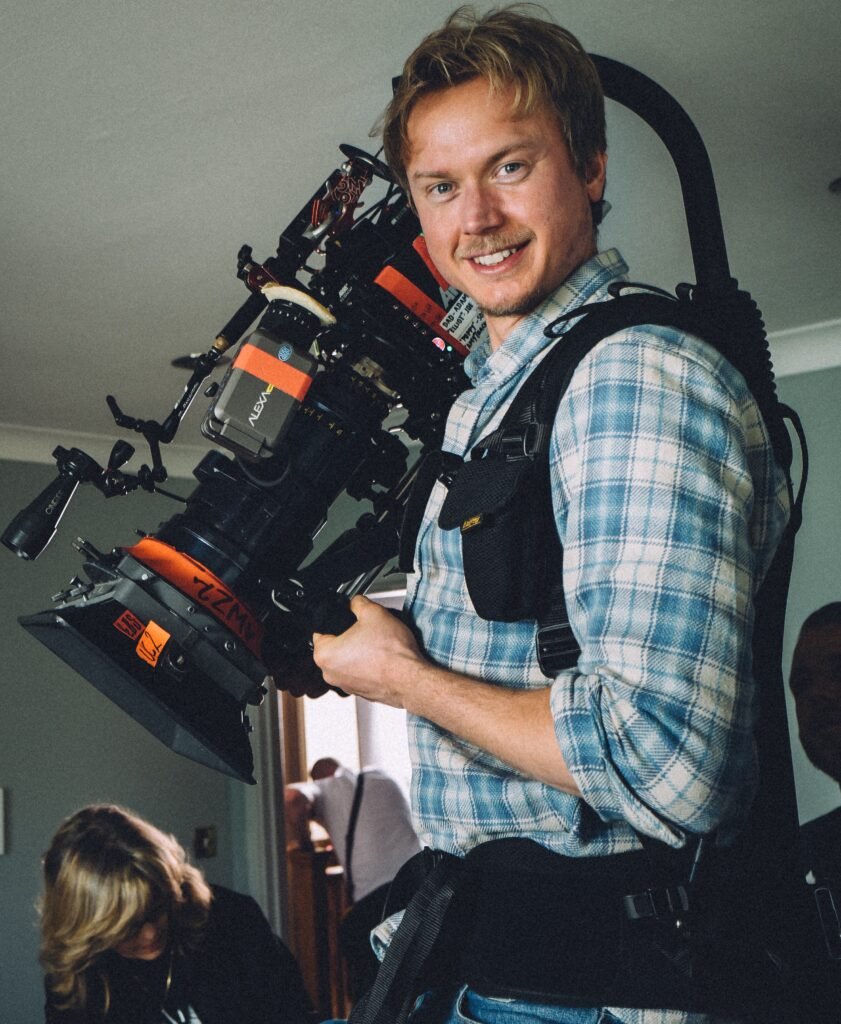
Cinematography is the art and technique of capturing moving images on film or digital sensors, encompassing how a scene is lit, framed, composed, and photographed to create a film’s overall visual style and emotional tone. The person responsible for these creative and technical decisions on a production, the cinematographer or director of photography, works closely with the director to translate the film’s intended look and feeling into specific choices about camera, lighting, and lens.
The role of the cinematographer
While the director serves as a film’s overall creative lead, the cinematographer, commonly abbreviated as DP for director of photography, is specifically in charge of how the film actually looks on screen, overseeing the camera and lighting crews and making detailed technical decisions, including film stock or digital camera settings, that directly shape a scene’s final appearance. The cinematographer and director typically collaborate closely during pre-production to establish a visual plan for the entire film, then the cinematographer executes and adapts that plan on set day to day, often making rapid creative decisions under significant time and budget pressure during actual filming.
Lighting: the foundation of cinematography
Lighting is one of cinematography’s most fundamental tools, and the standard starting point taught throughout the industry is three-point lighting, which uses a key light as the main source of illumination on a subject, a fill light positioned to soften and reduce the harsh shadows the key light creates, and a back light placed behind the subject to separate it visually from the background and add a sense of depth. Cinematographers deliberately vary and depart from this standard setup to create specific moods: a low-key lighting approach, using a strong key light with minimal fill, produces dramatic, high-contrast shadows well suited to crime dramas, horror, and film noir, while a high-key approach, using bright, even key and fill lighting with few deep shadows, suits comedies, musicals, and other lighter genres.
Camera movement and composition
Cinematographers also control how the camera itself moves and frames a scene. Basic camera movements include the pan, rotating the camera horizontally from a fixed position; the tilt, rotating it vertically from a fixed position; the dolly, physically moving the camera itself, often on wheels or tracks, to reveal new parts of a scene or follow a moving subject; and the zoom, which changes the lens’s focal length to make a subject appear closer or farther without physically moving the camera. Shot composition choices, including the distance of a shot, ranging from an extreme wide shot establishing a full location down to an extreme close-up isolating a small detail or expression, and camera angle, such as a low angle that can make a character appear powerful or threatening or a high angle that can make a character appear small or vulnerable, give cinematographers a rich visual vocabulary for shaping how an audience perceives characters and events without any dialogue at all.
Lens choice and depth of field
The specific lens a cinematographer selects for a given shot significantly affects the final image’s character, including how much of the scene appears in sharp focus at once, called depth of field, and how background and foreground elements relate to one another visually. A wide-angle lens captures a broad field of view and tends to exaggerate the sense of depth and distance between foreground and background elements, while a telephoto lens narrows the field of view and tends to compress that same sense of depth, making background elements appear closer to the foreground than they actually are, a visual effect cinematographers use deliberately to shape how spacious or claustrophobic a scene feels.
From black and white to color
For roughly the first four decades of narrative filmmaking, cinematographers worked exclusively in black and white, developing sophisticated techniques for using light, shadow, and tonal contrast to convey mood and depth without any color information at all. The introduction and gradual industry-wide adoption of color processes, most notably Technicolor from the 1930s onward, added an entirely new creative dimension cinematographers had to master, including how to use color contrast and color-based symbolism alongside the lighting and composition techniques already developed for black and white film, and many productions continued choosing to shoot in black and white deliberately for decades afterward when the stylistic or budgetary circumstances called for it rather than treating color as an automatic upgrade.
Cinematography’s relationship to genre and era
Distinctive visual styles have become closely associated with particular film genres and historical periods, in large part because of consistent cinematographic choices made across many films within those categories. Film noir of the 1940s and 1950s is instantly recognizable for its low-key lighting, deep shadows, and stark contrast, closely tied to the genre’s crime and moral ambiguity themes, while big-budget studio musicals of the same general era favored bright, even, high-key lighting well suited to their generally upbeat tone and elaborate costumes and sets. As digital cameras and lighting technology have evolved, cinematographers have gained new tools and flexibility, but the underlying creative principles of lighting, composition, and lens choice established over cinema’s first several decades continue to guide how visual style is planned and executed today.
FAQs
Is the cinematographer the same person as the camera operator? Not necessarily; on larger productions, the cinematographer or director of photography oversees the overall visual plan and lighting while a separate camera operator physically handles the camera during filming, though on smaller productions one person sometimes fills both roles.
Why does film noir look so different from a typical musical or comedy? Film noir relies heavily on low-key lighting with minimal fill light to create dramatic shadows and high contrast suited to its crime and moral-ambiguity themes, while musicals and comedies typically use high-key lighting with bright, even illumination and few deep shadows to match their lighter tone.
Key facts
- Led by the cinematographer / director of photography (DP)
- Three-point lighting (key, fill, back light) is the standard base setup
- Low-key lighting suits noir/horror; high-key suits comedy/musicals
- Lens choice (wide-angle vs telephoto) controls perceived depth of field
Related concepts
Quick checkIs the cinematographer the same person as the camera operator?Show answer
Not necessarily; on larger productions these are separate roles, though smaller productions sometimes combine them.
Sources
- Exploring Movie Construction and Production (Pressbooks). What Is Cinematography?. https://ecampusontario.pressbooks.pub/movieconstruction/chapter/6-what-is-cinematography/
Editorially reviewed by Specialty Digest Editorial TeamLast reviewed November 1, 2026Researched and drafted with AI assistanceReport an issue