Overview
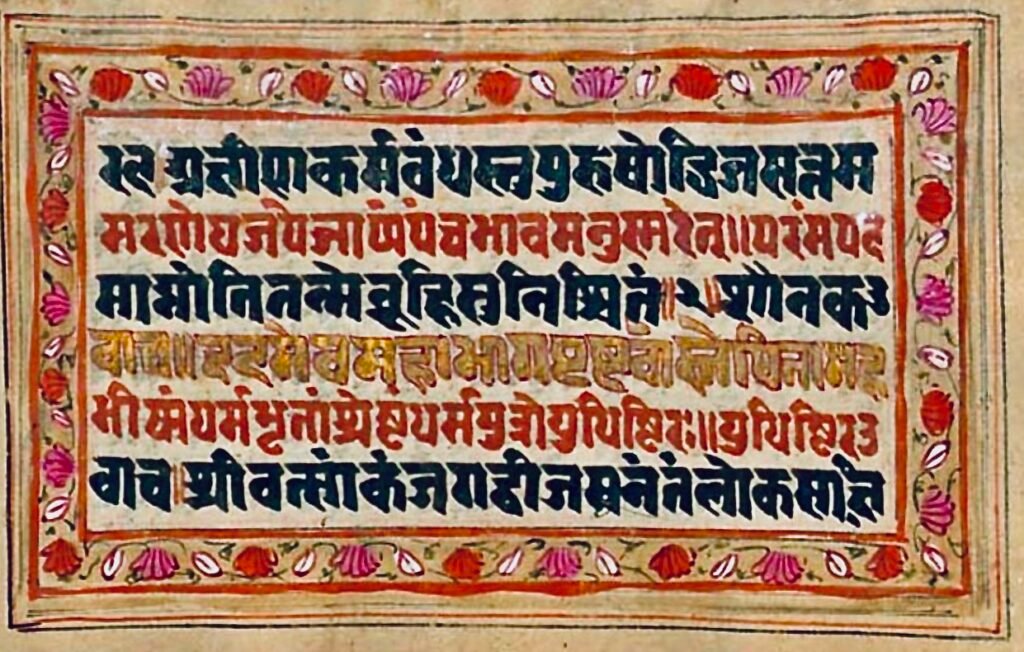
The Bhagavad Gita, often called simply the Gita, is a 700-verse Sanskrit scripture embedded within the sixth book of the Mahabharata, one of the great epics of ancient India. It presents a philosophical dialogue between Prince Arjuna and his charioteer, the god Krishna, delivered on the eve of a great battle. Though framed as a battlefield conversation, the text addresses timeless questions of duty, action, and the nature of the self.
Narrative Setting
As two opposing armies face each other at Kurukshetra, Arjuna grows paralyzed by the prospect of fighting kinsmen and teachers arrayed on the other side. He turns to Krishna for guidance, and what follows is Krishna revealing himself as divine while instructing Arjuna on the paths available for living a righteous life amid moral complexity.
Core Teachings
The Gita outlines several yogas, or disciplines, for spiritual realization: karma yoga, selfless action performed without attachment to outcome; bhakti yoga, devotion to the divine; and jnana yoga, the path of knowledge and discernment. Central to its teaching is the idea that a person should perform duty, or dharma, without craving the fruits of action, surrendering results to a higher order.
Philosophical Themes
The text addresses the immortality of the soul, the cycle of rebirth, and the relationship between the individual self and ultimate reality. The revelation by Krishna of his cosmic form in the eleventh chapter is considered one of the most striking theophanies in world scripture, illustrating the blend found throughout the text of narrative drama and metaphysical instruction.
Influence and Commentary
The Gita has attracted commentary from major Hindu philosophical schools, including the non-dualist interpretations of Shankara and the devotional readings of Ramanuja. Beyond India, it influenced thinkers such as Mahatma Gandhi, who drew on its teaching of selfless action, and found readers among Western philosophers and writers captivated by its synthesis of ethics and metaphysics.
Role Today
The Bhagavad Gita remains one of the most widely read and translated texts of Hindu tradition, studied both as scripture within devotional practice and as philosophical literature in academic settings across the world. Its guidance on duty amid difficulty continues to resonate well beyond the original religious context.
Manuscript and Textual History
As part of the Mahabharata, the Bhagavad Gita has been transmitted within a vast epic tradition that itself grew through oral performance over many centuries before achieving a more fixed written form. Scholars continue to study how the dialogue came to occupy its current position within the larger epic narrative and how its philosophical content relates to surrounding material concerned primarily with war, kinship, and political intrigue.
Sanskrit commentarial tradition surrounding the Gita is extensive, with major philosophers across competing schools of Vedanta thought offering readings that support their own broader theological positions. This has made the text a central reference point in debates over the nature of ultimate reality, the status of the individual self, and the proper relationship between action and liberation within Hindu philosophy.
Global Reception
Beyond South Asia, the Gita became an important touchstone for nineteenth and twentieth century intellectual exchange, read by European philosophers interested in Indian thought and later embraced within global literature on spirituality and self-development. Numerous English translations have appeared over the past two centuries, each reflecting different interpretive choices about how to render its philosophical vocabulary into accessible modern language.
Structure in Detail
The text divides into eighteen chapters, each traditionally treated as a distinct yoga or teaching unit, moving from Arjuna initial despair through successive instructions on selfless action, devotion, meditation, and ultimate knowledge. This structured progression has made the Gita useful as a staged guide for spiritual development, studied chapter by chapter in many devotional and academic settings around the world today.
Modern yoga traditions outside India have also drawn selectively on Gita concepts, particularly karma yoga and the idea of disciplined, detached action, incorporating them into broader frameworks of personal development only loosely tied to the original devotional and philosophical context from which these ideas first emerged within classical Hindu thought.
Within Indian independence movements, several leading figures drew on the text as a source of ethical guidance for engaged, principled action amid political struggle, reading its teaching on duty as compatible with nonviolent resistance even though the narrative setting itself concerns a literal battlefield and armed conflict between kinsmen.
It remains a touchstone for ethical reflection well beyond its original setting.
Contemporary readers, religious and secular alike, continue to find its treatment of duty and inner steadiness relevant to modern dilemmas.
Few short texts have traveled so far beyond their original cultural setting while retaining such depth.
New translations and commentaries continue to appear nearly every year, a sign of its enduring and wide reach.
Performance and Recitation
In addition to being studied as philosophical literature, the Gita verses are often chanted in devotional settings, with particular passages memorized and recited during daily prayer by practicing Hindus across India and within diaspora communities maintaining these devotional practices abroad.
These performative traditions keep the text alive as lived devotion rather than purely abstract philosophical reading.
Key Dialogue Partners
The dramatic tension of the dialogue depends heavily on the contrast between Arjuna, caught in grief and doubt, and Krishna, speaking with calm philosophical authority. This dynamic between a struggling human figure and a divine teacher has made the text a model for instructional dialogue found elsewhere within Indian religious literature more broadly.
Readers across centuries have returned to this exchange as a model for facing hard choices with clarity rather than paralysis.
Key facts
- Array
Quick checkIn what larger work is the Bhagavad Gita found?Show answer
It appears as an episode within the Mahabharata, one of the two great Sanskrit epics of ancient India.
Sources
- Array
Editorially reviewed by Specialty Digest Editorial TeamLast reviewed November 4, 2026Researched and drafted with AI assistanceReport an issue