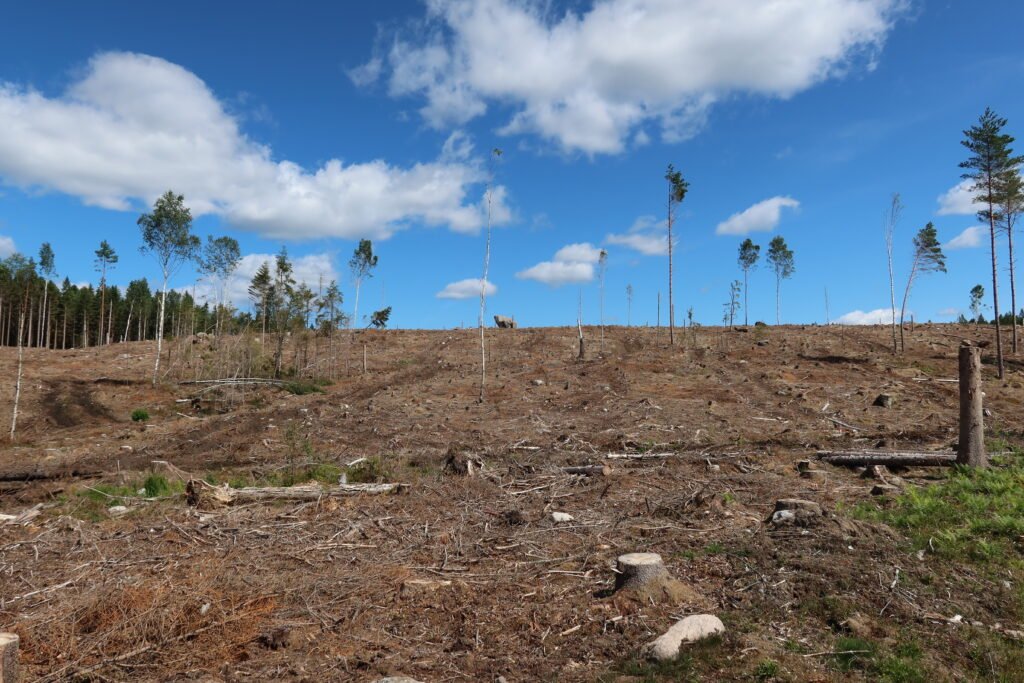
Clear-cutting is a forest harvesting method in which all or nearly all trees in a designated area are removed in a single operation, leaving an open site that then regenerates naturally or through replanting.
Why Clear-Cutting Is Used
Foresters favor clear-cutting for tree species that require full sunlight to regenerate, such as aspen and lodgepole pine, since removing the entire canopy mimics the open conditions created by natural disturbances like wildfire or windstorms. The method is also more economically efficient than selective harvesting, since it allows heavy equipment to operate across a site without navigating around standing trees.
Environmental Effects
Removing an entire stand at once can increase soil erosion, disrupt wildlife habitat, and temporarily raise stream temperatures by eliminating shade, effects that are most pronounced when clear-cuts are large or located near waterways. Modern forestry regulations in most jurisdictions limit clear-cut size, require buffer strips along streams, and mandate prompt replanting to limit these impacts compared with unregulated historical practice.
Comparison With Alternative Methods
Selective logging and shelterwood cutting remove only a portion of the stand, preserving more continuous canopy cover and generally causing less disturbance, but these methods are slower, costlier, and unsuitable for shade-intolerant species that cannot regenerate under a partial canopy. The choice between clear-cutting and partial-removal methods therefore depends heavily on the biology of the target species and the landowner’s management objectives.
Regeneration and Public Perception
After a clear-cut, land managers typically replant seedlings or rely on natural seeding from nearby trees, and well-managed sites can return to productive forest within a few decades. Despite this, clear-cutting remains one of the most visually striking and publicly controversial forestry practices, often drawing stronger opposition than its ecological footprint alone would predict, particularly in areas valued for recreation or scenic tourism.
Regulatory Limits on Clear-Cut Size
Most jurisdictions with active forestry regulation cap the maximum size of a single clear-cut, often to a few dozen hectares, and require a minimum distance or time interval before adjacent stands can also be clear-cut, preventing a landscape from being stripped of continuous forest cover across too wide an area at once. These rules aim to preserve wildlife corridors and limit the cumulative watershed impact that can occur when multiple large clear-cuts occur close together within the same drainage.
Post-Harvest Site Preparation
After a clear-cut, crews often conduct site preparation such as removing logging debris, controlling competing brush, or lightly disturbing the soil to expose mineral ground that favors seed germination, steps that significantly influence how quickly and successfully the site regenerates. Failure to adequately prepare a clear-cut site can allow aggressive brush or invasive species to dominate before tree seedlings establish, delaying forest recovery by years or even decades in difficult sites.
Wildlife Response to Clear-Cutting
Wildlife response to clear-cutting varies sharply by species: animals that depend on mature forest canopy, such as certain owl species, decline in freshly cut areas, while species favoring open, shrubby habitat, including many deer and some songbirds, can thrive in the early regrowth stage that follows a clear-cut. This variation means a landscape with a mix of clear-cut ages alongside uncut mature stands can support a broader range of wildlife than a uniformly managed forest of any single type.
Historical Context and Policy Evolution
Clear-cutting was once the dominant harvesting method across much of North America’s industrial timberland through the mid-twentieth century, but public backlash over large, visible clear-cuts during the 1960s and 1970s drove many of the size limits, buffer requirements, and visual screening rules that now constrain the practice. This history illustrates how public perception, not just ecological science alone, has shaped the regulatory framework governing modern clear-cutting.
Today, foresters generally treat clear-cutting as one tool among several rather than a default approach, reserving it specifically for stands and species where its ecological benefits genuinely outweigh its visual and short-term environmental costs.
Alternative Even-Aged Methods
Variants such as seed-tree cutting, which leaves a small number of mature trees standing to provide seed for natural regeneration, and shelterwood cutting, which removes the canopy in stages over several years, offer intermediate options between full clear-cutting and selective harvesting, each suited to particular species and site conditions. Foresters choose among these even-aged regeneration methods based on the specific light and soil requirements of the tree species they are trying to regenerate on a given site.
Visual Screening and Landscape Design
In areas valued for scenery or tourism, foresters sometimes design clear-cut boundaries to follow natural terrain features or leave screening strips of standing trees along roads and trails, reducing the visual impact of harvesting without necessarily reducing its ecological footprint. This landscape-conscious approach to clear-cut layout reflects growing attention to how forestry operations are perceived by the public, not just how they perform against purely ecological or economic criteria.
Understanding when clear-cutting genuinely serves forest health, rather than simply offering the cheapest extraction method, remains central to responsible forest management decisions today.
Equipment Innovations
Advances in feller-buncher and skidder design have steadily reduced the time and soil disturbance associated with clear-cut operations, allowing modern crews to harvest larger volumes with a lighter physical footprint per unit of timber removed than equipment from even a few decades ago.
With these continued refinements, clear-cutting remains likely to persist as a specialized tool for specific species and site conditions rather than disappearing from the forester’s toolkit entirely.
These incremental gains in machinery efficiency and site planning continue to make clear-cutting a steadily less disruptive operation than it was in past decades, even as the fundamental technique remains unchanged.
Key facts
- Used for shade-intolerant species needing full sun to regenerate;Can increase erosion and disrupt habitat without safeguards;Regulated through buffer strips and replanting requirements
Quick checkWhy do foresters use clear-cutting for certain tree species?Show answer
Because those species need full sunlight to regenerate, similar to conditions after a natural disturbance
Sources
- U.S. Forest Service silviculture guidelines
Editorially reviewed by Specialty Digest Editorial TeamLast reviewed November 3, 2026Researched and drafted with AI assistanceReport an issue