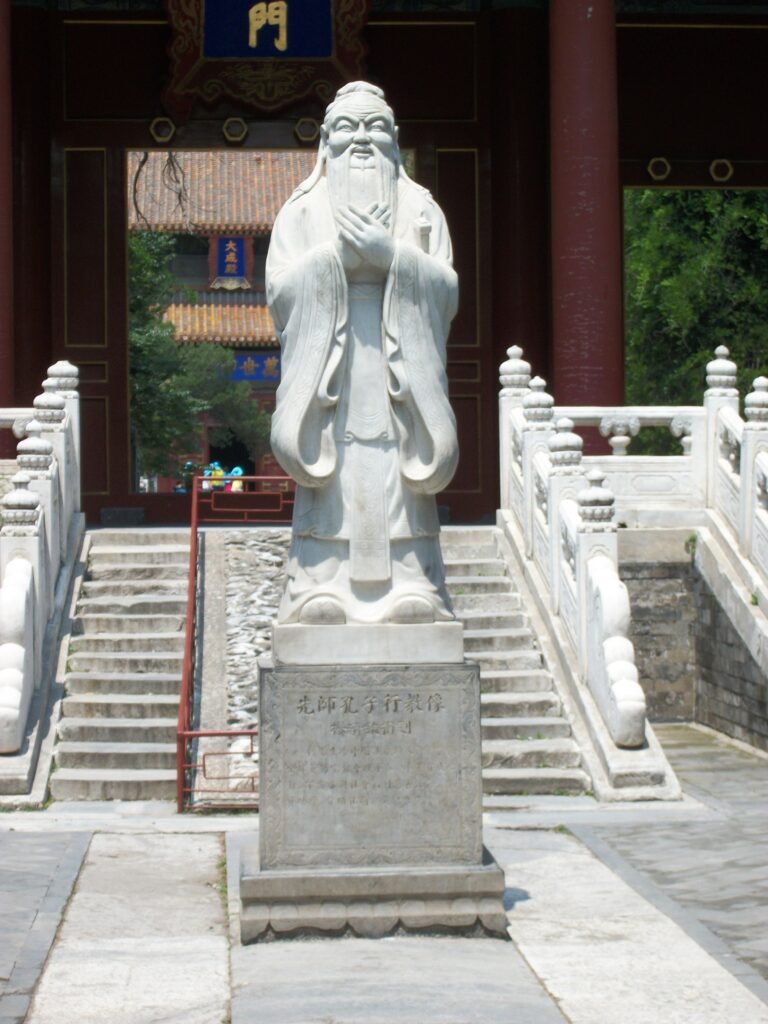
Overview
Confucianism is an East Asian tradition of ethical and social thought traced to the teachings of Confucius, a philosopher and teacher who lived in the state of Lu during a period of political fragmentation in ancient China. Rather than focusing on the worship of a single deity, Confucianism concentrates on how individuals should conduct themselves within family, community, and government to produce a harmonious and well-ordered society.
Core Teachings
Central to Confucian thought is the idea of ren, often translated as benevolence or humaneness, alongside li, the proper performance of ritual and social custom. Confucius taught that cultivating virtue begins with the individual and radiates outward, first through filial piety toward parents and respect for elders, then through loyalty and fairness in wider social and political relationships.
Practices and Rituals
Historically, Confucian practice included formal rites honoring ancestors and Confucius himself, performed at family altars and dedicated temples. Education played an equally central role, since mastering the Confucian classics was long the main pathway into government service across imperial China, reinforcing the tradition influence on statecraft as much as personal ethics.
Historical Development
After a period of suppression, Confucian thought was revived and elaborated by later scholars, eventually becoming the official state philosophy of several Chinese dynasties. It spread alongside Chinese cultural influence into Korea, Japan, and Vietnam, where it shaped legal codes, educational systems, and expectations around family hierarchy for centuries.
Role Today
Confucian values around education, family obligation, and social order remain influential across East Asia even where formal religious practice has declined. Contemporary discussions of Confucianism range from academic philosophy to its invocation in debates about national identity and governance in modern China.
Confucianism and the State
Across many dynasties, mastery of Confucian classics determined entry into the civil service through rigorous imperial examinations, linking personal moral cultivation directly to political power and social advancement. This examination system shaped Chinese elite culture for over a thousand years, rewarding literary and philosophical learning over hereditary privilege alone, even as it also entrenched a particular vision of social hierarchy rooted in Confucian relationships between ruler and subject, parent and child, husband and wife, elder and younger, and friend and friend.
Comparison with Other Traditions
Confucianism is often discussed alongside Daoism and Buddhism as one of the three major philosophical and religious streams of traditional Chinese thought, and the three have historically coexisted and influenced one another rather than existing as strictly separate competing systems. Many Chinese households and communities blended Confucian social ethics with Daoist or Buddhist spiritual practice, treating the traditions as complementary rather than mutually exclusive.
Key Texts
The Analects, a collection of sayings and ideas attributed to Confucius and recorded by his students, remains the foundational text of the tradition, supplemented by later works such as the Mencius and the Doctrine of the Mean. Together these texts, known as the Four Books once a core curriculum for aspiring officials, outline a vision of self-cultivation that moves outward from the individual to the family, the state, and ultimately the wider world.
Modern Reassessment
Confucianism faced significant criticism and even active suppression during periods of rapid modernization and political upheaval in twentieth-century China, viewed by some reformers as an obstacle to progress and equality. In recent decades, however, interest in Confucian thought has revived considerably, both as a subject of academic study and as a reference point in broader conversations about ethics, governance, and cultural identity across East Asia.
Family and Social Roles
Confucian thought places great weight on five key relationships, between ruler and subject, parent and child, husband and wife, elder and younger sibling, and friend and friend, each carrying specific reciprocal obligations intended to maintain social harmony. Critics have long debated whether this framework, particularly its traditional treatment of gender and hierarchy, remains appropriate for contemporary societies, prompting ongoing reinterpretation among modern scholars sympathetic to Confucian ethics.
Global Reception
Confucian institutes established by China in recent decades have promoted the study of Confucian thought and Chinese language and culture around the world, though these efforts have also sparked debate over the relationship between cultural diplomacy and political influence. Regardless of these contemporary debates, Confucian ideas about education, merit, and social responsibility continue to resonate well beyond their original East Asian context.
Enduring Legacy
Few philosophical traditions have shaped the daily lives, institutions, and self-understanding of so many people over so long a period as Confucianism has across East Asia. Its enduring emphasis on moral cultivation, respectful relationships, and the value of learning continues to inform debates about ethics and governance far beyond the tradition historical origins.
Closing Perspective
Understanding Confucianism requires holding together its roles as philosophy, ethical guide, religious practice, and political ideology all at once, since the tradition resists tidy categorization within frameworks developed primarily to describe religions elsewhere in the world. This complexity is precisely what has allowed Confucian thought to remain relevant across so many centuries and such varied social and political circumstances.
Its continued study in universities, think tanks, and policy circles across East Asia and beyond suggests Confucianism relevance has only deepened rather than faded as the region has modernized and globalized over the past century.
Readers encountering Confucian thought for the first time often find that its practical focus on everyday conduct, rather than abstract metaphysics, makes it surprisingly accessible despite its ancient origins.
This blend of accessibility and depth helps explain why Confucian ideas keep finding new audiences generation after generation.
Few other traditions have managed to remain both a living philosophy and a reference point for public policy debate across so many centuries.
Key facts
- Array
Quick checkIs Confucianism best described as a religion or a philosophy?Show answer
Scholars debate this question because Confucianism lacks a central deity and an organized clergy in the way many religions have, yet it addresses ultimate questions of morality, order, and human purpose, and historically included ritual veneration of ancestors and Confucius himself, so most specialists treat it as both an ethical philosophy and a lived religious tradition depending on context.
Sources
- Array
Editorially reviewed by Specialty Digest Editorial TeamLast reviewed November 4, 2026Researched and drafted with AI assistanceReport an issue