Economic Logic of Pricing Congestion
Congestion pricing rests on the economic principle that a driver entering an already-crowded road imposes a real cost on every other driver already on that road, through added travel time, yet typically pays nothing for that external cost under conventional free-road access. By attaching a monetary price to entering a congested zone or road during peak periods, congestion pricing aims to internalize that externality, encouraging some drivers to shift their trip to an off-peak time, switch to transit or another mode, or forgo the trip altogether, thereby reducing total congestion for everyone who still chooses to drive.
Singapore and London as Landmark Cases
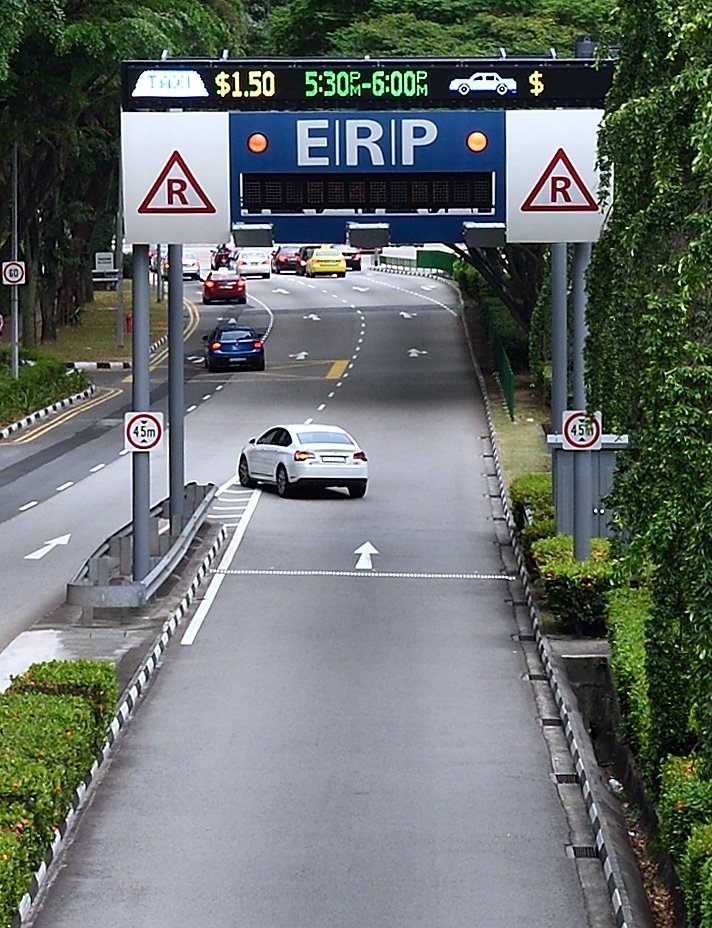
Singapore implemented the world’s first large-scale urban congestion pricing scheme in 1975, initially through a manually enforced licensing system later automated into an electronic road pricing network that varies charges by time of day and congestion level across multiple zones and expressways. London’s congestion charge zone, introduced in 2003 covering central London, became one of the most closely studied Western examples, demonstrating measurable reductions in traffic volume and improvements in bus reliability within the charged area, while also generating substantial revenue directed toward public transit investment.
Political and Equity Challenges
Despite demonstrated traffic and revenue benefits in cities that have implemented it, congestion pricing frequently faces significant political resistance, since drivers experience it as a new direct cost for behavior that was previously free, and concerns about disproportionate impact on lower-income drivers who may have fewer alternatives to driving have shaped debates in multiple cities considering similar schemes. Successful implementations have generally paired the pricing scheme with improved transit alternatives and, in some cases, discounts or exemptions for lower-income residents, aiming to address equity concerns while preserving the traffic-reduction benefits that make congestion pricing attractive to transportation planners.
Technology for Charging and Enforcement
Modern congestion pricing schemes rely on automated license plate recognition cameras or in-vehicle transponders to detect and charge vehicles entering a priced zone without requiring toll booths that would themselves create the very congestion the scheme aims to reduce. This camera-based approach, pioneered at scale in London and Stockholm, allows free-flow traffic through the zone boundary while still reliably billing registered vehicle owners, with enforcement against non-payment handled through registered-mail penalty notices similar to parking ticket enforcement rather than requiring a vehicle to stop.
Newer schemes, including New York City’s central business district tolling program, have extended this model with variable pricing by time of day, charging more during the highest-congestion hours and less or nothing overnight, aiming to more precisely match the price signal to the actual cost of driving at any given time.
Revenue Allocation and Public Trust
Because congestion pricing generates substantial toll revenue, usually running into the hundreds of millions of dollars annually in large programs, how that revenue is spent has become central to building and maintaining public support for a scheme that would otherwise be viewed purely as a new cost. Programs that transparently dedicate revenue to visible transit improvements, such as new subway cars, expanded bus service, or station accessibility upgrades within the same region generating the toll revenue, have generally maintained stronger public and political support than programs where revenue disappears into a general fund with no clear connection back to transportation users.
Exemptions for emergency vehicles, public transit, and sometimes taxis or low-emission vehicles are common features of congestion pricing schemes, reflecting policy judgments about which vehicle categories should not face the same price signal as private discretionary trips.
Effects on Traffic Patterns Beyond the Zone
Researchers studying congestion pricing schemes have found that reduced traffic within a priced zone can sometimes be partially offset by increased traffic on routes just outside the zone boundary, as some drivers reroute to avoid the charge rather than switching to transit or abandoning the trip altogether, a phenomenon that has prompted some cities to extend pricing zones or add complementary measures addressing boundary-adjacent congestion. Despite this boundary effect, most studied schemes still show a meaningful net reduction in total vehicle miles traveled across the broader metropolitan area, suggesting the mode-shift and trip-reduction effects generally outweigh the rerouting effect in aggregate.
Freight delivery vehicles operating within priced zones have received particular policy attention, since commercial deliveries cannot simply be deferred to another time as easily as discretionary personal trips, leading some cities to offer reduced commercial rates or off-peak delivery incentive programs.
Comparing Cordon and Distance-Based Approaches
Beyond the cordon-boundary model used in London and Stockholm, some schemes instead price road use based on distance traveled or specific road segments used, an approach technically more precise in matching charges to actual road use but requiring more sophisticated vehicle tracking technology and raising greater privacy concerns than a simple boundary-crossing charge. Singapore’s evolving electronic road pricing system increasingly blends elements of both approaches, charging varying rates across multiple gantries rather than a single cordon boundary, offering a middle path between simplicity and precision that other cities have studied as they design their own schemes.
Public opinion toward congestion pricing has in several cities shifted from initial opposition to majority support once residents experienced the reduced congestion and improved transit funding firsthand after implementation.
Air quality improvements within and near priced zones have been documented in several cities following congestion pricing implementation, an ancillary health benefit beyond the primary traffic and revenue goals.
Variable message signs approaching priced zones help drivers make informed decisions before committing to the charge.
Annual program reviews help cities adjust pricing levels and zone boundaries as travel patterns evolve over time.
Key facts
- Array
Quick checkWhat is the primary economic rationale behind congestion pricing?Show answer
Driving on crowded roads imposes a cost on other drivers through added delay; congestion pricing makes drivers pay a price reflecting that cost, encouraging some trips to shift time, mode, or route.
Sources
- Array
Editorially reviewed by Specialty Digest Editorial TeamLast reviewed November 4, 2026Researched and drafted with AI assistanceReport an issue