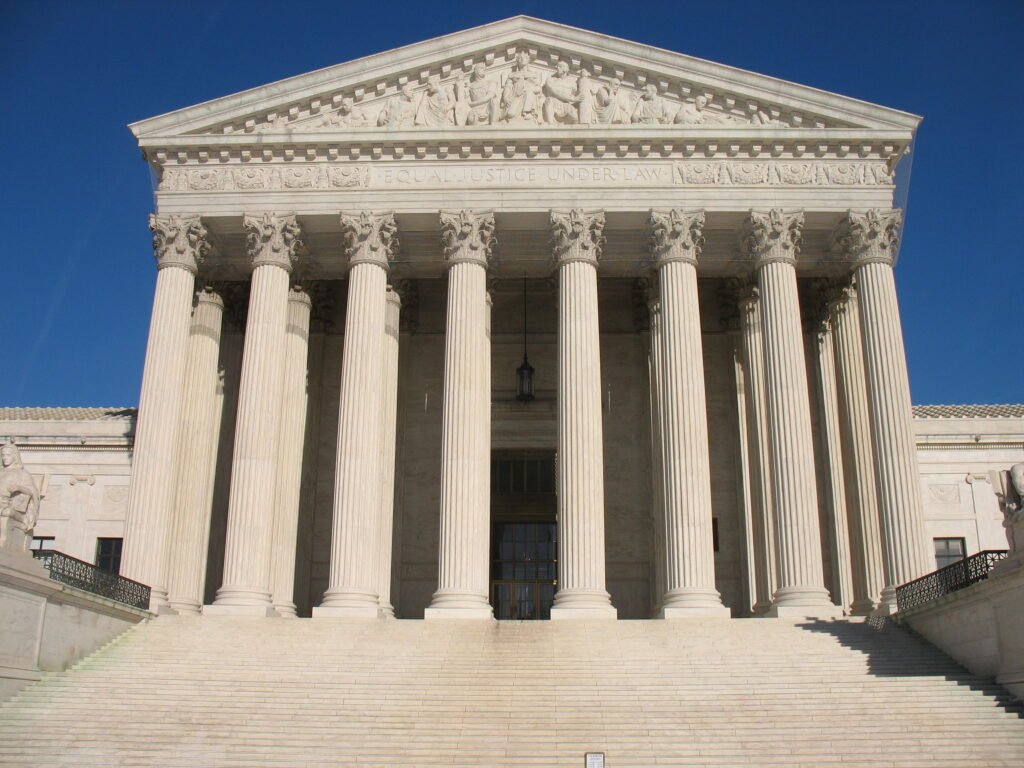
Constitutional law is the body of law concerned with interpreting and applying a country’s constitution, the foundational document that establishes how a government is structured, how power is divided among its branches, and what rights it guarantees to individuals. It sits above ordinary legislation in most legal systems, meaning that an ordinary law conflicting with the constitution can generally be struck down or declared invalid.
Core functions
Constitutional law performs several distinct functions within a legal system. It defines the basic architecture of government, establishing which institutions exist, such as a legislature, an executive, and a judiciary, and how each is selected and organized. It allocates power among these institutions and, in federal systems, between national and regional governments, specifying what each level or branch is permitted to do.
Constitutional law also typically enshrines a separation of powers among the branches of government, paired with checks and balances that allow each branch to limit the others, reducing the risk that any single branch becomes dominant. Finally, many constitutions guarantee fundamental rights to individuals, such as freedom of speech, due process, and equal protection, which constitutional law exists to interpret and enforce against government overreach.
Judicial review
Judicial review is the power of courts to examine whether government actions, including legislation and executive decisions, conform to the constitution, and to strike down those that do not. In the United States, the Supreme Court first asserted this power clearly in the 1803 case Marbury v. Madison, holding that the judiciary had authority to enforce the Constitution’s separation of powers by reviewing legislation, even though the Constitution never explicitly granted courts this role. The ruling, which neither Congress nor President Thomas Jefferson seriously contested at the time, is widely regarded as the foundation of American judicial review, even though some historians note the practice had informal precedents before 1803.
Judicial review operates quite differently across countries. In the United Kingdom, the doctrine of parliamentary sovereignty generally prevents courts from striking down Acts of Parliament outright, though they can review certain executive actions. Austria and Czechoslovakia pioneered specialized constitutional courts in 1920, following the model of legal theorist Hans Kelsen, an approach many European countries have since adopted, concentrating constitutional review in a single dedicated court rather than scattering it across the ordinary judiciary.
Judicial review around the world
India offers one of the most expansive models of judicial review among large democracies. Its Supreme Court and High Courts can invalidate legislation that conflicts with the constitution, particularly provisions protecting fundamental rights, and the landmark 1973 case Kesavananda Bharati established the basic structure doctrine, under which courts can strike down even formal constitutional amendments if they violate the constitution’s essential, unamendable core. Russia presents a more limited model: courts at every level can review legislation, but an ordinary court’s ruling binds only the parties to that specific case, while only the constitutional court’s decisions bind all judges and officials nationwide.
France and Germany each rely on specialized administrative courts, separate from their ordinary judiciary, to resolve disputes between citizens and government bodies, reflecting the continental European tradition of treating public law as a distinct field requiring its own specialized tribunals rather than folding such disputes into the general court system used for private disputes between individuals.
Sources of constitutional law
A country’s written constitution is the primary source of constitutional law, but it rarely operates alone. Judicial interpretation, built up case by case as courts apply constitutional text to new situations, fills gaps and resolves ambiguities the original drafters could not have anticipated, giving constitutional law much of its practical substance over time. Constitutional amendments, formal changes made through the procedures the constitution itself specifies, allow the document to evolve without requiring a wholesale rewrite, though many constitutions deliberately make amendment difficult, requiring supermajorities or multi-stage approval processes to protect the document’s stability.
Some countries also treat long-standing political conventions, unwritten customs that structure how government actually functions in practice, as carrying real constitutional weight even though they appear nowhere in the formal text, most notably in the United Kingdom, whose constitution is famously uncodified and instead assembled from statutes, judicial decisions, and precisely this kind of accumulated convention.
Constitutional rights protections
Beyond structuring government, constitutional law typically protects individuals against government overreach through enumerated and sometimes unenumerated rights. In the United Kingdom, the Human Rights Act 1998 allows courts to issue a declaration of incompatibility when a law conflicts with the European Convention on Human Rights, a mechanism that invites Parliament to amend the law but notably stops short of letting courts strike the legislation down outright, reflecting that country’s continued commitment to parliamentary sovereignty even within a modern rights framework. Other constitutional systems give courts more direct power to invalidate rights-violating legislation entirely, illustrating how the same underlying goal, protecting individuals from government overreach, can be pursued through meaningfully different institutional designs depending on a country’s particular constitutional history and values.
FAQs
- What is judicial review? Judicial review is the power of courts to examine whether laws and government actions conform to the constitution, and to strike down those that do not.
- What case established judicial review in the United States? The 1803 case Marbury v. Madison is widely credited with establishing the US Supreme Court’s power of judicial review, though the practice had some informal precedents beforehand.
- Do all countries let courts strike down unconstitutional laws? No. Countries like the United Kingdom limit courts to flagging incompatible laws for Parliament to address, rather than striking legislation down outright, reflecting a stronger commitment to parliamentary sovereignty than countries with more expansive judicial review.
Key facts
- Defines government structure, power allocation, separation of powers, and individual rights
- Judicial review lets courts strike down unconstitutional laws
- Marbury v. Madison (1803) established US judicial review
- Austria and Czechoslovakia pioneered specialized constitutional courts in 1920
- The UK's parliamentary sovereignty generally prevents courts from striking down Acts of Parliament
Quick checkWhat US Supreme Court case established the power of judicial review?Show answer
Marbury v. Madison (1803) is widely credited with establishing the Supreme Court's power of judicial review.
Sources
- Wikipedia, 'Judicial review', https://en.wikipedia.org/wiki/Judicial_review
Editorially reviewed by Specialty Digest Editorial TeamLast reviewed November 2, 2026Researched and drafted with AI assistanceReport an issue