Due process is the principle that government must follow fair, established legal procedures before depriving a person of life, liberty, or property, and that it must apply the law consistently and predictably rather than arbitrarily. It functions as a check on government power, balancing the state’s authority to act against the individual’s right to fair treatment under the law.
Origins in the Magna Carta
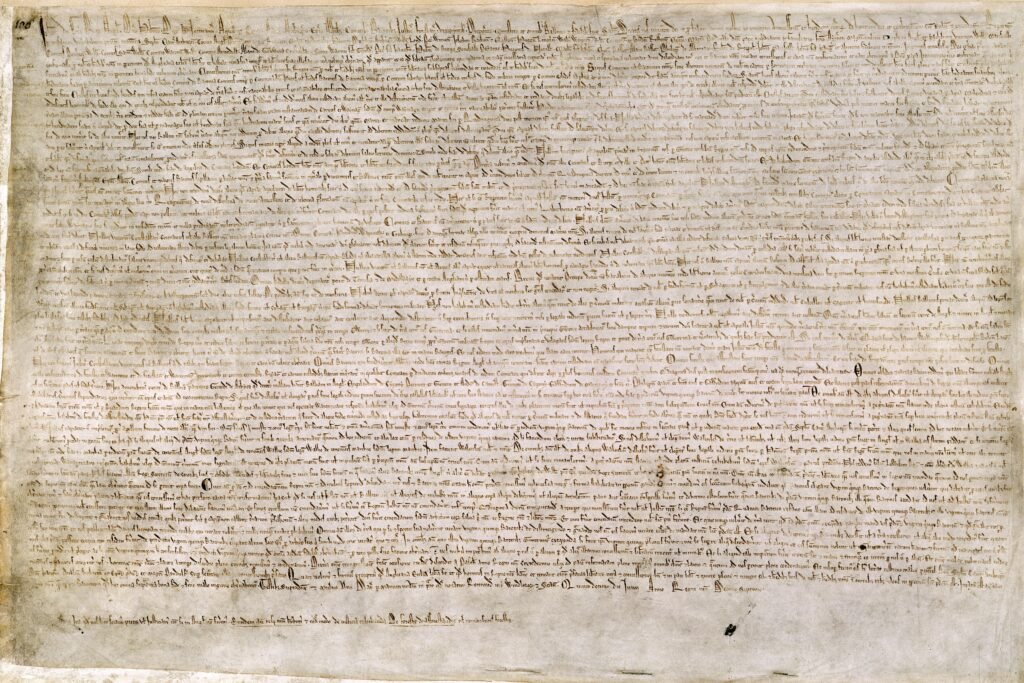
Due process traces its earliest roots to clause 39 of the Magna Carta, the charter English barons forced King John to accept in 1215, which promised that no free man would be seized, imprisoned, or stripped of his rights except by lawful judgment of his peers or by the law of the land. The specific phrase “due process of law” first appeared in a 1354 statute under King Edward III that restated this earlier guarantee in updated language. Some legal historians argue the original Magna Carta protection applied only to landowners rather than the broader population, reflecting the document’s origins in a dispute between the king and his noble barons rather than any universal conception of individual rights.
English jurist Edward Coke helped expand the doctrine in the early seventeenth century, explicitly tying the Magna Carta’s “law of the land” language to formal due course and process of law. In the 1704 case Regina v. Paty, the Queen’s Bench read this guarantee broadly to cover all laws then in force. The concept subsequently faded in England itself, however, as the rise of parliamentary supremacy and growing hostility toward judicial review led English courts to rely instead on related but distinct concepts like natural justice and the rule of law, rather than continuing to develop due process as such.
Procedural versus substantive due process
Modern due process doctrine, most fully developed in the United States, splits into two related but distinct strands. Procedural due process concerns the fairness of the actual legal proceedings used in a case, both civil and criminal, asking whether the government gave a person adequate notice and a genuine opportunity to be heard before taking action against them.
Substantive due process goes further, asking not just whether fair procedures were followed but whether the underlying law itself improperly infringes on fundamental rights or liberties, effectively allowing judges to evaluate the basic fairness and justice of a law’s substance rather than only the process used to apply it. This second strand remains considerably more controversial among legal scholars than procedural due process, since it gives judges substantial discretion to identify which rights count as sufficiently fundamental to warrant this heightened protection.
American development
Due process took a dramatically different path in the United States than it did in England. While English courts gradually moved away from actively enforcing the concept, American courts kept asserting their power to review government action against due process standards, allowing the doctrine to grow into a robust, continuously developing body of constitutional law rather than fading into disuse. The United States Constitution contains two separate Due Process Clauses: the Fifth Amendment restrains the federal government, while the Fourteenth Amendment, ratified after the Civil War, extends the same restraint to state governments.
The US Supreme Court has read these clauses as providing several distinct protections. Beyond the basic procedural and substantive strands, the Court has also used due process doctrine to strike down laws that are unconstitutionally vague, meaning they fail to give people fair notice of what conduct is actually prohibited, and to incorporate most of the protections in the Bill of Rights, which originally restrained only the federal government, against state governments as well, one of the most far-reaching applications of the due process guarantee in American constitutional history and a central reason the doctrine carries such outsized practical weight in US law today.
Why due process matters
Due process functions as one of the most basic structural safeguards against arbitrary government power, ensuring that even a government with legitimate authority to punish, regulate, or take property must still act within predictable legal bounds rather than at the unchecked discretion of individual officials. It underpins core procedural protections widely recognized across legal systems, including the right to notice of charges or claims against a person, the right to a meaningful hearing before a neutral decision-maker, and the right to present evidence and challenge the government’s case.
Because due process standards can vary significantly depending on what is at stake, a criminal trial where a person’s liberty hangs in the balance generally demands far more extensive procedural protections than a routine administrative hearing over a minor licensing dispute, reflecting a long-standing principle that the degree of process required should scale with the severity of what a person stands to lose, a balancing approach courts continue to apply when weighing new kinds of government action against individual rights.
FAQs
- Where does the concept of due process originate? Due process traces back to clause 39 of the Magna Carta in 1215, which promised that free men would not be punished except by lawful judgment or the law of the land.
- What is the difference between procedural and substantive due process? Procedural due process concerns whether fair legal procedures were followed, while substantive due process asks whether a law itself improperly infringes on fundamental rights, regardless of the procedures used to apply it.
- Which US constitutional amendments contain a Due Process Clause? The Fifth Amendment restrains the federal government and the Fourteenth Amendment, ratified after the Civil War, extends the same restraint to state governments.
Key facts
- Traces to clause 39 of the Magna Carta (1215)
- The phrase 'due process of law' first appeared in a 1354 English statute
- Splits into procedural due process (fair procedures) and substantive due process (fairness of the law itself)
- In the US, protected by the 5th and 14th Amendments
- Modern English law relies instead on natural justice and the rule of law
Quick checkWhat English document is the origin of due process?Show answer
Due process traces back to clause 39 of the Magna Carta (1215), which promised fair legal treatment under the law of the land.
Sources
- Wikipedia, 'Due process', https://en.wikipedia.org/wiki/Due_process
Editorially reviewed by Specialty Digest Editorial TeamLast reviewed November 2, 2026Researched and drafted with AI assistanceReport an issue