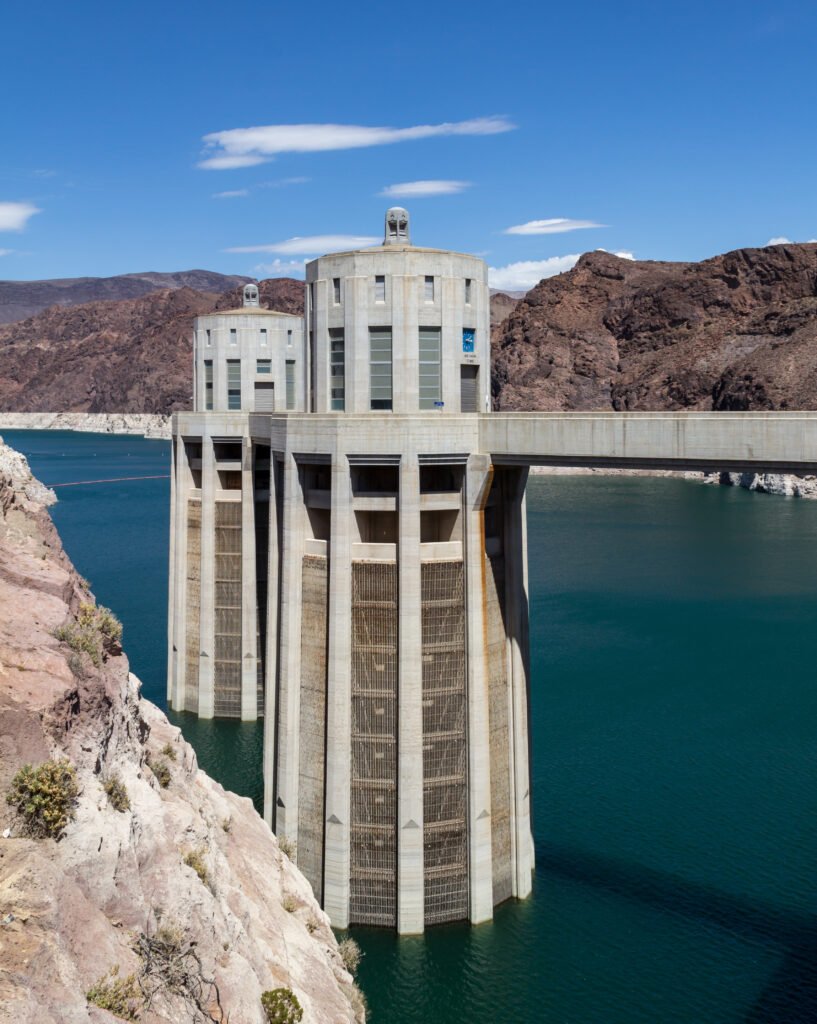
A dam is a barrier built across a river or stream to hold back water, creating a reservoir that can be used for water supply, irrigation, flood control, hydroelectric power generation, or a combination of these purposes. Dams rank among the largest structures civil engineers build, since they must hold back enormous volumes of water under constant pressure for decades or centuries without failing.
Types of Dams
Gravity dams rely on their own massive weight, usually built from concrete or masonry, to resist the pressure of water pushing against them. Embankment dams, built from compacted earth and rock, achieve a similar effect through sheer bulk and an internal waterproof core that prevents seepage through the structure. Arch dams curve against the water load, transferring pressure into the canyon walls on either side, a design that uses far less material than a gravity dam but requires a narrow, strong rock canyon to anchor against.
Why Dams Are Built
Dams serve several distinct purposes that often overlap in a single project. Water supply dams store water during wet periods for use during dry periods, essential in regions with highly seasonal rainfall. Flood control dams hold back floodwater during storms and release it gradually afterward, protecting downstream communities. Hydroelectric dams use the force of falling or flowing water to spin turbines and generate electricity, while irrigation dams divert stored water to agricultural land that would otherwise depend entirely on unpredictable rainfall.
Engineering Challenges
Dam engineers must account for enormous hydrostatic pressure that increases with water depth, seepage through and beneath the dam that can weaken its foundation over time, and the risk of overtopping during extreme floods that exceed the dam’s design capacity. Spillways, specially engineered channels that allow excess water to pass safely around or over a dam during high flow, are a critical safety feature, since a dam that cannot release floodwater fast enough risks catastrophic overtopping and failure.
Environmental and Social Impact
Large dams fundamentally alter the rivers they are built on, blocking fish migration routes, trapping sediment that would otherwise replenish downstream riverbanks and deltas, and flooding land upstream to create a reservoir, often displacing communities and ecosystems that previously occupied that land. These impacts have made large dam projects increasingly controversial, prompting many modern projects to include fish passages, sediment management plans, and extensive environmental review before construction can proceed.
Dam Safety and Failure
Although catastrophic dam failures are rare, they can be devastating given the volume of water involved, which is why dam safety has become a specialized engineering discipline of its own, involving regular inspection, instrumentation that monitors seepage and structural movement, and emergency action plans for communities located downstream. Aging infrastructure is a growing concern in many countries, where dams built decades ago now require significant investment to maintain safely as they approach or exceed their original design life.
History of Dam Building
Humans have built dams for thousands of years, with early examples used for irrigation and water storage in ancient civilizations across the Middle East, Asia, and the Mediterranean. The twentieth century brought a dramatic increase in dam size and ambition, driven by growing demand for hydroelectric power and large-scale irrigation, producing massive projects that reshaped entire river systems and, in some cases, became powerful symbols of national engineering achievement.
Dam Removal and Aging Infrastructure
In recent decades, some countries have begun removing older, smaller dams that no longer serve their original purpose or that cause environmental harm disproportionate to their benefit, particularly dams that block important fish migration routes without providing significant power, flood control, or water supply value. Dam removal restores a river’s natural flow and sediment transport, often producing rapid ecological recovery, though it also requires careful engineering to manage the sediment that has accumulated behind the dam over decades, since releasing it too quickly can harm downstream water quality and habitat.
Monitoring and Instrumentation
Modern dam safety programs rely heavily on instrumentation embedded within and around a dam structure, including piezometers that measure water pressure inside the dam and surrounding ground, and survey markers that detect even small amounts of structural movement over time. Combined with regular visual inspections by trained engineers, this data allows dam operators to catch developing problems, such as new seepage paths or shifting foundations, long before they threaten the structure’s safety, turning dam maintenance into an ongoing data-driven practice rather than a one-time construction achievement.
Dams and Regional Water Management
Beyond their individual engineering, dams are often managed as part of a broader regional water system, coordinated with other dams, reservoirs, and canals to balance competing demands for drinking water, irrigation, flood control, and power generation across an entire river basin, sometimes spanning multiple states or countries. This coordination has become increasingly important as droughts and shifting rainfall patterns strain water systems that were originally designed around historical weather patterns, pushing water managers to reconsider how reservoirs are operated and shared among competing users.
FAQs
What is the difference between a gravity dam and an arch dam?
A gravity dam relies on its own massive weight to resist water pressure, while an arch dam curves against the water load to transfer pressure into the surrounding canyon walls, using less material but requiring a narrow, strong rock foundation.
Why do dams need spillways?
Spillways allow excess water to pass safely around or over a dam during floods, preventing the dam from overtopping in an uncontrolled way that could damage or destroy the structure.
In the news
Quick checkWhy do dams need spillways?Show answer
Spillways allow excess water to pass safely around or over a dam during floods, preventing uncontrolled overtopping that could damage or destroy the structure.
Editorially reviewed by Specialty Digest Editorial TeamLast reviewed November 2, 2026Researched and drafted with AI assistanceReport an issue