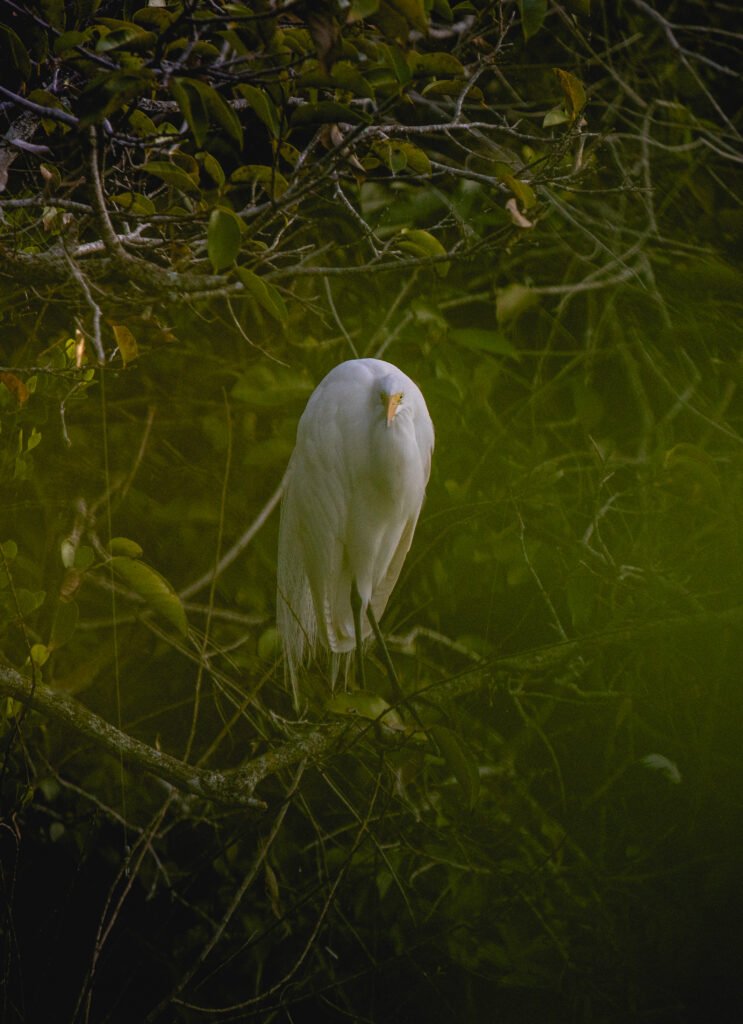
The Great Egret standing in a Florida Bay slough is, whether the photograph says so or not, standing inside the largest hydrologic restoration project ever attempted in the United States. Its presence there is not nature quietly bouncing back on its own — it is the closest thing wetland science has to a live scoreboard.
The plan behind the photograph
The Everglades that existed before large-scale drainage was a shallow, slow-moving sheet of water flowing from the Kissimmee lakes near Orlando, through Lake Okeechobee, down to Florida Bay. Twentieth-century flood-control and agricultural projects — principally the Central and Southern Florida Project, built starting in 1948 — carved that sheet flow into canals and levees, routing much of the fresh water that once fed the wetlands out to the Atlantic and the Gulf instead. By the 1990s the ecological toll was stark: wading bird nesting colonies that had once been documented in the hundreds of thousands of birds had collapsed to a small fraction of that historic scale.
Congress responded with the Comprehensive Everglades Restoration Plan (CERP), authorized under the Water Resources Development Act of 2000 and described by the National Park Service as the largest hydrologic restoration project ever undertaken in the United States. It covers 16 counties and roughly 18,000 square miles, built around a deceptively simple engineering goal: capture the fresh water currently being pumped out to tide, store it, clean it, and send it back through the system on something closer to its historical timing. Original cost estimates ran to roughly $10.5 billion; by the mid-2020s, cumulative federal and state commitments were commonly described as a $23 billion undertaking, with full build-out now projected to take on the order of 40 to 50 years rather than the 30 originally planned.
The year the birds came back
Wading birds are the metric restoration scientists watch most closely, because they sit at the top of the wetland food web and respond quickly to whether water depth and timing let fish and invertebrates concentrate into easy prey. The South Florida Water Management District has tracked nesting system-wide every year since 1996, and 2021 produced one of the best seasons on record: an estimated 102,000 wading bird nests initiated, the second-highest total since standardized counts began, and a dramatic reversal from the roughly 5,000 nests a year typical of the depressed 1980s and 1990s.
Every species tracked that year beat its own ten-year average. White ibis nesting ran to more than two and a half times its typical average; wood storks and roseate spoonbills each roughly doubled theirs; great egrets — the species standing in for the whole restoration story in this magazine’s photograph — also exceeded their historical average. About 34 percent of all nests that year were in coastal colonies, compared with roughly 10 percent five to ten years earlier, a shift researchers read as a sign that fresher water is again reaching the coastal estuaries the way it once did naturally. “Getting the water right will allow Mother Nature to take advantage of favorable conditions when presented,” said Dr. Mark Cook, the district’s lead scientist on the annual Wading Bird Report, crediting both a wet year and more than 50 restoration projects completed or advanced since 2019 — among them the Everglades Agricultural Area Reservoir and the Biscayne Bay Coastal Wetlands project.
Recovery that isn’t a straight line
The two seasons that followed complicate any tidy ending. The district’s 2022–2023 data showed nesting falling back below the ten-year average system-wide. Wood stork nests dropped by roughly a third in 2022 before recovering to about 2,800 — near their historical average — in 2023. White ibis, the most numerous nesting species most years, still accounted for roughly half to three-quarters of all nests, at close to 16,000 annually, but Cook was blunt about what raw nest counts don’t show: “For the most part, for most species, the nesting success was quite low” — meaning many nests that were started did not fledge chicks, often because shallow water dried out too early in the season to keep prey concentrated long enough to feed them.
Some of the news is unambiguous structural progress: bridging over the Tamiami Trail, the highway that for decades acted as a dam across the historical flow path into Florida Bay, has begun restoring more natural water movement toward the coast, and wood stork nesting patterns are shifting to reflect it. But Cook’s own assessment leaves little room for declaring victory: “there’s still quite a bit of restoration to do in the northern part of the system.” The honest reading of more than a decade of monitoring is neither collapse nor triumph — it is a wetland whose recovery tracks, almost mechanically, the arrival of specific engineering fixes, and stalls in the parts of the system still waiting on one.
The Great Egret itself has been through a version of this cycle before, on a longer arc. In the late 1800s, plume hunters killed egrets by the hundreds of thousands to supply the women’s-fashion trade; naturalist William Hornaday calculated that in a single nine-month period, London’s feather market alone had consumed plumes from nearly 130,000 egrets, with whole breeding colonies wiped out in a matter of days. The outcry helped found the Audubon movement and led to early federal bird-protection law, after which the species slowly recovered over the following century. Its return to a Florida Bay slough today is not the same story, but it rhymes: both recoveries required someone to deliberately stop doing the thing that caused the damage, and then wait, and keep watching to see if it worked.
Sources: South Florida Water Management District, “Above Average Rainfall, Everglades Restoration Efforts Lead to Near Record Wading Bird Nesting” (sfwmd.gov); WLRN, “A warning for the Everglades: South Florida had fewer nesting wading birds in the last two years,” March 2025 (wlrn.org); National Park Service, Comprehensive Everglades Restoration Plan overview (nps.gov); Congressional Research Service, “Comprehensive Everglades Restoration Plan” (congress.gov); Smithsonian Magazine, “How Two Women Ended the Deadly Feather Trade” (smithsonianmag.com).
- South Florida Water Management District, “Above Average Rainfall, Everglades Restoration Efforts Lead to Near Record Wading Bird Nesting,” 2021 South Florida Wading Bird Report findings. sfwmd.gov.
- WLRN Public Media, “A warning for the Everglades: South Florida had fewer nesting wading birds in the last two years,” reporting on the 2022–2023 South Florida Wading Bird Report, March 2025. wlrn.org.
- National Park Service, “Comprehensive Everglades Restoration Plan (CERP)” overview, authorized under the Water Resources Development Act of 2000. nps.gov.
- Congressional Research Service, “Comprehensive Everglades Restoration Plan,” program cost and timeline overview. congress.gov.
- Smithsonian Magazine, “How Two Women Ended the Deadly Feather Trade,” on the plume-hunting era and William Hornaday’s documentation of the egret feather trade. smithsonianmag.com.