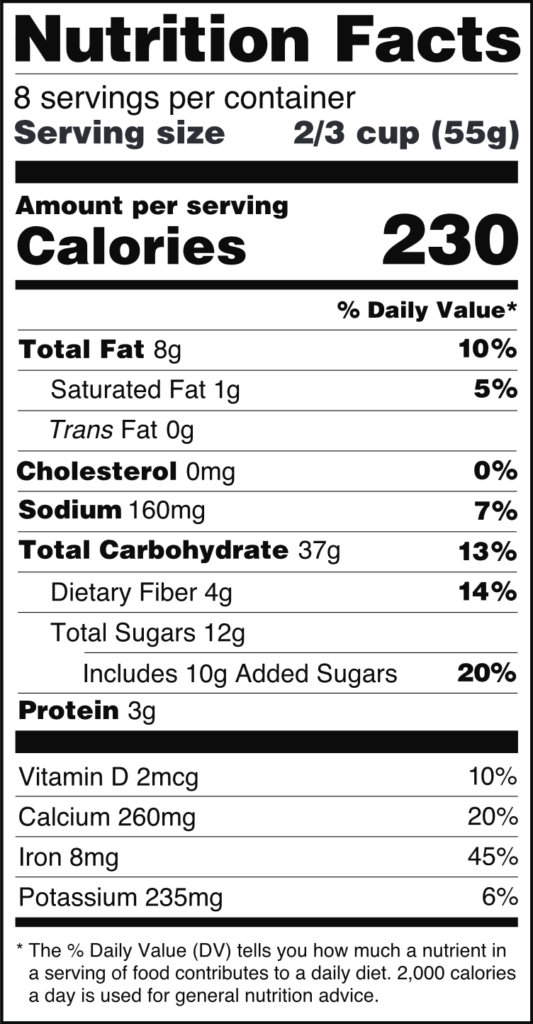
Nutrition labeling is the regulated practice of printing standardized nutritional information on packaged food, allowing consumers to compare products and make informed dietary decisions. Most countries require some form of nutrition label by law, though the exact format, required nutrients, and serving size rules vary considerably by jurisdiction.
The Nutrition Facts Label
In the United States, the Nutrition Facts label, standardized by the Food and Drug Administration, lists serving size, calories, and amounts of specific nutrients including total fat, saturated fat, cholesterol, sodium, carbohydrates, fiber, sugars, added sugars, and protein, alongside percent daily value figures showing how a serving fits into a standard reference diet. A major 2016 revision enlarged the calorie count display, added a required added sugars line distinct from total sugars, and updated serving sizes to better reflect how much people actually eat, replacing outdated reference amounts set decades earlier.
International Formats
The European Union requires a nutrition declaration per 100 grams or 100 milliliters in addition to per-serving figures, making cross-product comparison more consistent regardless of package size, a notable difference from the U.S. per-serving-only approach. Several countries have adopted front-of-package warning labels or scoring systems, such as Chile’s black stop-sign warnings for excess sugar, sodium, or saturated fat, and France’s Nutri-Score letter grading system, both designed to communicate nutrition quality at a glance without requiring consumers to parse a detailed back-of-package table.
Purpose and Criticism
Nutrition labeling exists to support informed consumer choice and to standardize health and nutrient content claims that manufacturers might otherwise exaggerate or misrepresent on packaging. Critics note that serving sizes can still mislead when a package contains several servings consumed as one, and that literacy and numeracy barriers can limit how effectively some consumers use detailed nutrition tables, a key argument behind the push toward simpler front-of-package systems in several countries.
Health and Nutrient Content Claims
Beyond the standard nutrition table, regulators also control specific wording manufacturers can use to describe a product’s health attributes, with terms like low fat, high fiber, or good source of requiring the product to meet defined nutrient thresholds before the claim can legally appear on packaging. This regulation prevents manufacturers from using vague or exaggerated health language that the underlying nutrition content does not actually support, giving consumers a more reliable basis for comparing marketing claims against a product’s real nutrient profile.
Digital and Evolving Formats
Some retailers and apps now offer digital nutrition label scanning, letting shoppers photograph a barcode to see simplified nutrition scores or personalized dietary flags, such as allergen warnings, layered on top of the standard printed label. Regulators in several countries are actively studying whether current label formats remain effective as shopping increasingly moves online, where a printed label designed for in-person inspection does not always translate cleanly to a small product thumbnail on a phone screen.
Allergen Labeling Requirements
Separate from general nutrition content, most countries require clear labeling of major food allergens, such as peanuts, tree nuts, milk, eggs, soy, wheat, fish, and shellfish, either within the ingredient list or in a dedicated allergen statement, reflecting the serious and sometimes life-threatening risk that undisclosed allergens pose to sensitive consumers. These allergen disclosure rules are generally treated as a food safety matter distinct from, though often printed alongside, the broader nutrition facts panel covering calories and nutrient content.
Label Literacy and Consumer Behavior
Research on nutrition label use finds that simply having access to detailed nutrition information does not guarantee consumers will use it effectively, with factors like time pressure while shopping, limited nutrition knowledge, and the sheer density of information on a standard label all reducing how much it actually influences purchasing decisions in practice. This gap between information availability and effective use is a central argument behind simplified front-of-package systems, which aim to convey a quick overall judgment rather than requiring a shopper to calculate percent daily values on the spot.
Looking Ahead
Regulatory agencies in several countries continue to study potential further label reforms, including possible mandatory front-of-package symbols similar to those already used in Chile and several other nations, reflecting an ongoing international trend toward simplifying how nutrition quality is communicated at the point of purchase rather than relying solely on the detailed back-of-package panel that has been standard for decades.
Whatever format ultimately prevails, nutrition labeling researchers broadly agree that the underlying goal, giving consumers an honest, usable basis for comparing food products, remains unchanged even as the specific visual and regulatory tools used to achieve it continue to shift across different countries and eras.
Small Business and Labeling Compliance
Smaller food producers sometimes qualify for simplified labeling exemptions or reduced requirements compared to large manufacturers, reflecting a regulatory tradeoff between ensuring consistent consumer information and avoiding compliance burdens that could be disproportionately difficult for small-scale producers to meet, though consumer advocates have periodically argued that such exemptions should be narrowed as nutrition labeling technology and compliance tools become more accessible and affordable even for small operations.
Online grocery platforms increasingly surface nutrition label data directly within product search and filtering tools, allowing shoppers to sort or filter by specific nutrient thresholds before ever seeing the physical package, a shift that nutrition labeling regulators are beginning to account for when considering how label requirements should apply to digital retail contexts.
Consumer testing of proposed label redesigns typically precedes formal regulatory adoption, with agencies gathering feedback on comprehension and visual clarity from diverse demographic groups before finalizing any new mandatory format, a process intended to catch confusing design choices before they reach store shelves nationally.
Key facts
- The FDA Nutrition Facts label was significantly revised in 2016.nThe EU requires per-100-gram figures in addition to per-serving data.nChile and France use front-of-package warning or scoring systems.nServing size misunderstanding remains a common criticism of standard labels.
Quick checkWhat changed in the 2016 revision of the U.S. Nutrition Facts label?Show answer
The 2016 revision enlarged the calorie display, added a required added sugars line, and updated serving sizes to better reflect actual consumption.
Sources
- FDA Nutrition Facts Label guidance, European Food Safety Authority
Editorially reviewed by Specialty Digest Editorial TeamLast reviewed November 3, 2026Researched and drafted with AI assistanceReport an issue