In simple terms A half-life is the time it takes for half the atoms of a radioactive substance to decay into something else. The count never quite finishes. After one half-life, half is left. After two, a quarter. After three, an eighth. The fraction is the same whatever amount you started with. How it works
Half-life Read More »
A half-life is the time it takes for half the atoms in a radioactive sample to decay into something else.
In simple terms An interstellar object formed around another star, was thrown out of that system, and drifted between the stars until it reached ours. It is a visitor, not a resident. The Sun bends its path but never captures it, so the object leaves again and does not return. How it works Astronomers identify
Interstellar object Read More »
An interstellar object is a comet or asteroid that formed around another star and is passing through our solar system without ever orbiting the Sun.
In simple terms Isotopes are versions of the same element. They carry the same number of protons, which is what makes them that element, but different numbers of neutrons. The International Atomic Energy Agency puts it simply: isotopes share almost the same chemical properties but differ in mass. How it works An isotope is named
Isotope Read More »
Isotopes are atoms of the same element with the same number of protons but different numbers of neutrons, so they differ in mass.
In simple terms A survey asks some people, not everyone. Ask a different sample and the answer would come out a little differently. The margin of error puts a size on that wobble. It does not say the survey is wrong. It says how precise the number is. How it works Sampling error is the
Margin of error Read More »
A margin of error shows how far a survey estimate could sit from the true population value simply because only a sample was measured.
In simple terms Marie Curie was a physicist and chemist whose research on radioactivity transformed science’s understanding of the atom, and who became the first person to win Nobel Prizes in two different scientific fields. [2] Life and work Born Maria Sklodowska in Warsaw in 1867, she moved to Paris to study physics and mathematics,
Marie Curie Read More »
Marie Curie was a physicist and chemist who pioneered research on radioactivity and became the first person to win Nobel Prizes in two different sciences.
In simple terms A meta-analysis pools the results of several studies that asked the same question. It treats them as one larger body of evidence. The output is a single summary figure, reported with a confidence interval that shows how much uncertainty is left. How it works A meta-analysis normally sits inside a systematic review.
Meta-analysis Read More »
A meta-analysis statistically combines the results of two or more separate studies to produce a single, more precise estimate of an effect.
In simple terms Almost all of a person’s DNA sits in the nucleus of each cell. A small amount sits somewhere else, inside the mitochondria. Mitochondria are the structures that convert energy from food into a form cells can use. They carry a little DNA of their own, called mitochondrial DNA, or mtDNA. How it
Mitochondrial DNA Read More »
Mitochondrial DNA is a small, separate loop of DNA inside a cell's mitochondria, inherited almost entirely from the mother.
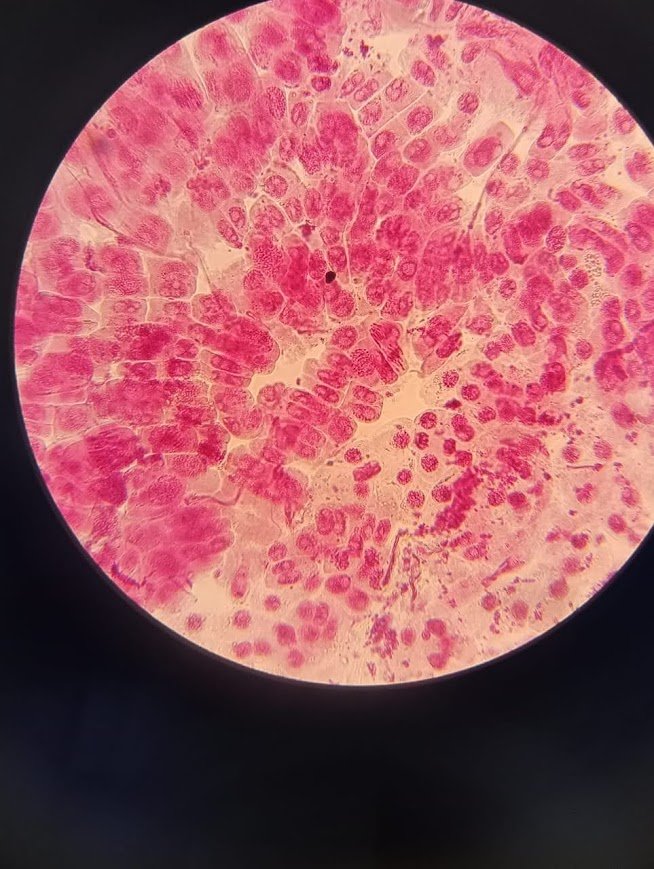
Mitosis is the process by which a single eukaryotic cell divides to produce two genetically identical daughter cells, each containing a complete copy of the original cell chromosomes. Mitosis is the mechanism behind growth, tissue repair, and the replacement of worn-out cells in multicellular organisms, and it is distinct from meiosis, the related process that
Mitosis Read More »
The process by which a eukaryotic cell divides to produce two genetically identical daughter cells.
In simple terms A mole is a counting unit for very small things. One mole is a fixed number of particles, the way a dozen is a fixed number of eggs. The number is enormous because atoms are tiny. NIST calls the mole a shorthand way to talk about huge numbers, especially of tiny things.
Mole (chemistry) Read More »
A mole is the SI unit of amount of substance: exactly 6.02214076 times 10 to the power 23 entities, such as atoms, molecules or ions.
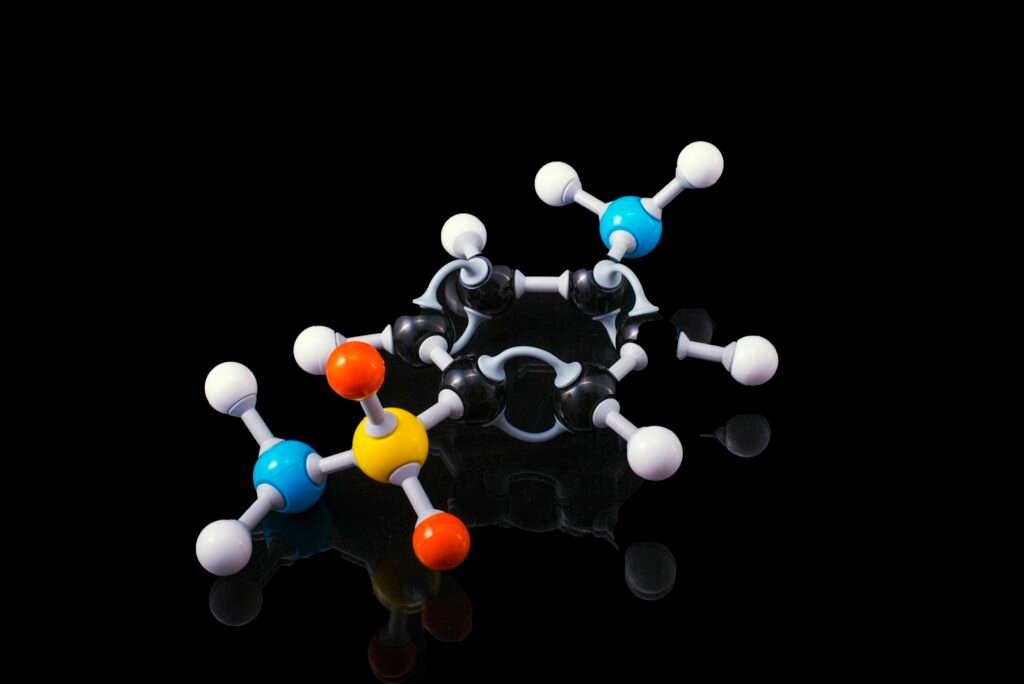
In simple terms A molecule is a group of atoms bonded together and behaving as one unit. Water is the familiar case: hydrogen and oxygen atoms joined into a single particle. The atoms on their own are gases with nothing watery about them. How it works IUPAC, the body that sets chemical terminology, defines a
Molecule Read More »
A molecule is an electrically neutral group of two or more atoms held together as a single unit by chemical bonds.