World War I was a global conflict fought from 1914 to 1918, primarily centered in Europe but drawing in colonies and allies from across the world, that pitted the Allied Powers, principally France, the British Empire, Russia, and later the United States and Italy, against the Central Powers, principally Germany, Austria-Hungary, and the Ottoman Empire. The war began after the assassination of Archduke Franz Ferdinand of Austria-Hungary by a Bosnian Serb nationalist in Sarajevo in June 1914, which triggered a rapid chain of diplomatic ultimatums and alliance obligations that drew the major European powers into conflict within weeks.
Although the assassination was the immediate trigger, historians generally point to deeper underlying causes that had been building for decades, including intense militarism and arms races among the great powers, a rigid system of competing alliances that turned a regional crisis into a continental war, aggressive nationalism, and imperial rivalries over colonies and global influence. No single cause is treated as sufficient on its own, and historians continue to debate how much weight to assign each factor, with some emphasizing structural pressures built up over decades and others stressing the specific decisions made by political and military leaders during the crisis of July 1914.
Trench Warfare and the Western Front
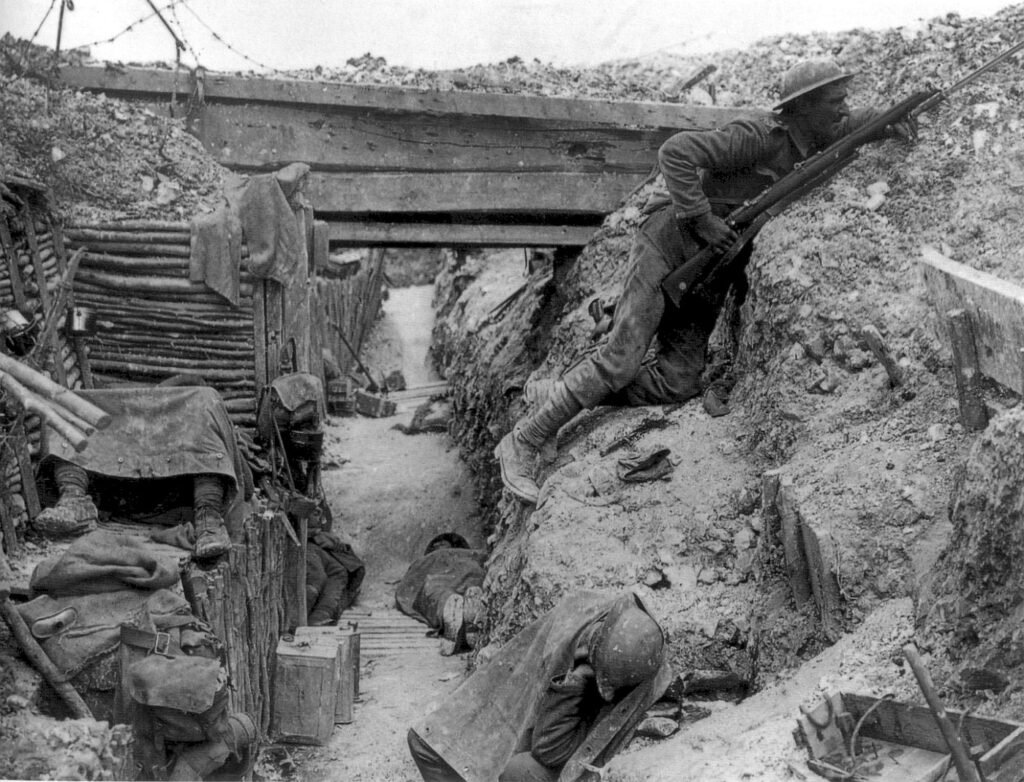
The war on the Western Front, stretching across Belgium and northeastern France, became infamous for trench warfare, a grinding, largely static form of combat in which opposing armies dug extensive networks of trenches separated by a heavily fortified no man’s land. New industrial weapons, including machine guns, barbed wire, heavy artillery, and poison gas, gave defenders overwhelming advantages over attacking infantry, producing enormous casualties for minimal territorial gain in major battles such as the Somme and Verdun. Military leaders on both sides struggled for years to develop tactics capable of breaking this deadlock, and the eventual introduction of tanks and more sophisticated combined-arms tactics only gradually shifted the balance toward the war’s end.
A Truly Global and Industrial War
Although centered in Europe, World War I was fought on multiple continents, with campaigns in the Middle East, Africa, and the Asia-Pacific region, and it drew heavily on the human and material resources of colonial empires. It was also the first major conflict to be shaped decisively by industrial-scale mobilization, as combatant nations redirected their economies toward total war production, and by new military technologies, including airplanes used for reconnaissance and combat, submarines, and chemical weapons, all of which previewed forms of warfare that would dominate later conflicts.
The United States, Russia, and the War’s End
Russia withdrew from the war in 1917 following the Russian Revolution, which removed one major front but also introduced a new source of ideological upheaval across Europe. The United States entered the war in 1917 on the Allied side, bringing substantial fresh troops and resources that helped tip the balance decisively against the Central Powers by 1918. Germany and its remaining allies agreed to an armistice in November 1918, ending the fighting, though the formal peace settlement came later with the Treaty of Versailles in 1919.
Casualties and Lasting Consequences
World War I resulted in roughly 9 to 11 million military deaths and significant civilian casualties, along with the collapse of several major empires, including the Austro-Hungarian, Ottoman, Russian, and German empires, and reshaping the political map of Europe and the Middle East for the remainder of the twentieth century. The war’s settlement, particularly the terms imposed on Germany, left lasting resentments that many historians consider a significant contributing factor to the rise of extremist political movements and the outbreak of World War II barely two decades later.
The Home Front and Total War
World War I reshaped civilian life as thoroughly as it reshaped the battlefield, since sustaining armies of a size never before mobilized required entire national economies to be reorganized around war production. Governments introduced rationing, conscription, and extensive propaganda campaigns to maintain public support for a conflict that dragged on far longer, and at far greater cost, than most leaders had anticipated in 1914. Women took on industrial and agricultural roles in unprecedented numbers as men left for military service, a shift that contributed to postwar movements for expanded political rights, including women’s suffrage, in several combatant nations.
Censorship and propaganda shaped how civilians understood the war, often presenting a far more optimistic picture of progress than conditions at the front actually supported. This gap between official messaging and the grim reality experienced by soldiers contributed to growing disillusionment in several countries as the war ground on, feeding into postwar literary and artistic movements that portrayed the conflict’s human cost in starkly different terms than wartime propaganda had allowed.
FAQs
What event triggered the start of World War I?
The assassination of Archduke Franz Ferdinand of Austria-Hungary in Sarajevo in June 1914, which set off a rapid chain of alliance-driven declarations of war.
Why did trench warfare on the Western Front become so deadly and static?
Machine guns, barbed wire, and heavy artillery gave defenders a major advantage over attacking infantry, producing enormous casualties for little territorial gain for years.
When and how did World War I end?
Germany and its remaining allies agreed to an armistice in November 1918, with the formal peace settlement following in the Treaty of Versailles in 1919.
What major empires collapsed as a result of World War I?
The Austro-Hungarian, Ottoman, Russian, and German empires all collapsed during or shortly after the war, reshaping the political map of Europe and the Middle East.
Key facts
- Triggered by the 1914 assassination of Archduke Franz Ferdinand in Sarajevo.
- Western Front trench warfare produced enormous casualties for minimal territorial gain.
- The United States entered in 1917; Russia withdrew the same year after its revolution.
- Ended with the November 1918 armistice and the 1919 Treaty of Versailles.
In the news
Quick checkWhat triggered World War I, and why did it escalate so quickly into a continental war?Show answer
The 1914 assassination of Archduke Franz Ferdinand triggered the war, which escalated rapidly because a rigid system of competing alliances turned a regional crisis into a continent-wide conflict within weeks.
Sources
- Encyclopaedia Britannica, 'World War I'
- Imperial War Museums, World War I collections and history
- National WWI Museum and Memorial
Editorially reviewed by Specialty Digest Editorial TeamLast reviewed November 2, 2026Researched and drafted with AI assistanceReport an issue