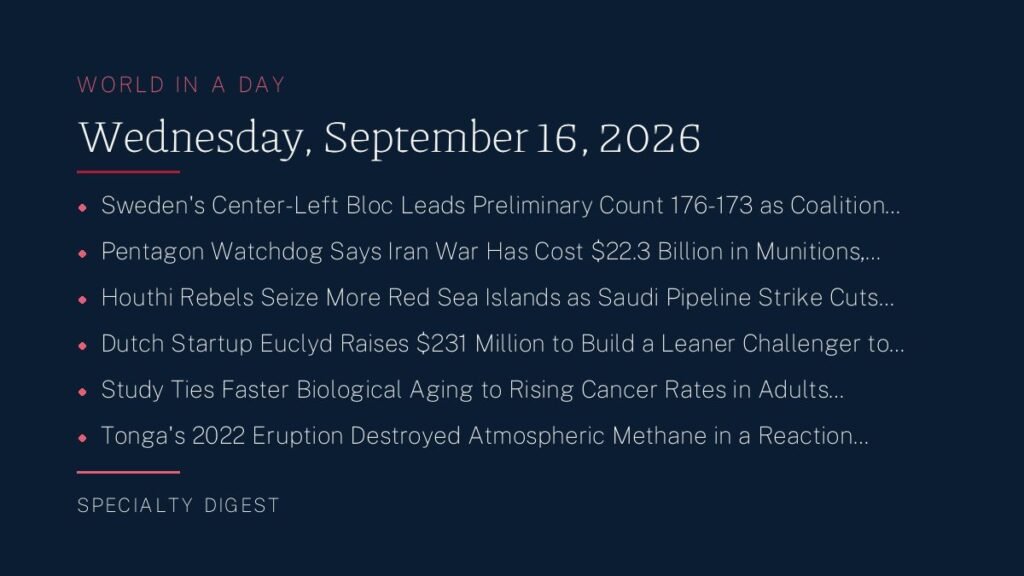
WORLD IN A DAY · WEDNESDAY, SEPTEMBER 16, 2026
Six stories worth five minutes: Sweden’s knife-edge election leaves two blocs doing coalition math, a Pentagon audit puts a dollar figure on what the Iran war has cost America’s own arsenal, and Yemen’s Houthis add a second squeeze to an oil market already strained by that war.
Sweden’s Center-Left Bloc Leads Preliminary Count 176-173 as Coalition Talks Begin
Preliminary counts from Sweden’s September 13 election show Magdalena Andersson’s Social Democrat-led opposition bloc ahead of Prime Minister Ulf Kristersson’s coalition by 176 seats to 173 in the 349-seat Riksdag, a near-exact reversal of 2022. Some tallies put the margin at 175 to 174; Sweden’s election authority says the official count will not be finalized until this weekend. The Sweden Democrats lost about three percentage points, their first setback since entering parliament in 2010, while the Social Democrats posted one of their weakest results in over a century. Andersson has begun coalition talks with three ideologically disparate partners.
Why it matters A one-seat margin leaves the next government exposed on nearly every vote, and the four-party opposition bloc agrees on little beyond isolating the Sweden Democrats, so what looks like a win could produce Sweden’s least stable government in decades.
Source: Al Jazeera
Pentagon Watchdog Says Iran War Has Cost $22.3 Billion in Munitions, Straining U.S. Stockpiles
A Defense Department inspector general report sent to Congress found that Operation Epic Fury, the U.S. war with Iran now in its seventh month, cost $33.4 billion between February 28 and June 30, with $22.3 billion spent on expended munitions alone. The report said the pace “resulted in strategic inventory shortfalls and revealed industrial base bottlenecks for munitions resupply,” and documented the loss of four F-15s, one damaged F-35, seven damaged KC-135 tankers, and as many as 30 MQ-9 Reaper drones. President Trump dismissed the findings on Truth Social, and the Pentagon denied any shortage, though Defense Secretary Pete Hegseth has pushed manufacturers to increase weapons production.
Why it matters An official government audit, not a war critic, is now on record saying the pace of the war is outrunning America’s ability to restock its own arsenal, a gap one defense analyst said would leave the U.S. underprepared for a longer fight elsewhere.
Source: CBS News
Houthi Rebels Seize More Red Sea Islands as Saudi Pipeline Strike Cuts Oil Flow for Weeks
Yemen’s Houthi rebels captured the Greater and Lesser Hanish islands on September 14, extending a push that already took Mokha port and Mayun island in the Bab el-Mandeb Strait, tightening their grip on one of the world’s busiest shipping lanes. Days earlier, a drone strike Saudi Arabia blamed on Iran-backed militias hit the 1,200-kilometer East-West Pipeline, which carries up to 4 million barrels a day to the Red Sea port of Yanbu; officials say repairs could take three to five weeks. Brent crude rose more than 2% to $109 a barrel on the news.
Why it matters The double squeeze, on the shipping lane and on the pipeline built to bypass it, removes two of the few routes global oil relies on to avoid the Strait of Hormuz chokepoint the Iran war has already disrupted.
Source: AP via Click2Houston
Dutch Startup Euclyd Raises $231 Million to Build a Leaner Challenger to Nvidia’s AI Chips
Eindhoven-based Euclyd closed a Series A round of more than 200 million euros, $231 million, co-led by Samsung, the company said September 15, to develop AI inference chips designed to cut the electricity and memory bandwidth that running large models consumes. Former ASML chief executive Peter Wennink is joining as chairman. The round is among the largest Series A raises in European chip history and adds Euclyd to a wave of startups, including EU and Chinese ventures, racing to unseat Nvidia’s grip on AI hardware by competing on efficiency rather than raw compute.
Why it matters With Nvidia’s rivals and even some of its own customers warning that AI spending has outrun near-term returns, competing on efficiency rather than raw compute is emerging as the industry’s next battleground.
Source: NL Times
Study Ties Faster Biological Aging to Rising Cancer Rates in Adults Under 55
A study in Nature Medicine, led by researchers at Washington University School of Medicine, found that Americans born between 1990 and 1999 show 92% higher biological aging than those born between 1965 and 1969, using data from the UK Biobank and the NIH’s All of Us program. Each unit increase in that biological aging score raised the risk of a cancer diagnosis at 55 or younger by 8%, rising to 15% when comparing the most and least aged groups, with the strongest links found in lung, gastrointestinal, and uterine cancers. The study defines early-onset cancer as any diagnosis at age 55 or under.
Why it matters If biological rather than chronological age drives cancer risk, screening guidelines built around fixed birthdays may be catching early-onset cancers too late, and aging itself becomes a measurable, and possibly modifiable, target.
Source: Nature Medicine
Tonga’s 2022 Eruption Destroyed Atmospheric Methane in a Reaction Scientists Didn’t Expect
A study published in Nature Communications found that the January 2022 Hunga Tonga eruption triggered a chemical reaction that destroyed roughly 900 megagrams of methane a day, equivalent to the emissions of two million cows, for more than a week after the blast. Researchers led by Maarten van Herpen traced the effect to volcanic ash and sea salt releasing reactive chlorine atoms in sunlight, confirmed by unusually high formaldehyde levels in the plume. It is the first time this specific methane-destroying pathway has been documented from a real eruption rather than a lab model.
Why it matters A natural process that removes a potent greenhouse gas could help refine climate models, though researchers note the same chemistry is already being studied as a possible deliberate climate intervention, with its own risks.
Source: ScienceDaily
Sources
- Al Jazeera: Sweden election is too close to call as far right loses ground
- Swedish Election Authority: Election results 2026
- CBS News: Pentagon inspector general says $22.3B spent on Iran war munitions has caused shortfalls
- AP via Click2Houston: Houthi rebels seize more key islands in southern Red Sea
- NBC News: Saudi Arabia’s shutdown of key pipeline limits oil flow
- NL Times: Eindhoven AI chip-making company Euclyd raises 200 million euros
- Data Center Dynamics: Dutch AI chip startup Euclyd raises $231 million
- Nature Medicine: Biological aging and generational shifts in early-onset cancer risk
- WashU Medicine: Faster aging in younger generations linked to rise in early-onset cancer
- ScienceDaily: Scientists stunned as volcano cloud starts destroying methane
- Nature Communications: Satellite quantification of enhanced methane oxidation following the Hunga Tonga eruption