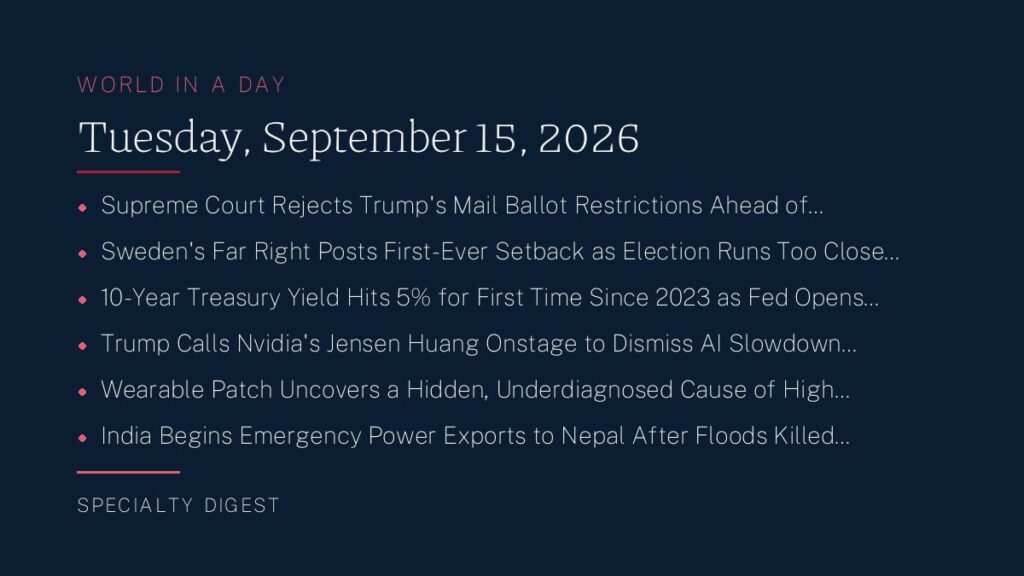
WORLD IN A DAY · TUESDAY, SEPTEMBER 15, 2026
Election rules were tested on two continents today, in a Supreme Court order protecting mail ballots and a Swedish vote too close to call, while a bond market milestone last sustained before the 2008 financial crisis reminded investors how much the ground has shifted.
Supreme Court Rejects Trump’s Mail Ballot Restrictions Ahead of Midterms
The Supreme Court on Monday rejected the Trump administration’s bid to enforce new mail ballot restrictions before the November midterms, ruling 7-2 in an unsigned order that officials were “unlikely to succeed on the merits.” Justices Samuel Alito and Clarence Thomas dissented; Trump appointee Brett Kavanaugh joined the majority while signaling he could back the policy later. Trump’s March executive order had required states to give the Postal Service full voter rolls and use pre-approved ballot envelopes, letting mail go undelivered if it didn’t match. Democrat-led states sued, and a federal judge had already found the rule unconstitutional and unworkable this close to an election.
Why it matters The ruling keeps mail voting rules unchanged in the states that rely on it most just eight weeks before Americans vote, and signals a conservative-majority Court isn’t yet willing to rewrite election procedure this close to a vote, though Kavanaugh’s separate signal keeps the door open past November.
Source: Al Jazeera
Sweden’s Far Right Posts First-Ever Setback as Election Runs Too Close to Call
Sweden’s Sweden Democrats lost ground in Sunday’s parliamentary election, the first drop in support for the far-right party since it entered parliament in 2010, falling to 17.5 percent of the vote from 20.5 percent in 2022. With 95 percent of districts counted, the center-left opposition, led by the Social Democrats at 28.1 percent, held a narrow 176 to 173 seat edge over the governing coalition. Full results, including early and overseas ballots, won’t be certified until Wednesday, and analysts say the four-party opposition bloc’s internal splits could make forming a government difficult even if the lead holds.
Why it matters A first-ever contraction for one of Europe’s most closely watched far-right parties would mark a genuine shift after a decade of gains, but a fractured opposition bloc could leave Sweden without a stable government heading into winter.
Source: Al Jazeera
10-Year Treasury Yield Hits 5% for First Time Since 2023 as Fed Opens Rate Meeting
The 10-year Treasury yield touched 5 percent on Monday for the first time since October 2023, a level economists call a threshold where markets risk broader trouble. The yield has climbed from 4.15 percent in January, pulled up by high energy prices, expectations that other central banks will raise rates, Iran-war-driven uncertainty, and investor unease over U.S. deficit spending. The 30-year fixed mortgage rate has followed it up, to 6.76 percent from 6.15 percent at the start of the year. The move comes days before the Federal Reserve’s rate decision, due Wednesday, September 16.
Why it matters Every extra fraction of a point on the world’s benchmark borrowing rate raises the cost of mortgages, corporate debt and the U.S. government’s own multi-trillion-dollar obligations, and a sustained break above 5 percent is the kind of move that has preceded serious market stress before.
Source: CNN Business
Trump Calls Nvidia’s Jensen Huang Onstage to Dismiss AI Slowdown Fears as a Hoax
President Trump phoned Nvidia CEO Jensen Huang live onstage at the All-In Summit in Los Angeles on Monday and put him on speakerphone in front of the audience, days after Anthropic CEO Dario Amodei called for the industry to slow the pace of AI capability gains, a position Elon Musk and Sam Altman had both echoed. “They’re just playing right in the hands of a lot of people that don’t want to see it happen,” Trump said. “That could be political people. It could also be China. And we’re not going to let that happen. It’s a hoax.” Huang replied, “You’re right. We’re not going to let that happen, sir.”
Why it matters The exchange puts the White House squarely against the industry’s own safety-slowdown camp just as public opposition to new AI data centers is rising, with 70 percent of Americans now telling pollsters they oppose one being built nearby.
Source: TechCrunch
Wearable Patch Uncovers a Hidden, Underdiagnosed Cause of High Blood Pressure
A proof-of-concept study found that primary aldosteronism, a hormone disorder that may cause up to one in five cases of high blood pressure, produces a distinctive hormone surge at night that standard daytime blood tests miss entirely. Researchers from the University of Bristol and University of Manchester, working with teams in Bergen, Stockholm and Athens, fitted 60 patients with a new wearable called U-RHYTHM that samples hormones through the skin every 20 minutes over a full 24-hour cycle, including sleep. The device picked up nighttime aldosterone spikes invisible to conventional testing, published Monday in Science Translational Medicine.
Why it matters Primary aldosteronism is treatable, sometimes with a single procedure, but it’s rarely tested for; a wearable that catches it without a hospital stay could get patients off blood pressure pills that were never treating the actual cause.
Source: ScienceDaily
India Begins Emergency Power Exports to Nepal After Floods Killed Over 1,400
India’s Ministry of Power approved emergency electricity exports of up to 654 megawatts a day, for 18 hours daily through December 31, to Nepal, where flash floods and landslides triggered by a glacial collapse on the China-Nepal border last month killed more than 1,400 people and left over 5,500 missing. The floods destroyed 12 hydropower projects in a country that normally meets nearly all its own electricity needs from hydropower alone, and had even exported surplus power to India before the disaster. Rebuilding the damaged plants and grid is expected to cost at least $5 billion.
Why it matters A country that was a net power exporter a month ago now depends on its neighbor to keep the lights on, a reversal that shows how one disaster can undo years of energy infrastructure and take years longer to rebuild.
Source: Al Jazeera
Sources
- Al Jazeera: US Supreme Court rejects Trump mail ballot restrictions ahead of midterms
- Al Jazeera: Sweden election is too close to call as far right loses ground
- CNN Business: 10-year Treasury yield hits 5%, critical threshold for US economy and markets
- TechCrunch: Nvidia CEO Jensen Huang tells Trump “we’re not going to let [an AI slowdown] happen”
- ScienceDaily: Scientists find a hidden cause of high blood pressure that routine tests can miss
- Al Jazeera: India to supply Nepal electricity after floods wrecked hydropower projects