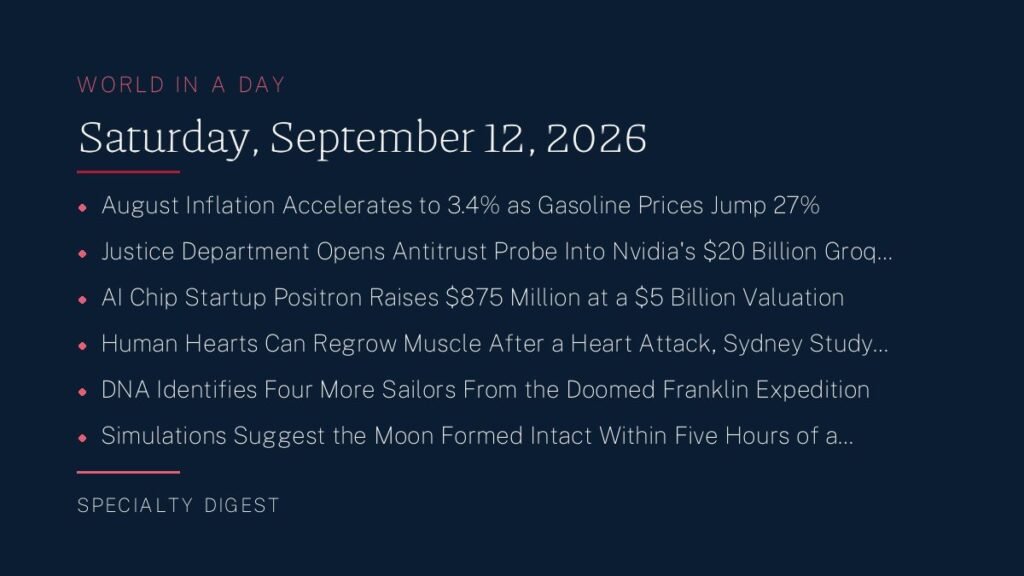
WORLD IN A DAY · SATURDAY, SEPTEMBER 12, 2026
An AI chip startup’s valuation jumped fivefold in six months, on the same day regulators opened a probe into whether a rival’s biggest deal was built to dodge them. Elsewhere, three research teams found nature keeps more of its own history recoverable than expected, in a heart, in an Arctic grave, and in the collision that made the Moon.
August Inflation Accelerates to 3.4% as Gasoline Prices Jump 27%
The Bureau of Labor Statistics reported Friday that consumer prices rose 0.4 percent in August, pushing annual inflation to 3.4 percent, unchanged from July. Core inflation, which excludes food and energy, climbed 0.3 percent for the month and 2.4 percent over the year, the slowest annual pace since March 2021. Gasoline prices jumped 3.9 percent in August after falling in July and are now up 27.4 percent from a year earlier, driven largely by supply disruptions from the seven-month US-Iran war; gasoline alone accounted for more than a third of the month’s overall price increase. Shelter costs rose 0.3 percent and food prices rose 0.1 percent.
Why it matters The report lands five days before the Federal Reserve’s September 16 meeting, and a gasoline-driven spike complicates Chair Kevin Warsh’s case for holding rates steady even as core inflation keeps cooling toward target.
Source: Bureau of Labor Statistics, Fox Business
Justice Department Opens Antitrust Probe Into Nvidia’s $20 Billion Groq Deal
The Justice Department has opened an investigation into whether Nvidia structured its licensing agreement with AI chip startup Groq to avoid antitrust review, the New York Times reported September 9. The non-exclusive deal, worth up to $20 billion and announced in December 2025, lets Nvidia license Groq’s inference technology without an outright acquisition, a structure that Axios noted at the time appeared designed to sidestep merger scrutiny. Investigators are examining whether the arrangement functions as a de facto acquisition that concentrates control over AI inference hardware, the fast-growing segment of chips that run trained models rather than build them. Neither company has commented publicly.
Why it matters A ruling against the deal’s structure would put every AI licensing agreement built to dodge merger review on notice, at a moment when a handful of chipmakers already dominate the industry’s infrastructure.
Source: Axios
AI Chip Startup Positron Raises $875 Million at a $5 Billion Valuation
Positron AI, which builds inference chips for large language models, raised $875 million in Series C funding on September 10, lifting its valuation to $5 billion from roughly $1 billion six months earlier. The round was led by NEA, Atreides Management, Valor Equity Partners and semiconductor analyst Dylan Patel’s SemiAnalysis Capital, with Silicon Graphics co-founder Jim Clark, the Qatar Investment Authority and Cisco Investments also participating. Positron builds memory-first systems using commodity LPDDR5X memory instead of scarce high-bandwidth memory chips, aiming to cut the cost of running AI models rather than training them. The funds will finance a new chip built on TSMC’s 3-nanometer process, due for production in late 2027.
Why it matters Investors are betting that running AI models profitably, not just building them, is the next scarce resource, and a fivefold valuation jump in six months shows how much capital is chasing an alternative to Nvidia’s dominant hardware.
Source: PR Newswire
Human Hearts Can Regrow Muscle After a Heart Attack, Sydney Study Finds
Researchers at the University of Sydney, the Baird Institute and Royal Prince Alfred Hospital found the first direct evidence that human heart muscle cells divide and multiply after a heart attack, in a study published in Circulation Research on September 10. Using living tissue collected from consenting patients during bypass surgery, the team led by Dr. Robert Hume and Professor Sean Lal compared damaged and healthy heart regions and found new muscle cell growth specifically in the injured areas. The regeneration was not enough to replace all the tissue destroyed during an attack, but the researchers identified several proteins already linked to heart regeneration in mice that could become drug targets.
Why it matters Cardiologists have long treated heart attack damage as permanent scarring; a confirmed, if limited, human repair mechanism gives drug developers an actual biological process to try to amplify instead of just working around dead tissue.
Source: ScienceDaily
DNA Identifies Four More Sailors From the Doomed Franklin Expedition
Anthropologists from the University of Waterloo and Lakehead University used DNA extracted from skeletal remains on King William Island to identify four more sailors from Sir John Franklin’s 1845 Arctic expedition, whose two ships and 129 men vanished searching for the Northwest Passage. The team, led by Douglas Stenton and Robert Park, matched mitochondrial and Y-chromosome DNA against living descendants with zero genetic distance, confirming Harry Peglar, captain of the foretop on HMS Terror, and three crew members from HMS Erebus. The findings were published September 9 and 10 in Polar Record and the Journal of Archaeological Science: Reports. One identified descendant, a BBC journalist, learned of the connection through the research.
Why it matters A mystery that outlasted the search parties, the salvage expeditions and 166 years of speculation is closing name by name, showing how modern genetic databases keep making nineteenth-century disasters solvable.
Source: ScienceDaily
Simulations Suggest the Moon Formed Intact Within Five Hours of a Giant Impact
Researchers at the Southwest Research Institute and the University of Arizona ran new simulations of the giant impact believed to have formed the Moon roughly 4.5 billion years ago and found that, under the right temperature and material conditions, an intact moon could have emerged within about five hours of the collision rather than slowly coalescing from a debris disk over years. The study, published September 10 in the Astrophysical Journal Letters, is the first to model the colliding bodies’ geologic strength instead of treating them as fluids, and found that hotter, mechanically weaker protoplanets produce different outcomes than cooler ones. The result links the Moon’s makeup to the thermal state of early Earth and the impactor known as Theia.
Why it matters Which formation path actually happened is still unsettled, but the modeling gives scientists a concrete variable, protoplanet temperature, that could finally explain why decades of Moon-formation theories keep contradicting each other.
Source: ScienceDaily
Sources
- Bureau of Labor Statistics, “Consumer Price Index Summary, August 2026”
- Fox Business, “August CPI inflation: Consumer price growth remained elevated”
- Axios, “DOJ investigates Nvidia’s deal with Groq”
- PR Newswire, “Positron AI Raises $875 Million at a $5 Billion Valuation”
- ScienceDaily, “Scientists discover the human heart can regrow muscle after a heart attack”
- ScienceDaily, “DNA solves the mystery of a body found in the Arctic in 1859”
- ScienceDaily, “The Moon may have formed intact just hours after a giant collision”