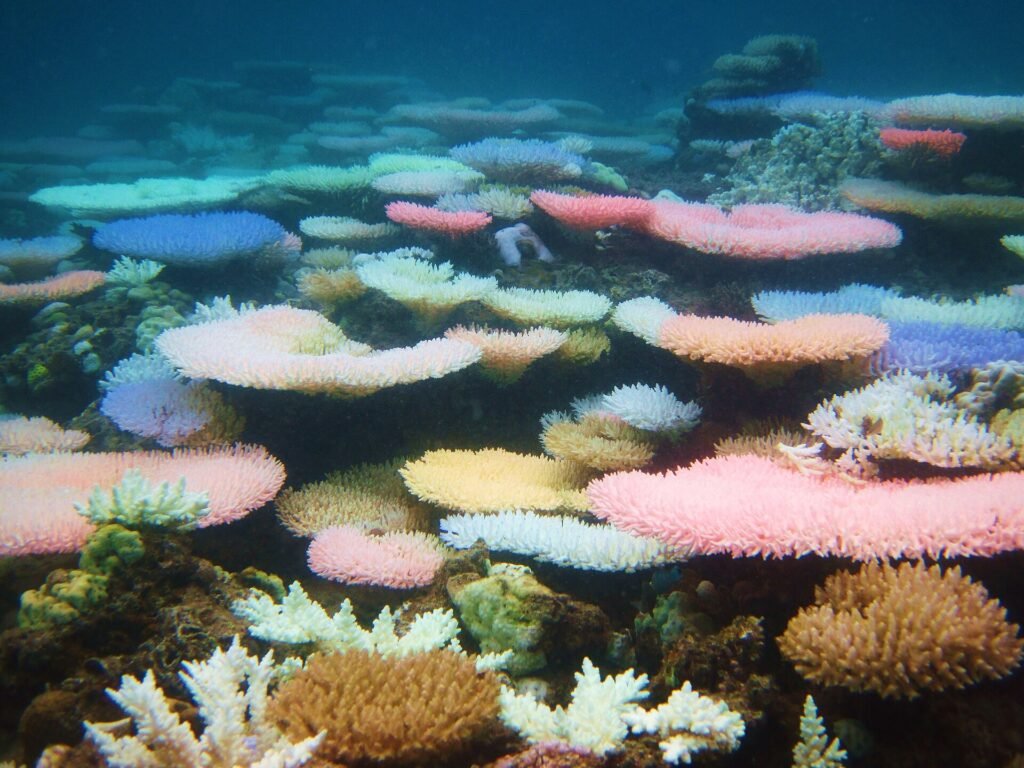
Coral reefs cover a tiny fraction of the seabed but support a huge range of marine life. Between 2023 and 2025, they went through the most widespread bleaching on record. In 2026 the U.S. National Oceanic and Atmospheric Administration (NOAA) said the world’s fourth global coral bleaching event likely ended in 2025, and it laid out what could come next.
What is coral bleaching?
Bleaching happens when corals under stress lose the colorful algae that live in their tissues, which turns them white and leaves them without much of their food supply. The usual cause is ocean heat. NOAA attributes this event to heat stress from elevated ocean temperatures, which it describes as unprecedented. A bleached coral is not necessarily dead, but it is weakened, and prolonged stress can kill it.
What is a global bleaching event?
A global event means bleaching occurs in all three ocean basins that contain coral reefs: the Pacific, Atlantic and Indian. NOAA confirmed the fourth such event on April 15, 2024. It tracked heat stress from early 2023 to mid-2025, and NOAA’s experts say the event likely concluded in mid-2025.
How big was the fourth event?
NOAA reports that bleaching-level heat stress affected 84 percent of the world’s coral reef area. Mass bleaching was documented in at least 83 countries and territories. Those two numbers show how widespread the event was, although the agency’s article does not state a peak date or peak extent. The scale is one reason the coral reef ecosystem draws so much scientific attention.
How should the 84 percent be read?
The figure describes the share of the world’s coral reef area that experienced bleaching-level heat stress. It is a measure of heat exposure, not a count of dead coral. Reefs that were exposed may have bleached lightly, severely or not at all, and some recover. Separately, the 83 countries and territories figure counts places where mass bleaching was documented, which is based on observation instead of the satellite heat-stress map.
What was the timeline?
- Early 2023: NOAA’s tracking of heat stress for the event begins
- April 15, 2024: NOAA confirms the fourth global bleaching event
- Early 2025: severe bleaching in Western Australia, which NOAA says likely bookended the event
- Mid-2025: NOAA’s experts say the event likely concluded
- December 2025 to February 2026: no widespread bleaching reported, which allowed NOAA to confirm the end
How did NOAA decide when it started and ended?
The determination relied on satellite data and bleaching observations. NOAA’s forecasts use bleaching alert levels, expressed as probabilities. Going forward, NOAA plans to rely on field bleaching observations to decide when global events start and end, a change from relying mainly on forecasts. Global heat stress declined after severe bleaching in Western Australia in early 2025, which NOAA says likely bookended the event. The agency then waited to confirm the end until no widespread bleaching was reported during the December 2025 to February 2026 austral summer.
Why did it happen?
Heat. NOAA notes that sea surface temperatures remain higher than they were 25 to 30 years ago. Warming oceans are tied to rising climate change and to the carbon dioxide trends covered in our article on CO2 emissions. The 2023 to 2025 period also overlapped with a strong El Nino, which is a natural pattern that can add to ocean heat, but NOAA’s article ties the bleaching to the elevated temperatures as a whole.
What does NOAA expect next?
NOAA warned that an expected El Nino could raise ocean temperatures and bring widespread bleaching back. Its four-month outlook at the time showed high risk across much of the north Pacific, including Hawai’i, and in Florida and the Caribbean later in the summer. Derek Manzello, coordinator of NOAA’s Coral Reef Watch, said reefs will increasingly bleach on a near-annual basis and that frequent monitoring is now more vital than ever.
Why do reefs matter?
Reefs shelter a wide range of marine species, which is why their health is often used as a signal for the wider ocean. A bleached reef that recovers still carries a cost, because stressed corals grow more slowly and are more vulnerable to other threats. Repeated bleaching in close succession gives less time to recover, which is the concern behind NOAA’s warning of near-annual bleaching.
Are any reefs resisting?
Yes, some. NOAA and partners are studying why certain reefs resisted bleaching despite high temperatures, with the aim of informing restoration. Finding the traits or conditions that protect these reefs is a stated priority for NOAA and its partners, because it could point to places where conservation has the best chance of working.
Bleaching vs. ocean acidification
Both threaten reefs, but they work differently. Bleaching is a heat response. Ocean acidification is a chemical change that makes it harder for corals to build skeletons, a topic we cover in our explainer on ocean acidification. Together they put pressure on biodiversity, since reefs shelter a wide range of species.
Frequently asked questions
How much of the world’s reef area was affected?
84 percent experienced bleaching-level heat stress, according to NOAA.
When did the fourth global bleaching event start and end?
NOAA confirmed it on April 15, 2024, tracked heat stress from early 2023, and says it likely concluded in mid-2025.
How many countries were affected?
Mass bleaching was documented in at least 83 countries and territories.
Will bleaching events become more common?
NOAA’s Derek Manzello says reefs will increasingly bleach on a near-annual basis, which is why NOAA is stressing frequent monitoring of reefs.
Is the 2023 to 2025 event over for good?
NOAA says it likely ended, but warned that a new El Nino could bring widespread bleaching back.
Is a bleached coral dead?
Not necessarily. It is stressed and weakened, and it can recover if conditions improve.