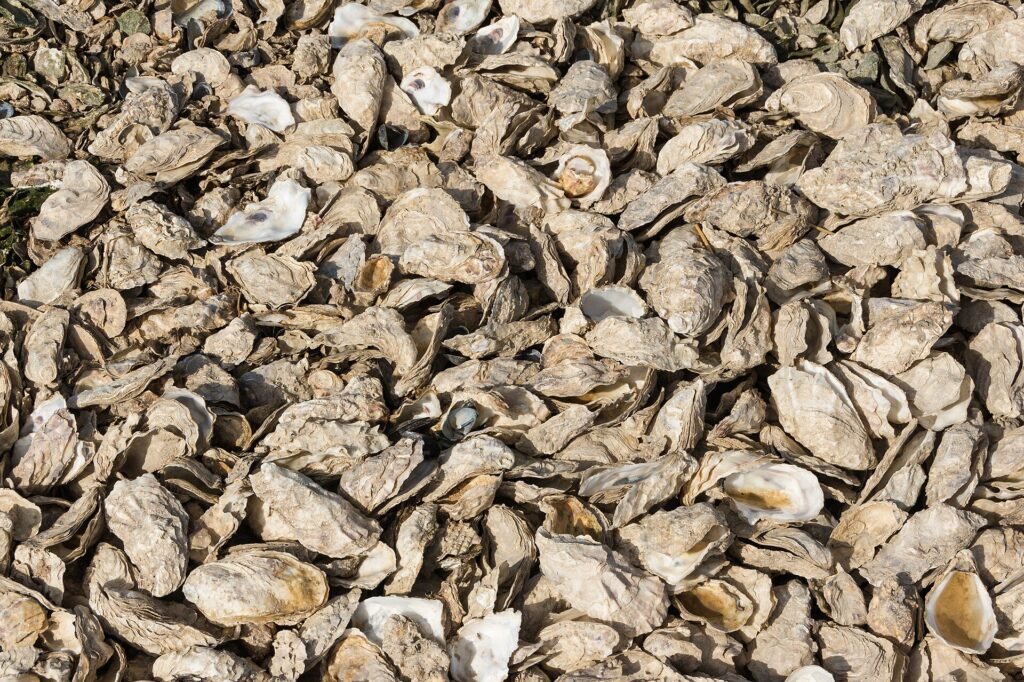
The ocean absorbs a large share of the carbon dioxide people release, and that service has a chemical cost. As seawater takes up the gas, it becomes slightly more acidic. The change sounds small on paper, but it matters for the animals that build their shells and skeletons from the ocean’s minerals.
What is ocean acidification?
Ocean acidification is a long-term decrease in the pH of seawater caused by the ocean absorbing carbon dioxide (CO2) from the atmosphere. The U.S. National Park Service (NPS) notes that the ocean naturally absorbs over a quarter of atmospheric CO2, and that atmospheric CO2 has risen sharply since the industrial revolution because of burning fossil fuels such as oil and coal. A UC Davis summary puts the share of human-made CO2 absorbed by the oceans at roughly 30 percent. The two figures are consistent in scale and differ because they describe slightly different things.
How does CO2 change seawater?
When CO2 dissolves in seawater it forms carbonic acid, which splits into a hydrogen ion and a bicarbonate ion. More hydrogen ions mean greater acidity, and the pH of the ocean is decreasing, so it is becoming more acidic. This is one reason the ocean works as a carbon sink and also why that sink affects marine life.
How much has ocean pH changed?
The NPS states that over the last 200 years the pH of the ocean has dropped from 8.2 to 8.1, which it says means the ocean has become 30 percent more acidic. UC Davis, citing NOAA, gives the same size of change: a drop of 0.1 pH units since the start of the Industrial Revolution, equal to about a 30 percent rise in acidity. A drop of 0.1 sounds tiny because the pH scale is logarithmic. Each whole pH value below 7 is ten times more acidic than the value above it, so small shifts in the number represent large shifts in chemistry. A change of 0.1 units is therefore not a rounding error, even though it looks like one on a scale that runs from 0 to 14.
Which animals are affected?
Oysters, mussels, crabs and corals need calcium carbonate to build their shells and skeletons. The NPS explains that as the ocean becomes more acidic, there are fewer carbonate ions available for these organisms. With less to work with, they grow more slowly, build weaker shells and are more vulnerable to threats and predators. UC Davis adds that shellfish find it harder to build shells and reproduce, and that acidification can disrupt the predator-prey response of some animals, such as sea snails.
- Shellfish: mussels, oysters and abalone struggle to build shells
- Corals: need calcium carbonate for their skeletons, a topic tied to the health of any coral reef
- Small shelled organisms: affected at the base of the food chain
How is it being monitored?
Monitoring is still being set up in many places. Dry Tortugas and Biscayne National Parks work with the U.S. Geological Survey to monitor coral reef growth rates and how reefs respond to changing ocean conditions. The NPS also reports that effects vary by park, which is why local data matter alongside global averages.
Why does it matter for ecosystems?
Many of the affected organisms form the base of the food chain. The NPS describes a possible domino-like effect on species that rely on them for food, and calls ocean acidification a clear and present threat to marine resources in ocean and coastal parks, though effects vary by park. The agency says nine national parks, monuments and historical sites have started research and monitoring programs. For biodiversity, the concern is that losses at the base could ripple upward, a pattern described in our entry on biodiversity.
What is the projection for the future?
UC Davis, citing NOAA, says that if high emissions continue, acidification is projected to grow 144 percent by 2100. The same source notes that even if CO2 emissions were cut drastically and immediately, the effects of acidification and climate change would persist in the ocean for thousands of years. The latest emission numbers are covered in our article on CO2 emissions, and the wider warming picture appears under climate change.
Ocean acidification vs. ocean warming
The two are linked by the same cause, but they are different processes. Acidification is a chemical change caused by dissolved CO2. Warming is a physical change caused by trapped heat. Corals can be hit by both: acidification makes it harder to build skeletons, while heat stress causes bleaching. Studying them separately helps scientists work out which pressure is responsible for a given decline.
Is the ocean actually acidic?
No. A pH of 8.1 is still above 7, so seawater remains alkaline. The word acidification describes the direction of change, a move toward lower pH, and not a switch to acid. This is a common point of confusion, and it does not make the shift less serious for organisms adapted to a narrow range.
Frequently asked questions
How much has ocean pH dropped?
From 8.2 to 8.1 over about 200 years, which is roughly 30 percent more acidic, according to the NPS and UC Davis.
What causes ocean acidification?
The ocean absorbing carbon dioxide from the atmosphere.
Is the ocean now acidic?
No. At a pH of about 8.1 seawater is still alkaline, and acidification describes the direction of change.
Which animals are most affected?
Shell-building animals such as oysters, mussels, crabs and corals.
Can it be reversed quickly?
Not according to UC Davis: even after drastic cuts in emissions, the effects would persist for thousands of years.