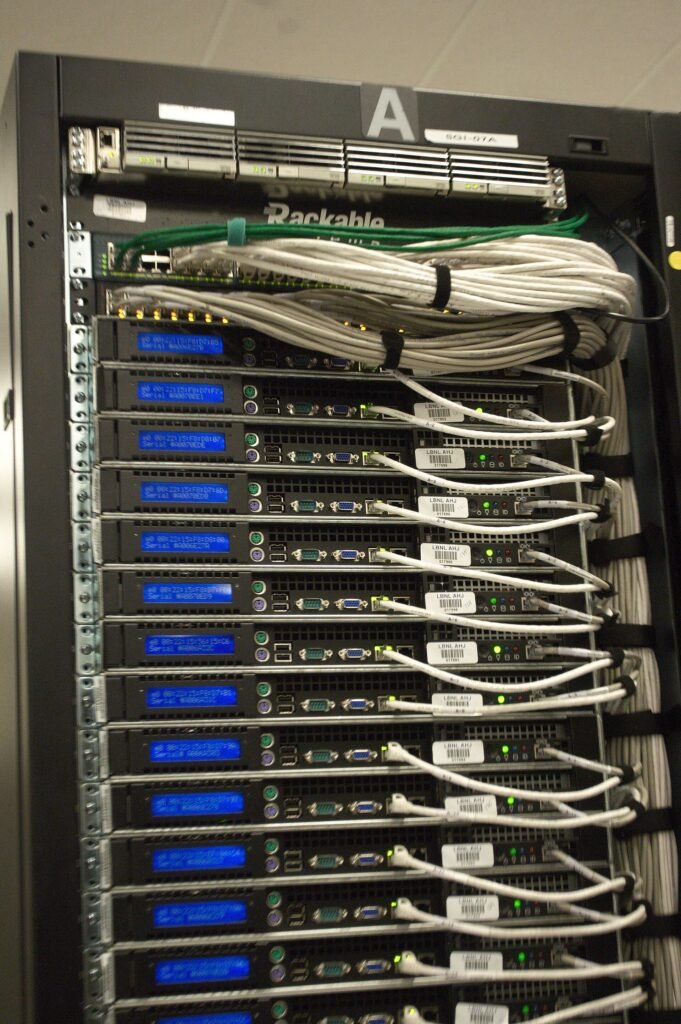
Every search, video and chatbot answer runs on a physical building full of servers, and those buildings use a lot of electricity. The International Energy Agency (IEA), an intergovernmental energy body, examined the question in its special report Energy and AI, released in 2025. Its central finding is that artificial intelligence is set to push data center electricity demand sharply higher by 2030.
What is a data center?
A data center is a facility that houses the computers, storage and networking equipment used to process and store information. The services behind cloud computing depend on them, and so does the training and operation of artificial intelligence and machine learning systems. The IEA uses the British spelling data centre, and this article uses the American spelling except when quoting the agency.
How much electricity will data centers use?
The IEA projects that data centre electricity demand will reach around 945 terawatt-hours (TWh) by 2030, which is more than double current levels. A terawatt-hour is a billion kilowatt-hours. For scale, the IEA says the 2030 total is slightly more than the entire electricity consumption of Japan today. The pages consulted here do not give a figure for current global data center consumption, so we do not repeat one.
What role does AI play?
AI is the most significant driver of the increase, according to the report. Demand from AI-optimized data centers is projected to more than quadruple by 2030. In other words, the growth comes mostly from the particular kind of computing needed to train and run AI models, and not from data centers as a whole growing at the same rate.
Which countries drive the growth?
The IEA singles out the United States and advanced economies in general:
- United States: data centers are on course to account for almost half of the growth in electricity demand through 2030
- United States, by 2030: the country is expected to use more electricity for data processing than for manufacturing all energy-intensive goods combined, including aluminum, steel, cement and chemicals
- Advanced economies: data centers are projected to drive more than 20 percent of electricity demand growth through 2030
The IEA adds that data centers help return power sectors in advanced economies to growth after years of flat or falling demand. The pages consulted here do not give figures for China or Europe.
Where will the electricity come from?
The report expects a mix of sources, with renewables and natural gas leading because of their cost-competitiveness and availability in key markets. Which mix a country chooses affects the emissions linked to data centers, and our explainer on renewable energy describes the main options. The IEA also says that improving the efficiency and flexibility of data centers would help.
How certain are these projections?
Not very, and the IEA says so. It lists several uncertainties:
- The macroeconomic outlook
- How quickly AI is adopted
- How capable and productive AI becomes
- How fast efficiency improves
- Whether energy-sector bottlenecks can be resolved
Because the speed of efficiency gains is itself uncertain, the 945 TWh number is best read as a central projection and not a forecast of a fixed outcome.
What does the IEA recommend?
The agency recommends quickly accelerating investment in electricity generation and grids, and strengthening dialogue between policymakers, the technology sector and the energy industry. The reasoning is practical: new generation and grid connections take time to plan and build, so the electricity side and the technology side need to coordinate early.
Why does growth in demand matter for grids?
Electricity systems in many advanced economies have had flat or falling demand for years. The IEA says data centers are projected to drive more than 20 percent of demand growth through 2030, which is enough to change that pattern. Utilities and regulators must decide how much new supply and network capacity to build, and they must do so while the size of future AI demand is still uncertain. Building too little risks bottlenecks, which the IEA lists among its uncertainties, and building too much risks idle assets.
What should readers ask about data center headlines?
- Which year? Projections for 2030 are not measurements of today
- Which scope? Data center electricity, all AI use and total electricity demand are different quantities
- Which region? Figures for the United States or advanced economies do not describe the whole world
- What is the source? The IEA is an intergovernmental agency, and its report states its own uncertainties
How to read the numbers
Three cautions help. First, a rising total does not mean each AI query costs more energy, since efficiency can improve while total use climbs. Second, data centers are one part of a bigger demand picture, though the IEA expects them to be a notable part of growth in advanced economies. Third, the report is a projection made in 2025, and later data may revise it. Readers who want current numbers should check the IEA directly.
Frequently asked questions
How much electricity will data centers use in 2030?
Around 945 TWh, more than double current levels, according to the IEA.
What is driving the increase?
AI, which the IEA calls the most significant driver. Demand from AI-optimized data centers is projected to more than quadruple.
Which country will see the biggest effect?
The IEA says the United States is on course for almost half of its electricity demand growth to come from data centers through 2030.
How big is 945 TWh?
Slightly more than the entire electricity consumption of Japan today, according to the IEA.
How sure is the IEA about these projections?
It names several uncertainties, including how fast AI is adopted, how capable it becomes and how quickly efficiency improves.
What will power them?
A mix of sources, led by renewables and natural gas, according to the report.