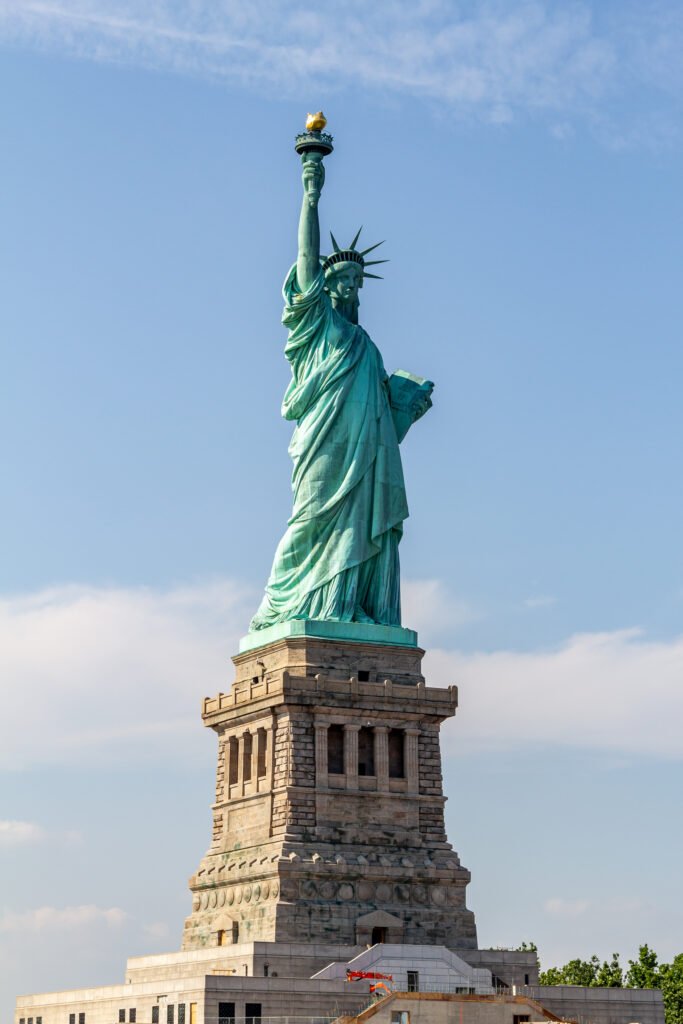
The United States of America is a federal republic of 50 states spanning most of North America’s mid latitudes, from the Atlantic to the Pacific, with the world’s largest economy and, through the Statue of Liberty in New York Harbor, one of the most recognized symbols of national identity anywhere in the world.
Where Is the United States Located?
The contiguous United States stretches across the middle of North America, bordered by Canada to the north and Mexico to the south, with coastlines on the Atlantic Ocean to the east and the Pacific Ocean to the west. The states of Alaska and Hawaii lie outside this contiguous block, with Alaska in the northwest of the continent and Hawaii in the central Pacific Ocean.
Geography of the United States
The country’s geography ranges from the Appalachian Mountains in the east, across the Great Plains, to the Rocky Mountains and the Sierra Nevada in the west, with major river systems including the Mississippi and Missouri draining much of the interior. Climate varies enormously by region, from humid subtropical conditions in the southeast to arid desert in the southwest and subarctic conditions in much of Alaska.
A Brief History of the United States
Thirteen British colonies along the Atlantic coast declared independence on July 4, 1776, and secured it following the Revolutionary War, formally recognized by Britain in 1783. The United States Constitution, ratified in 1788 and in effect since 1789, established a federal system of government with powers divided among executive, legislative, and judicial branches. The country expanded westward across the continent over the following century, a process that involved the displacement and, in many cases, forced removal of Native American nations from their lands.
Civil War to Superpower
The Civil War of 1861 to 1865, fought primarily over the expansion of slavery, ended with the abolition of slavery nationwide and preserved the union of states. Industrialization accelerated rapidly in the decades that followed, and the United States emerged from the Second World War in 1945 as one of the world’s two dominant superpowers, a position it continued to hold as the Soviet Union’s sole superpower rival after the Cold War ended in 1991.
Government and Economy
The United States is a federal republic with a presidential system, in which an elected president serves as head of state and head of government, Congress holds legislative power, and the federal judiciary, headed by the Supreme Court, interprets the Constitution. It has the world’s largest national economy by nominal gross domestic product, with major strengths in technology, finance, agriculture, energy, and advanced manufacturing, and the US dollar functions as the principal reserve currency used in global trade and finance.
Culture and People
The United States is one of the most ethnically and culturally diverse countries in the world, built substantially through successive waves of immigration from Europe, Latin America, Asia, and Africa, alongside its Indigenous peoples and the descendants of enslaved Africans brought to the country before 1865. English is the de facto national language, though the country has no official language at the federal level, and American popular culture, including its film, music, and technology industries, has had an outsized influence on global culture since the twentieth century.
What Is the United States Known For?
The United States is widely recognized abroad through the Statue of Liberty, a copper statue on Liberty Island in New York Harbor given to the United States by France and dedicated on October 28, 1886, to commemorate the two countries’ alliance during the American Revolution and the abolition of slavery. Designed by the sculptor Frederic Auguste Bartholdi, with an internal iron framework engineered by Gustave Eiffel, the statue became a symbol of welcome to immigrants arriving by sea and remains one of the most photographed monuments on Earth. It was designated a UNESCO World Heritage Site in 1984.[1] The country is also known more broadly for cities such as New York and Los Angeles, its national parks, and its global cultural exports in film, music, and technology.
Why the United States Matters
As the world’s largest economy, its leading military power, and a permanent member of the United Nations Security Council, the United States exerts substantial influence over global trade, finance, security arrangements, and technology standards. Its decisions on monetary policy, trade, and foreign affairs routinely have consequences that extend well beyond its own borders, making it a central reference point in nearly every major area of international affairs.
Key Takeaways
- The United States is a federal republic of 50 states that declared independence from Britain on July 4, 1776.
- Its Constitution, in effect since 1789, divides federal power among executive, legislative, and judicial branches.
- The United States has the world’s largest economy by nominal GDP and the US dollar is the world’s leading reserve currency.
- The Statue of Liberty, dedicated in 1886 as a gift from France, is a UNESCO World Heritage Site and one of the world’s most recognized monuments.[1]
- The country’s population and culture have been shaped substantially by successive waves of immigration alongside its Indigenous peoples.
Sources
- UNESCO World Heritage Centre, “Statue of Liberty” (accessed October 5, 2026)
- Encyclopaedia Britannica, “United States” (accessed October 5, 2026, used as a tertiary reference for uncontroversial chronology)
Key facts
- Capital: Washington, D.C.
- Declared independence from Britain on July 4, 1776; Constitution in effect since 1789
- World's largest economy by nominal GDP; the US dollar is the leading global reserve currency
- The Statue of Liberty, a gift from France dedicated in 1886, is a UNESCO World Heritage Site1
- A federal republic of 50 states with power divided among executive, legislative, and judicial branches
Quick checkWhen was the Statue of Liberty dedicated, and who gave it to the United States?Show answer
The Statue of Liberty was dedicated on October 28, 1886, as a gift from France to the United States.
Sources
- UNESCO World Heritage Centre. Statue of Liberty. Undated (accessed Accessed October 5, 2026)
- Encyclopaedia Britannica. United States. Undated (accessed Accessed October 5, 2026)
Editorially reviewed by Specialty Digest Editorial TeamLast reviewed October 5, 2026Researched and drafted with AI assistanceReport an issue