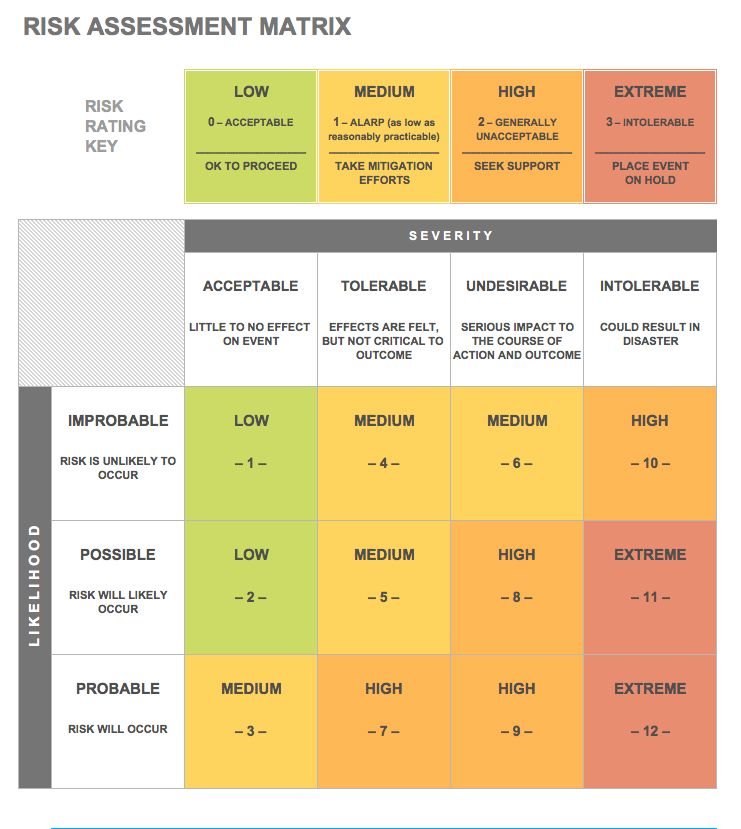
Risk scoring is a quantitative or semi-quantitative methodology that assigns numerical values to the likelihood and severity of identified hazards, enabling direct comparison and prioritization across a diverse range of risks using a single consistent scale. By converting inherently subjective judgments into numbers, risk scoring aims to reduce inconsistency between different assessors and make resulting priorities easier to communicate and justify to stakeholders.
n
Common Scoring Approaches
n
Many risk scoring systems use a simple multiplicative formula, assigning likelihood a numerical rating on a defined scale, assigning severity a similarly defined rating, and multiplying the two values to produce a composite risk score, with higher scores indicating greater overall risk warranting more urgent attention. Some more sophisticated systems incorporate additional factors beyond basic likelihood and severity, such as the number of people potentially affected or the frequency of exposure to a given hazard, producing a more nuanced score at the cost of additional complexity.
n
Calibration and Consistency Challenges
n
Despite its apparent numerical objectivity, risk scoring still depends on underlying human judgments about what rating a given likelihood or severity level deserves, meaning that without proper calibration, training, and clear rating definitions, different assessors can still arrive at substantially different scores for the same hazard. Organizations seeking consistent, reliable risk scoring typically invest in assessor training and periodic calibration exercises, recognizing that the numerical precision of a risk score can create a false impression of objectivity if the underlying judgments feeding into it remain inconsistent.
n
Weighted and Multi-Factor Scoring
n
Beyond simple likelihood-times-severity calculations, some risk scoring systems incorporate additional weighted factors, such as the number of workers exposed, the frequency of exposure, or the existence of partial controls already in place, producing a more nuanced score that better reflects the full complexity of real-world risk. While these more sophisticated approaches can improve accuracy, they also introduce additional complexity and require more extensive data collection, creating a practical tradeoff that organizations must weigh based on their specific needs and available resources.
n
Using Scores for Resource Allocation
n
Beyond simply ranking hazards, risk scores often directly inform resource allocation decisions, helping justify budget requests for control measures by clearly demonstrating the relative risk reduction expected from addressing higher-scored hazards first. This quantitative justification can be particularly valuable when safety professionals need to compete for limited organizational resources against other business priorities, since a clear numerical risk score often proves more persuasive to decision makers than a purely qualitative argument alone.
n
Avoiding False Precision
n
A recognized pitfall in risk scoring is mistaking numerical precision for genuine accuracy, since a calculated score of, for example, twelve out of twenty-five can create an impression of rigorous objectivity even when the underlying likelihood and severity ratings feeding into that calculation were themselves based on subjective judgment rather than hard data. Safety professionals experienced in risk scoring generally caution against over-interpreting small differences between scores, instead using scores primarily to establish broad priority tiers rather than treating every point difference as meaningfully distinct.
n
Communicating Scores to Decision Makers
n
Presenting risk scores alongside clear qualitative explanations of what drives each score helps decision makers understand not just the numerical ranking but the underlying reasoning, supporting more informed choices about which risks to address first and why, rather than treating the score as a black box output to be accepted without further scrutiny or question.
n
Summary of Protective Role
n
Risk scoring provides a practical bridge between purely qualitative hazard judgment and the kind of structured, comparable prioritization that organizations need to allocate safety resources effectively, provided the numerical outputs are always interpreted alongside the underlying reasoning rather than treated as objective facts beyond question.
n
Integrating with Other Risk Tools
n
Risk scoring often works alongside other risk management tools rather than standing alone, with scores frequently feeding directly into a risk register for ongoing tracking or informing which hazards receive priority attention during subsequent safety audits and inspections. This integration helps ensure that the effort invested in scoring translates into tangible downstream action rather than remaining an isolated analytical exercise disconnected from actual hazard control decisions.
n
Used with appropriate humility about its underlying assumptions, risk scoring remains one of the most practical tools available for bringing structure to otherwise difficult prioritization decisions.
n
Final Considerations
n
Few tools translate subjective hazard judgment into actionable priorities as efficiently, provided the organization remains honest about what the numbers can and cannot tell them.
n
That balanced perspective, numbers informed by judgment, is what makes risk scoring genuinely useful rather than merely a veneer of false certainty.
n
Closing Perspective
n
As organizations face a widening array of hazards requiring comparison and prioritization, the disciplined structure that risk scoring imposes on an otherwise unwieldy set of judgments continues to prove its practical worth across industries.
n
It remains a dependable bridge between messy real-world judgment and the structured decisions organizations ultimately need to make.
n
Few habits of mind serve safety professionals as consistently well across such varied hazard scenarios.
n
Organizations that apply it thoughtfully tend to make more defensible, better-justified safety investment decisions overall.
n
Risk scoring works best as a starting point for conversation rather than a final verdict. Teams that pair a numeric score with a brief written rationale tend to make better decisions than those that act on the number alone, since the discussion behind the score often surfaces context that the formula cannot capture.
n
This combination of structure and judgment tends to produce decisions that hold up well under later scrutiny.
n
A score without context can mislead; a score paired with reasoning tends to earn lasting trust across a team.
Key facts
- Array
Sources
- Array
Editorially reviewed by Specialty Digest Editorial TeamLast reviewed November 3, 2026Researched and drafted with AI assistanceReport an issue