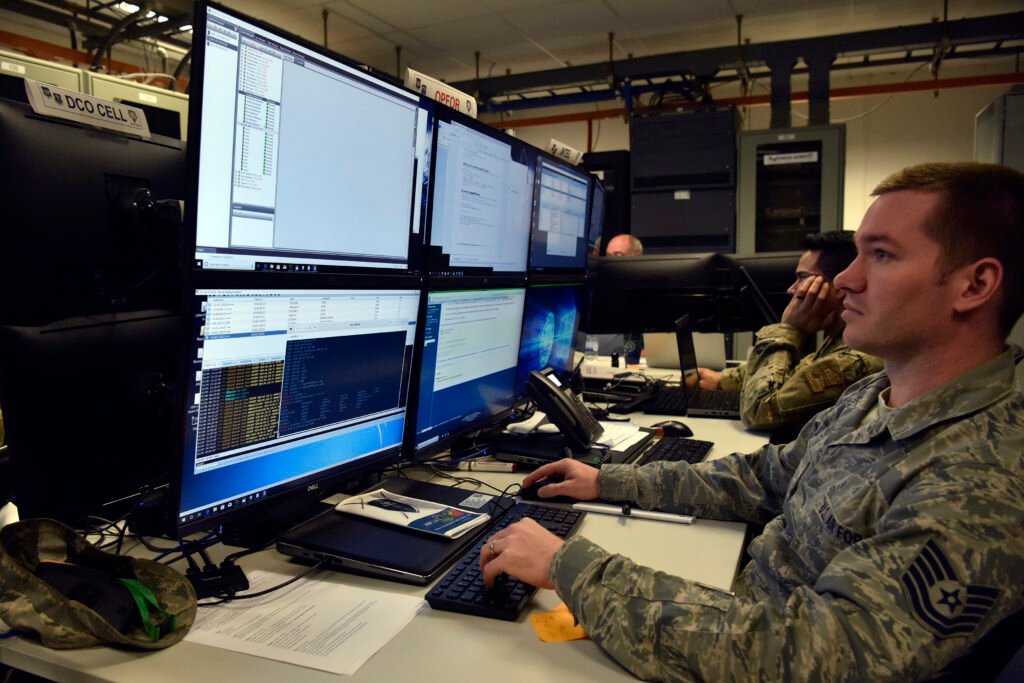
Overview
Cyber warfare describes digital attacks that a nation-state, or a group acting on its behalf, directs against the computer systems of another nation. Unlike ordinary cybercrime carried out for financial gain, cyber warfare pursues strategic or military goals, whether disrupting an enemys power grid, stealing defense secrets, or disabling command networks ahead of a wider conflict.
Methods and Targets
Attacks can range from quiet espionage, in which an intruder sits unnoticed inside a network collecting data, to destructive strikes that corrupt or disable industrial control systems. Military networks, financial systems, and critical infrastructure such as power and water utilities are common targets because disrupting them can impose real-world costs without a single soldier crossing a border. Attribution, tracing an attack back to its true sponsor, is often difficult, since attackers route traffic through compromised machines in other countries and can mimic the techniques of unrelated groups.
Notable Incidents
Several widely reported incidents have shaped public understanding of cyber warfare. Attacks attributed to state actors have disrupted power grids, damaged industrial equipment through malicious code, and compromised government networks to extract sensitive data over extended periods without detection. These episodes demonstrated that digital attacks could produce effects once associated only with physical sabotage, prompting militaries worldwide to treat cyberspace as a distinct operational domain alongside land, sea, air, and space.
Deterrence Challenges
Deterring cyber warfare is unusually difficult compared with deterring conventional military attack. Attribution delays mean a victim may not be able to respond quickly or confidently, and the line between espionage, sabotage, and an act of war remains contested in international law. Some states have responded by publicly naming attackers through indictments or sanctions, hoping that even imperfect attribution imposes reputational and diplomatic costs on the sponsoring government.
Defensive Measures
Nations have built dedicated military cyber commands tasked with defending critical networks and, where authorized, conducting offensive operations of their own. Critical infrastructure operators, including power utilities and financial institutions, are increasingly required to meet baseline cybersecurity standards and report intrusions, reflecting a recognition that a successful cyber attack on civilian infrastructure can carry consequences as serious as a conventional military strike.
The Role of Non-State Actors
While cyber warfare proper involves state sponsorship, the line can blur when governments tolerate, encourage, or loosely direct non-state hacking groups to conduct operations on their behalf, gaining some of the strategic benefit of state action while retaining additional deniability. This pattern has complicated international efforts to establish clear norms of acceptable behavior in cyberspace, since responsibility can be diffused across criminal groups, patriotic hackers, and formal military units operating with varying degrees of government direction.
International Norms
Efforts to establish international rules for cyber warfare remain underdeveloped compared with longstanding laws governing conventional conflict. Some governments and international bodies have proposed that existing laws of armed conflict should extend to cyberspace, treating a sufficiently damaging cyber attack as equivalent to a kinetic act of war, but consensus on specific thresholds and enforcement mechanisms has proven difficult to achieve among states with very different cyber capabilities and interests.
Cyber Warfare and Critical Infrastructure
Power grids, water treatment systems, and financial networks increasingly depend on interconnected industrial control systems that were often designed decades ago without modern cybersecurity in mind, creating a persistent vulnerability that state-sponsored attackers have sought to exploit. Defending this infrastructure requires close cooperation between government cyber agencies and the private companies that actually own and operate most critical systems, since government alone typically lacks direct access to secure privately held networks.
The Future of Cyber Conflict
As militaries integrate artificial intelligence, autonomous systems, and ever more networked equipment into their operations, the potential attack surface for cyber warfare continues to expand. Analysts increasingly expect cyber operations to accompany, rather than replace, conventional military action in future conflicts, disrupting communications and logistics in the opening phase of a crisis to gain advantage before any physical engagement begins.
Private Sector Role in Cyber Defense
Because so much of the technology underlying both offensive and defensive cyber capability originates in the private sector, governments increasingly rely on cooperation with technology companies to identify vulnerabilities, patch software, and share threat intelligence about emerging attack techniques, a partnership that raises its own questions about how much visibility private companies should have into classified government cyber operations.
Training and Workforce Development
Sustaining an effective cyber warfare capability requires a specialized workforce combining technical computing skills with military and intelligence tradecraft, prompting militaries to invest heavily in dedicated training pipelines and to compete directly with the private sector for the same scarce pool of advanced cybersecurity talent, a competition that shapes recruitment and retention policy within military cyber organizations.
Measuring Cyber Capability
Comparing the cyber warfare capabilities of different nations is notoriously difficult, since much of the relevant capability remains classified and even successful operations often go unacknowledged, leaving outside analysts to infer relative strength from disclosed incidents, budget figures, and the scale of publicly known cyber commands rather than from any complete, verifiable accounting.
As societies grow more dependent on interconnected digital systems, cyber warfare seems certain to remain a central feature of international competition, demanding sustained investment in both offensive capability and, just as importantly, the defensive resilience needed to withstand an attack that cannot always be prevented.
Insurance markets have also begun responding to the rise of cyber warfare, with specialized cyber risk policies and, increasingly, explicit war exclusions meant to clarify that a state-sponsored attack may fall outside ordinary commercial cyber insurance coverage, a distinction insurers and policyholders continue to dispute.
Key facts
- Array
Quick checkWhat distinguishes cyber warfare from ordinary cybercrime?Show answer
Cyber warfare is conducted by or for a nation-state to achieve strategic or military ends, not personal profit.
Sources
- Array
Editorially reviewed by Specialty Digest Editorial TeamLast reviewed November 4, 2026Researched and drafted with AI assistanceReport an issue