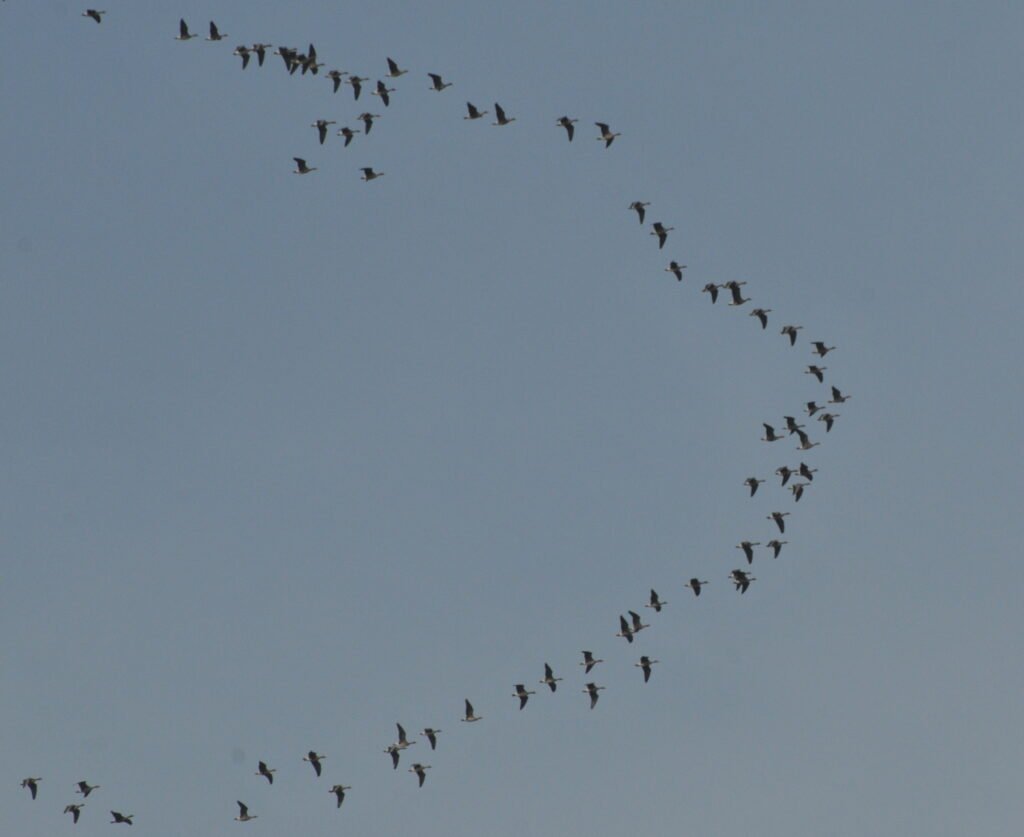
Birds migrate to follow food and daylight, not mainly to escape the cold — and they do it using a navigation system built into their own eyes that outperforms most human technology. On a good autumn night over the United States, an estimated one billion birds can be airborne at once, most traveling after dark when the air is calmer and predators are fewer.
Why birds actually migrate: it’s mostly about food, not the cold
According to the Cornell Lab of Ornithology’s All About Birds, many species that migrate north in spring aren’t simply escaping winter — plenty of birds can survive freezing temperatures as long as food is available. What they can’t survive is a lack of insects, seeds and budding plants. Northern Hemisphere birds fly north each spring to cash in on a short burst of abundant food and open nesting habitat in places like the Arctic tundra and boreal forest, which are far less crowded than the tropical regions where many of these species spend the winter. Longer days at those northern latitudes mean more daylight hours to hunt for food and feed hungry chicks, which is the real payoff that makes the trip worth the risk.
What actually triggers the journey
Cornell notes that changing day length itself is the biological cue, triggering a restless migratory drive in birds known as zugunruhe — a German term for the fidgety urge to travel that shows up even in birds kept in captivity as the seasons shift. In other words, the birds aren’t reacting to the weather that day; their bodies are responding to the calendar.
How far they actually travel
Some of the resulting journeys are almost hard to believe. Arctic terns and sooty shearwaters log more than 31,000 miles a year crisscrossing the globe. Bar-tailed godwits have been tracked flying nonstop from Alaska to New Zealand in about eight days, without landing once to rest, eat or drink. Even small songbirds and hummingbirds routinely cross 700 miles of open water over the Gulf of Mexico in a single overnight flight, according to All About Birds. Distances like these only make sense once you factor in what the birds are navigating with.
How they find their way without getting lost
Part of the answer is genuinely strange. Research described by National Geographic suggests migratory birds have specialized light-sensitive molecules in their eyes that let them essentially see Earth’s magnetic field, appearing as a subtle shading layered over their normal vision — evidence that’s still an active area of study rather than settled textbook fact. In one study, researcher Dominik Heyers and colleagues traced a direct neural pathway from these eye molecules to a brain region called Cluster N, which is highly active during nighttime migratory flight, suggesting the birds are genuinely processing magnetic information as they fly rather than simply reacting to it after the fact.
Why a compass alone isn’t enough
A magnetic compass only tells a bird which way is north; it doesn’t tell it where a specific wintering ground or home nesting site actually is. To close that gap, birds likely combine their magnetic sense with other cues, including magnetic particles believed to sit in the beak and the position of the stars, which some species appear to calibrate against as chicks, before they’ve ever made the trip themselves. As researchers have put it, an animal capable of migrating thousands of miles needs both a compass and a map — and birds appear to carry a working version of both, built entirely into their own bodies.
- Cornell Lab of Ornithology, All About Birds, “The Basics of Bird Migration: How, Why, When, and Where.” allaboutbirds.org.
- National Geographic, “Birds Can ‘See’ Earth’s Magnetic Field.” nationalgeographic.com.
- Photo: Julo, public domain, via Wikimedia Commons.